
US investment-grade companies are selling bonds at a record pace, with AI infrastructure spending helping drive the surge. That has not made AI data center debt cheaper for everyone.
Issuance was on track to reach $1.76 trillion once deals priced on October 26, according to data compiled by Bloomberg News. That would top the roughly $1.75 trillion borrowed in the 2020 pandemic boom.
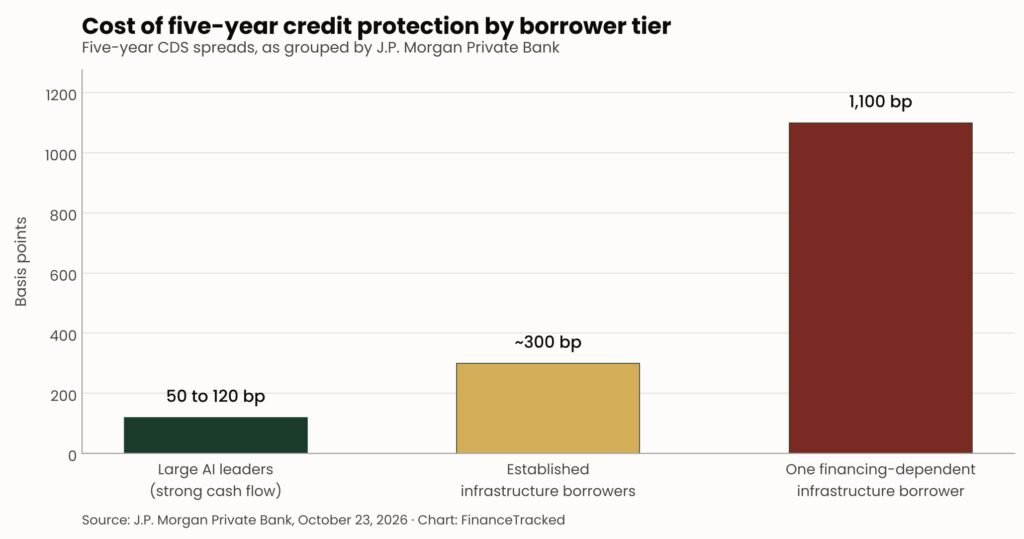
Over the same stretch, five-year CDS pricing has ranged from 50 to 120 basis points for strong AI leaders to 1,100 for one financing-dependent borrower.
The money has not left. It has turned selective.
Issuance is on track for a record $1.76 trillion
A week before the record came into view, issuers led by megacap tech had already sold about $1.7 trillion of investment-grade bonds.
Appetite may not hold.
“If investors are seeing their AI-linked bonds losing value, they will be less interested in buying new bonds.” — John Briggs, Head of US Rates Strategy, Natixis North America, via 24/7 Wall St
That tension runs through the AI data center debt market.
Nebius and CoreWeave sit at opposite ends
Nebius secured a $3.5 billion senior secured facility from Citi at Term SOFR plus 2.75 percentage points. CoreWeave’s longer-dated unsecured bonds trade at yields approaching 16%.
The instruments are not comparable. Tenor, collateral and the primary-versus-secondary gap explain part of the distance.
The rest is what credit markets make of the borrowers.
Nebius announced a $3.5 billion Citi facility on October 22
The facility sits at the cheap end of AI data center debt. Nebius entered the bridge facility agreement on October 17 and disclosed it five days later.
It is a senior secured term loan maturing October 16, 2027.
Pricing starts at Term SOFR plus 2.75 percentage points and rises to a maximum of 3.50. Citi acted as mandated lead arranger, agent and security agent.
Proceeds cover data center development, GPU purchases and general corporate purposes. The amount drawn was not disclosed.
CoreWeave bonds imply a far higher cost of capital
CoreWeave sits at the expensive end of AI data center debt. Its October 2031 notes, issued in April, carry a 9.75% coupon. At 08:38 ET on October 27, TradingView showed them yielding 15.98%, as they trade below par.
Three further issues yielded 15.67%, 15.47% and 15.10%. Those yields reflect what buyers demand, not what CoreWeave pays.
It carries roughly $50 billion of debt.
“The AI label alone is no longer enough to reassure lenders.” — Justin Biemann, Global Investment Strategist, J.P. Morgan Private Bank
Key numbers behind the AI data center debt split
- Nebius facility of $3.5 billion at Term SOFR plus 2.75 percentage points, 364-day maturity (Nebius, October 22, 2026)
- CoreWeave October 2031 notes yielding 15.98% against a 9.75% coupon (TradingView, October 27, 2026)
- CoreWeave full-year 2025 net loss of $1.17 billion (CoreWeave, fiscal 2025 results)
- IREN net loss of $702.6 million for the year to June 2026 (IREN, fiscal 2026 results)
- Weekly CDS trading across seven large AI-linked issuers above $9 billion in September (Morgan Stanley, via CoinDesk, October 27, 2026)
JPMorgan calls it a targeted reassessment of risk
Biemann’s October 23 report shows how markets price default risk across AI data center debt. These are the costs of buying protection, not the rates lenders charge borrowers.
Five-year CDS spreads for large, cash-generative AI leaders range from 50 to 120 basis points. Some established investment-grade infrastructure borrowers have climbed toward 300.
One financing-dependent AI infrastructure borrower reached 1,100 basis points, roughly $1.1 million a year to insure $10 million of debt.
Biemann says the move “reflects a targeted reassessment of repayment risk” rather than a blanket verdict on AI.
Implied default odds rose above 50%
That pricing “implies near or above a 50% probability of default over five years, up from below 30% a year ago,” Biemann writes.
He cautions that implied probabilities are not forecasts. His report heading captures it: “One trade, several credit stories.”
Equity markets have been slower than AI data center debt to separate the names.
More on the capex question:
What an AI slowdown does to $700 billion in AI capex
Share prices steadied while credit kept repricing
On October 26, Nebius closed down 3.45%, while IREN rose 2.11% and CoreWeave rose 1.76% after touching a 52-week low of $51.24. Kathleen Brooks, research director at XTB, calls CoreWeave “the AI trade’s canary in the coal mine.”
All three traded higher in pre-market dealing at 08:37 ET on October 27, with CoreWeave up 3.99%.
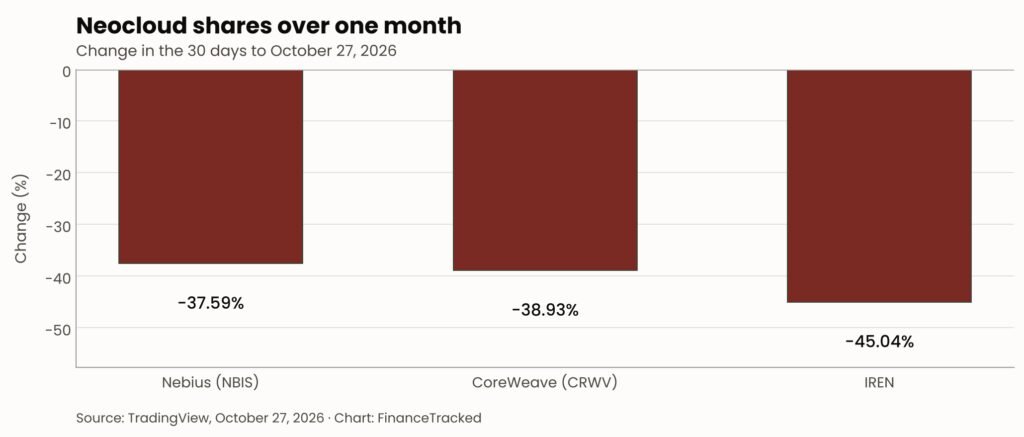
The month of AI data center debt repricing tells a harsher story. Nebius was down 37.59% over 30 days, CoreWeave 38.93% and IREN 45.04%.
Nebius leans on customer prepayments
Arkady Volozh, chief executive of Nebius Group, told an interviewer at NVIDIA’s GTC conference in Berlin that some capital sources had temporarily dried up, including asset-backed financing and debt markets.
“We have a pretty healthy balance sheet.” — Arkady Volozh, Chief Executive Officer, Nebius Group, in remarks reported by 24/7 Wall St
He said customer advances and other instruments would probably fund the company’s first gigawatt of capacity.
Prepayments cut the external capital Nebius needs
Nebius reports $40 billion of long-term customer contracts, including deals with Microsoft and Meta. Remaining performance obligations stood at $37.5 billion in the second quarter, against $8.04 billion of cash.
Chief financial officer Dado Alonso expects more than $9 billion of customer prepayments across 2026.
Prepayments cut the external capital needed. They do not remove AI data center debt from the plan.
More on the slowdown debate:
AI slowdown backed by four chiefs as China cries Cold War
Banks and Blackstone back $63 billion for Anthropic compute
Bank of America, Blackstone, Citi and Morgan Stanley announced a $63 billion AI compute financing structure on October 26 to fund Broadcom equipment leased to Anthropic.
The financing sits in a newly formed special purpose vehicle, which buys the equipment and leases it to Anthropic.
Bank of America, Citi and Morgan Stanley arrange the first lien. Blackstone provides the committed second lien, and Broadcom supplies residual value support.
The vehicle funds Broadcom XPU accelerators, with deliveries from 2027.
Musk and Tan describe different parts of the market
Elon Musk wrote on October 25 that debt markets had “almost entirely shut off access to money” for companies without substantial revenue independent of AI data centers.
He said SpaceX closed $40 billion of GPU debt as an investment-grade issuer, alongside SpaceX’s AI segment expansion. Reuters reported it was unclear what that meant.
Broadcom’s chief executive described a different segment the next day. Musk is describing borrower-level access, Tan how structured capital still moves when collateral and liens cut lender risk.
“This validates that there is capital available to finance such growth.” — Hock Tan, President and Chief Executive Officer, Broadcom
Structured financing fills the gap
The Anthropic IPO filing discloses up to $77 billion of financing capacity from its own suppliers, against $3.2 billion of bank revolver availability.
Customer advances at Nebius and supplier-linked structures at Anthropic address the same problem. Both widen the capital available beyond ordinary unsecured corporate borrowing.
Hedging against AI data center debt has surged alongside it. Weekly CDS trading on seven large AI-linked issuers averaged above $9 billion in September, against under $2 billion in July.
More on listed AI demand:
AI stocks rallied after the Fed’s first hike since 2023
The takeaway on AI data center debt
The sector-wide trade in AI data center debt is breaking down. Record issuance is arriving alongside unusually wide dispersion in AI credit.
Watch whether CoreWeave refinances below its traded yields, whether Nebius draws the Citi facility, and whether the 300 basis point tier widens toward the 1,100 outlier.
The money has not left the AI buildout. It has started asking who is borrowing it.
Biemann’s framing is the one to hold onto. Credit spreads are warning lights, not countdown clocks.