
AI stocks rose across the board on Thursday, a day after the Federal Reserve raised interest rates for the first time since July 2023.
Intel gained 8.79%, Advanced Micro Devices 5.91% and Micron 5.46% as of mid-afternoon London time. The Philadelphia Semiconductor Index rose 3.03% and Nvidia added 2.47%, per TradingView.
Treasury yields reversed lower the same day, after rising in the immediate aftermath of the decision.
The rebound followed a week in which the AI trade had pulled apart.
Every AI stock in the group rose
The gains across AI stocks were broad rather than concentrated.
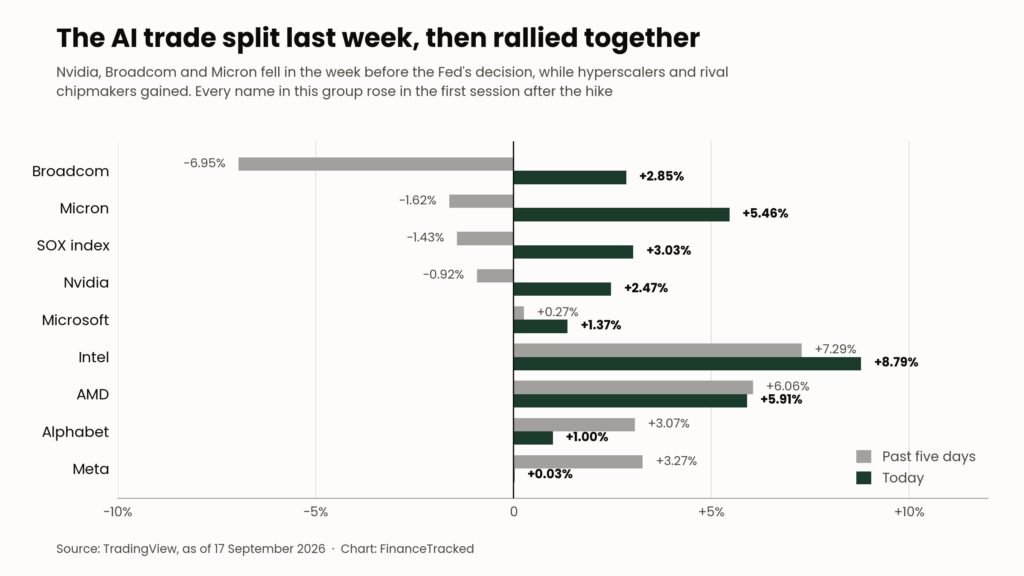
Thursday broadened the rebound rather than simply reversing it. Intel and AMD, which had already gained over the prior five sessions, led the move. Broadcom, Micron and Nvidia recovered from earlier losses.
Broadcom had fallen 6.95% over five days and rose 2.85%. Micron was down 1.62% over the week and gained 5.46%.
The hyperscalers moved least. Microsoft rose 1.37%, Alphabet 1.00% and Meta 0.03%, after all three had gained over the prior week.
The Fed hiked and yields swung both ways
The Federal Open Market Committee raised the target range for the federal funds rate by a quarter point to between 3.75% and 4.00% on a 12-0 vote, according to the Federal Reserve.
The statement ran to about 130 words. It said economic activity is expanding at a solid pace, that productivity growth is strong and capital investment is robust, and that inflation remains elevated.
The 10-year Treasury yield rose back to about 5.01% after Wednesday’s decision, after touching a 19-year high of 5.04% on Tuesday, then eased to about 4.95% on Thursday, according to BLS data. The 2-year fell to 4.69% and the 30-year to 5.31%.
Chair Kevin Warsh said he would be hard-pressed to describe broad financial conditions as restrictive before the decision.
“I would be hard-pressed to describe broad financial conditions as restrictive.” — Kevin Warsh, chair, Federal Reserve, in his press conference opening statement
That view was widely shared by the Committee, he said, and so it removed a dose of accommodation.
Trading Economics attributed Thursday’s decline in yields to Warsh reaffirming the Fed’s commitment to tackling inflation, which reassured investors on policy credibility.
Key numbers behind the rally
- Fed funds target raised to 3.75% to 4.00% on a 12-0 vote (Federal Reserve)
- Intel rose 8.79%, the largest single-day gain in the group (TradingView)
- Broadcom fell 6.95% over five days before gaining 2.85% (TradingView)
- The 10-year Treasury yield reached 5.01% on Wednesday before easing to about 4.95% (Bureau of Labor Statistics)
- Median participant projections put the fed funds rate at 4.1% at the end of 2026 and again at the end of 2027 (Federal Reserve)
- US CPI inflation ran at 3.40% in August with unemployment at 4.10% (Trading Economics, citing BLS data)
The split that preceded it
The week before the decision had split AI stocks between the buildout chain and the companies funding it.
That followed calls from four AI chiefs to slow frontier development, which hit the companies selling into the capital spending cycle hardest. Nvidia fell 3.4% and the Philadelphia Semiconductor Index dropped 5.9% on Monday.
Hyperscaler AI stocks went the other way. Meta rose 3.27% over five days and Alphabet 3.07%, as investors weighed which companies benefit if the AI capital spending cycle slows.
Not everyone reads the AI stocks rebound as relief
The Fed signaled at least one further increase this year. Its median participant projections put the rate at 4.1% at the end of 2026 and at the same level at the end of 2027, implying no net change between those two points.
Ed Yardeni cut his year-end S&P 500 target to 7,900 from 8,400, pointing to higher Treasury yields driven by rising energy prices.
“The risks of a downturn have increased over the next three to six months.” — Ed Yardeni, president, Yardeni Research, via Yardeni Research’s “Proceed With Caution”
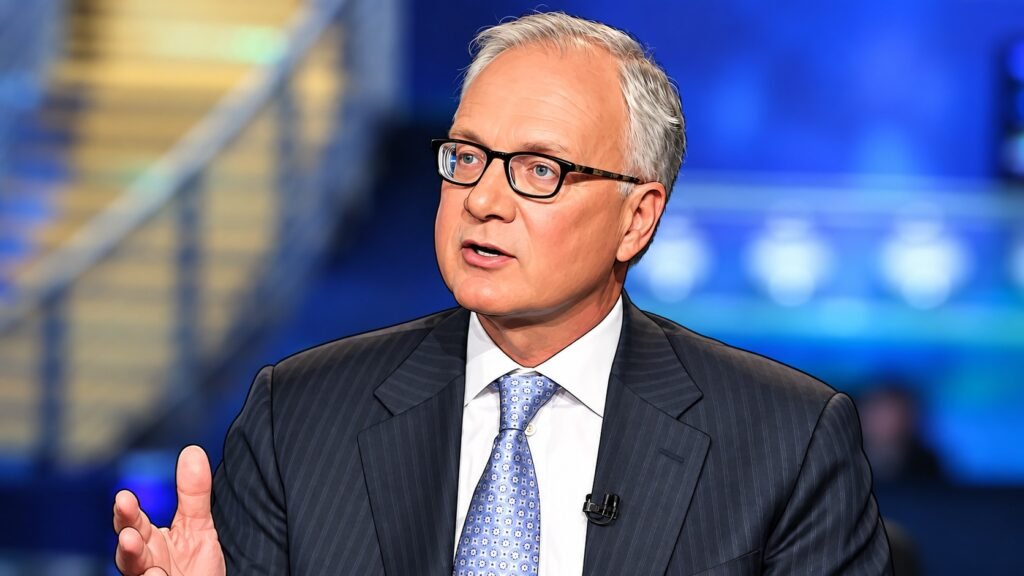
The Dow fell more than 600 points on Wednesday as Warsh spoke, AP News reported, before Thursday’s recovery.
Others see the repricing in AI stocks as largely complete.. Deutsche Bank’s Jim Reid said in a Deutsche Bank note cited by The Guardian that a moderation in the AI investment cycle seems unlikely for now, because it is difficult to imagine firms voluntarily stepping back while rivals push ahead.
What the rally means for AI investors
AI stocks rose across the board after the Fed lifted rates for the first time in more than three years, with Intel and AMD leading and the prior week’s decliners recovering. Yields spiked on the decision then eased, and AI stocks read that as uncertainty clearing rather than conditions tightening further.
That reading is fragile. The Fed has signaled at least one more increase this year, and its median projections show the rate no lower at the end of 2027 than at the end of 2026, so the discount rate applied to long-dated AI payback stays higher for longer. Two things to track: whether the Fed moves again in December, and whether hyperscalers change their capital spending guidance at the next earnings round.