
SpaceX AI revenue reached $7.56 billion in the third quarter, making Super Intelligence the company’s largest reporting segment for the first time. A year earlier, it was the smallest.
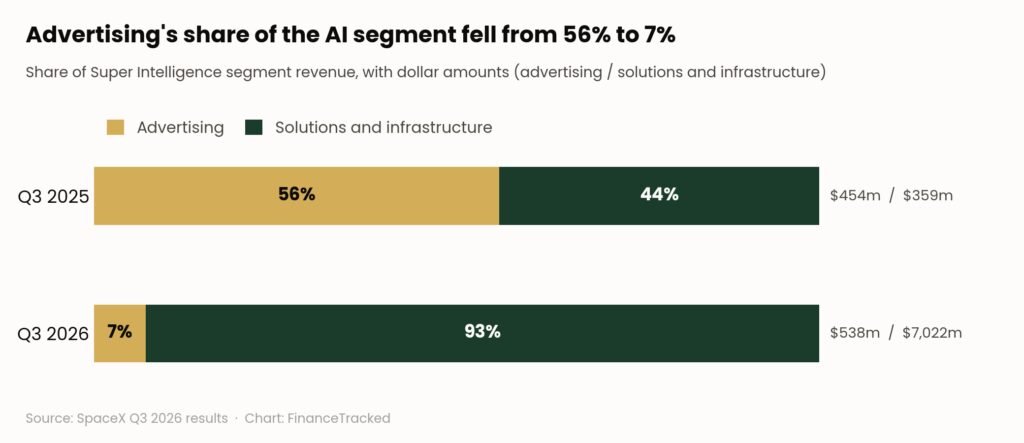
The segment table shows what changed. Solutions and infrastructure supplied 93% of SpaceX AI revenue, against 44% a year earlier.
The quarter also carried SpaceX’s first quarterly profit as a public company. It came with a capital program concentrated almost entirely behind SpaceX AI revenue, and a merger disclosure absent from the earnings filing.
Super Intelligence overtook both other segments in four quarters
Super Intelligence revenue rose to $7,560 million from $813 million, a gain of 830%, SpaceX reported.
Connectivity reached $5,248 million and Space $1,767 million. Total revenue was $14,575 million, up 161%, with net income of $4.4 billion against a $1.1 billion loss.
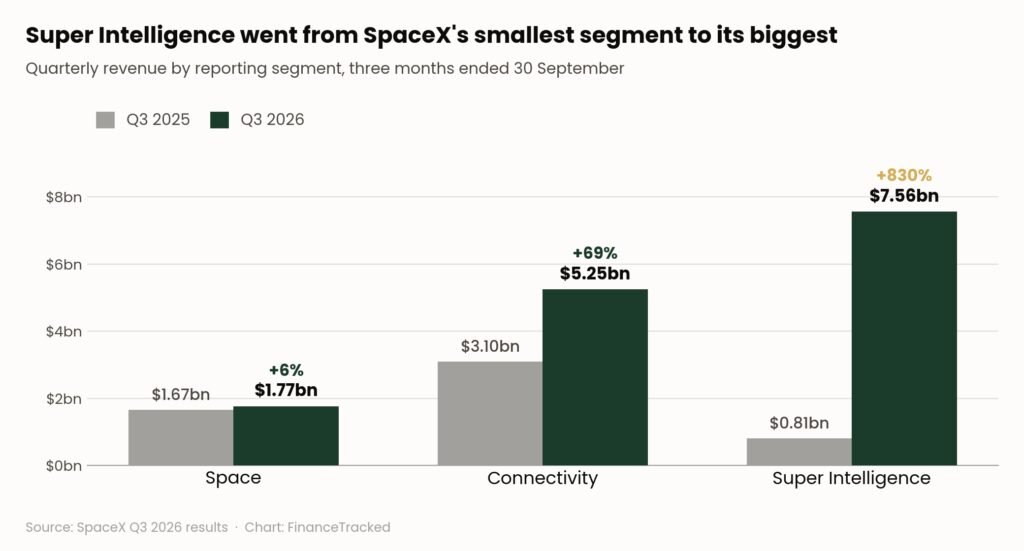
The ranking inverted. Super Intelligence held 14.6% of revenue a year ago and holds 51.9% of it as of September 30.
“We delivered another strong quarter in Q3. Revenue grew an impressive 161% year-over-year, fueled by continued momentum in Connectivity and a clear inflection in our Super Intelligence business.”
Bret Johnsen, chief financial officer at SpaceX, in the CFO commentary accompanying the results
SpaceX’s first quarterly profit as a public company
Income from operations was $2,791 million, against a $273 million loss a year earlier. Adjusted EBITDA reached $8.8 billion, up 306% from $2.2 billion.
Basic earnings were $0.37 a share and diluted earnings $0.35. The company closed the quarter with $51.3 billion of cash and $38.6 billion of marketable securities.
This is not the company’s first profit. SpaceX reported net income of $791 million for 2024, between losses of $4.6 billion in 2023 and $4.9 billion in 2025.
More on AI market reaction:
AI stocks rallied after the Fed’s first hike since 2023
The revenue mix flipped from advertising to infrastructure
Advertising produced $538 million, up 18.5% from $454 million. Its share of SpaceX AI revenue fell to 7.1% from 55.8%.
Solutions and infrastructure produced $7,022 million against $359 million, 19.6 times the year-earlier level. SpaceX attributes the gain to cloud services agreements, the Cursor acquisition and Grok adoption.
So the composition of SpaceX AI revenue changed, not only its size. A segment that was majority advertising in the prior-year quarter is overwhelmingly an infrastructure and software business.
Key numbers behind SpaceX AI revenue
- Super Intelligence revenue reached $7,560 million against $813 million a year earlier (SpaceX, October 20, 2026)
- Solutions and infrastructure supplied 93% of segment revenue, against 44% in the prior-year quarter (SpaceX, October 20, 2026)
- Super Intelligence capital spending was $16,444 million, or 84% of the company total (SpaceX, October 20, 2026)
- Nameplate compute reached 1.7 GW, against 0.6 GW a year earlier (SpaceX, October 20, 2026)
- Cursor contributed $608 million of revenue following its August 14 close (SpaceX, October 20, 2026)
SI capex was more than twice quarterly revenue
Super Intelligence capital expenditure was $16.4 billion in the quarter, against SpaceX AI revenue of $7.6 billion. That is 2.2 times revenue, and 84% of the company’s $19.6 billion total.
That gap is central to the AI capex debate, which turns on whether revenue and cash returns scale quickly enough to justify the infrastructure spending. The executives arguing for a slowdown have made the same point.
Across nine months, the pattern holds. Operating cash flow was $13.1 billion against $48.1 billion of capital expenditure.
External financing supported the compute buildout
SpaceX raised $85.7 billion net through its IPO and $51.8 billion in gross debt and other financing proceeds.
It repaid $39.8 billion of debt and financing obligations over the same period.
Starlink added 1.6 million subscribers as ARPU rose sequentially
Connectivity revenue was $5,248 million, up 69%, and segment income from operations rose 99% to $2.4 billion.
Starlink consumer subscribers reached 13.6 million, up 1.6 million from the June quarter and 6.4 million year over year.
Monthly ARPU rose 5% sequentially to $69. Against the year-earlier quarter it fell 17%, from $83.
The constellation covers 174 countries with 11,100 satellites in orbit, and Starlink is active on more than 3,800 aircraft.
SpaceX has agreed to acquire nationwide licenses covering up to 14 MHz of paired spectrum in the 800 MHz band, with closing expected in the first half of 2027.
Starship flew its first revenue-generating mission
Space revenue was $1,767 million, up 6% from a year earlier and 84% sequentially, making it the smallest of the three segments.
Starship Flight 14 delivered 26 Starlink V3 satellites, which SpaceX says carry roughly 10 times the downlink capacity added by a Falcon 9 Starlink launch.
Launch cadence slowed. SpaceX flew 35 launches in the quarter against 44 a year earlier, and 113 year to date against 128. It also announced Starbase, Louisiana, targeting a first launch in 2029.
SpaceX renamed AI after the White House switched to Super Intelligence
The label on SpaceX AI revenue changed during the year. Super Intelligence “refers to the operating and reportable segment previously reported as Artificial Intelligence (AI),” the release states.
That wording follows Executive Order 14434, signed September 29 and published October 2. It directs that the executive branch “shall use the terms ‘Super Intelligence’ and ‘SI’ in place of ‘Artificial Intelligence’ and ‘AI’.”
The order binds federal agencies, not companies. SpaceX was not required to rename anything.
Musk made the change voluntarily, days after the order
Elon Musk renamed the division days later, posting “No more AI. SI, it’s better,” as Fox Business reported. The reporting-segment label in the results follows that change.
More on AI policy:
US lawmakers push AI rules after extinction warnings
A merger disclosure absent from the earnings filing
Musk said on the earnings webcast that SpaceX and Tesla have formed special committees of independent directors to weigh a combination, and that he is recused as a conflicted party.
He described the process as an “odd kabuki dance,” according to TechCrunch, and said shareholder approval was “quite a high hurdle to achieve,” as Investing.com reported. No terms have been agreed.
None of it is in the results release or the Form 8-K, which reports Items 2.02 and 9.01 and mentions neither Tesla nor a committee.
What to watch on SpaceX AI revenue
The comparison is like-for-like. SpaceX treats the xAI transaction as a common control merger, so prior periods include the acquired businesses, which is why 2025 shows advertising revenue at all.
Watch whether the solutions and infrastructure line behind SpaceX AI revenue grows faster than the compute it requires.
SpaceX AI revenue tripled its share of the company in a year. Whether the buildout earns adequate returns depends on how quickly revenue scales against the installed compute base.
Watch also the compute buildout, since nameplate capacity reached 1.7 GW from 0.6 GW, and model pricing determines what that capacity returns.