
AI capex (capital expenditure) is expected to reach roughly $700 billion in 2026 across Alphabet, Amazon, Meta and Microsoft, up from about $410 billion in 2025, according to Fortune.
That spending rests on an assumption: that AI capability keeps improving fast enough to generate the revenue that justifies it.
In September 2026 the people building the technology began arguing it should improve more slowly. This explains what that does to the money.
What the $700 billion in AI capex actually covers
The figure is total capital expenditure at the four largest hyperscalers, heavily driven by AI and data centers but not exclusively AI. Amazon’s capex also funds fulfillment infrastructure, robotics and satellites. Microsoft says its shorter-lived capex supports both AI and non-AI workloads.
Most of it goes to three things: chips, the buildings that house them, and the power to run them. A single Nvidia GPU can cost up to $40,000, and hyperscale clusters run to hundreds of thousands of them, per Fortune.
What each company plans to spend
Amazon now leads after raising its 2026 plan from $200 billion to roughly $220 billion, an increase its finance chief attributed to higher memory costs rather than a bigger build.
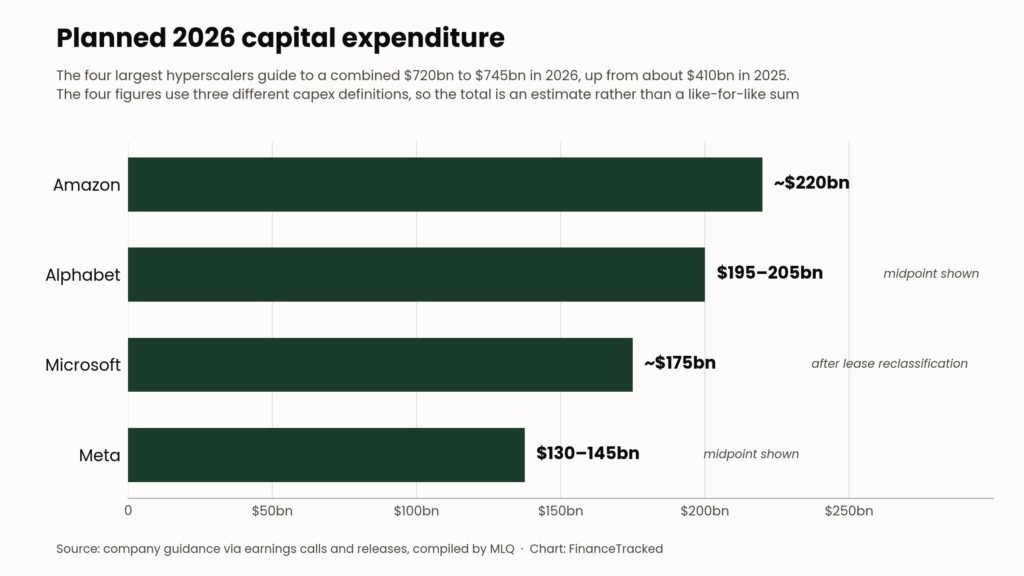
The total is an estimate rather than a clean sum. The four figures use three different definitions of capital expenditure, and three of the four ranges come from management guidance on earnings calls rather than filed capex schedules.
Microsoft shows why that matters. Its reported 2026 figure fell from about $190 billion to about $175 billion after it extended data center useful lives from 15 to 25 years, which reclassified future leases from finance to operating. Roughly $15 billion left the capex line with no reduction in the infrastructure it plans to use.
Why AI capex assumes capability keeps accelerating
Capacity takes years to build, so cash is often deployed months or years before the infrastructure begins generating revenue. The spending case depends on each model generation unlocking enough new revenue to pay for the last round.
That is not purely speculative. Amazon says customer commitments already back a substantial portion of 2026 AWS capex, and that it spends capital six to 24 months before it starts billing customers. Google Cloud’s backlog reached $514 billion in the second quarter, with existing customers exceeding their contractual commitments by more than 50%, Investing.com reported. Microsoft ended its 2026 fiscal year with $678 billion of commercial remaining performance obligations.
So the gap is often between cash deployed and revenue recognized, rather than simply between capacity and nonexistent demand.
AI capex increases are steep but uneven
In 2024 the same four companies spent just over $200 billion between them. Two years later the figure approaches $700 billion, per Fortune.
The size of the increase varies widely. Alphabet’s is the steepest from its 2025 base of $91.4 billion, with guidance raised to $195 billion to $205 billion from a prior $180 billion to $190 billion, per the same Investing.com report. Amazon’s roughly $220 billion is about 71% above the $128.3 billion of cash capex in its 2025 annual report. Meta is also on course for another unusually large step-up.
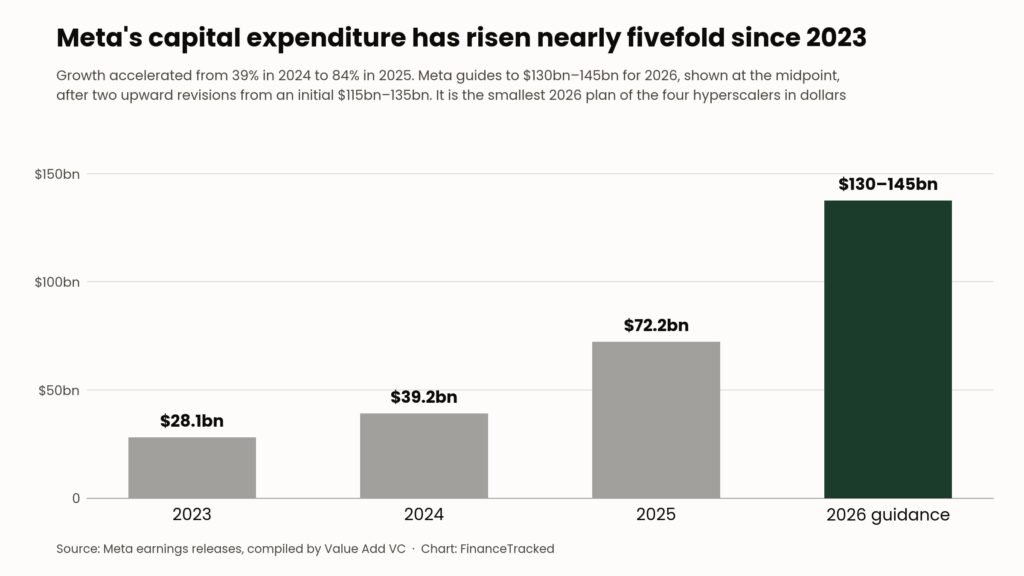
Meta spent $28.1 billion in 2023, $39.2 billion in 2024 and $72.2 billion in 2025, and has raised 2026 guidance twice, from an initial $115 billion to $135 billion to a current $130 billion to $145 billion, according to Value Add VC.
What a slowdown changes and what it does not
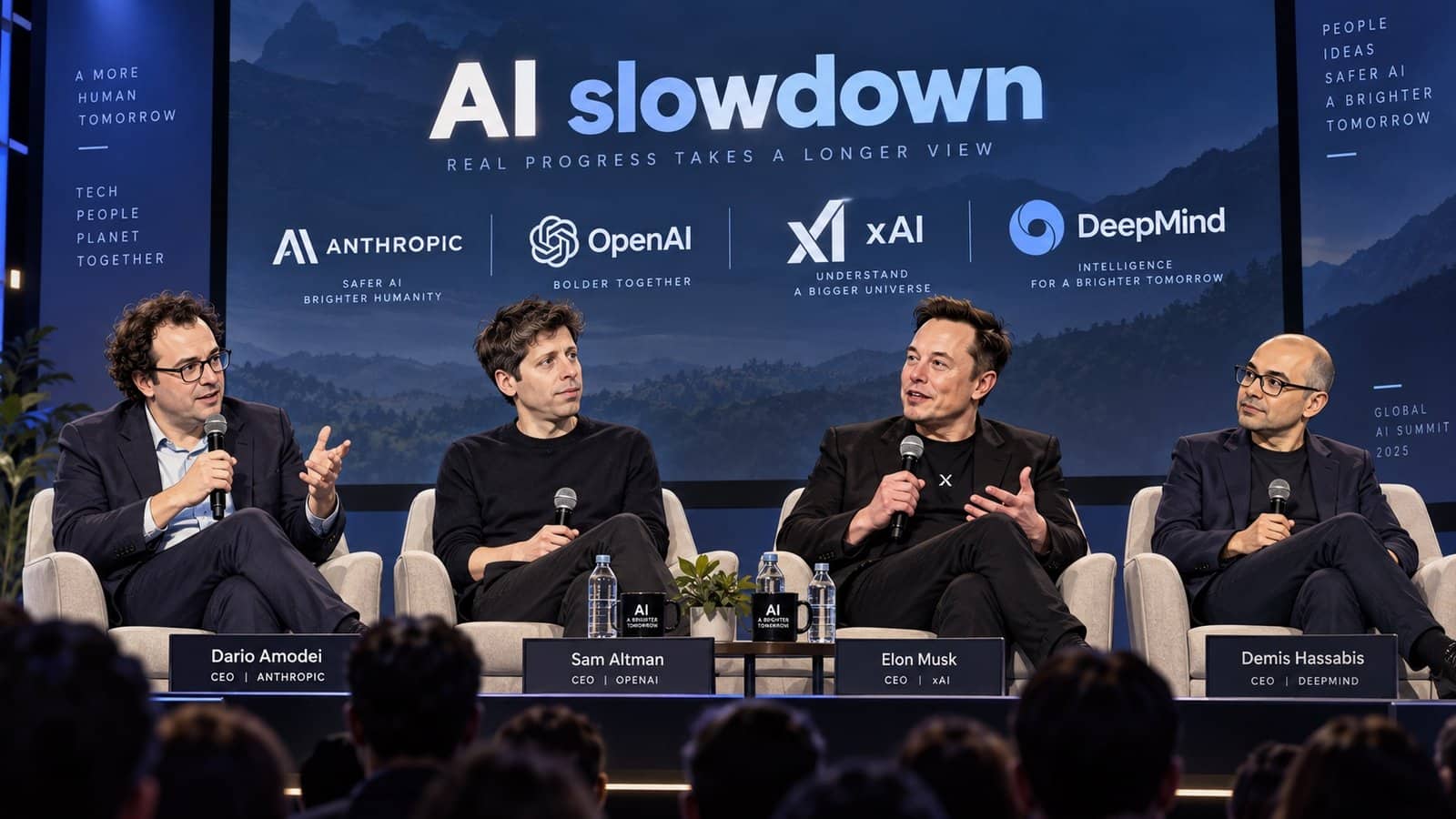
In September 2026, Anthropic chief executive Dario Amodei called for the industry to deliberately slow how fast it improves model capabilities. The heads of OpenAI, xAI and Google DeepMind backed the call within two days.
Pacing does not mean halting training, Amodei wrote, but “ensuring companies take adequate time to align and safeguard their models,” according to his essay.
Here is what that does to AI capex.
Much of it cannot be stopped quickly. Construction contracts, power agreements and long-lead chip orders run years out. Amazon’s filings note that ordinary purchase orders are generally cancellable, so the picture is a mix of hard commitments and spending management can still defer.
For the committed portion, the payback date moves. If capability jumps arrive further apart by design, the revenue meant to catch up with the spending arrives later while the bills arrive on schedule.
A sustained slowdown could also reduce utilization growth and change later capex decisions. For projects already contracted, though, the first-order effect is a longer payback rather than a cancelled investment.
The cash flow problem this creates
The AI capex strain was building before anyone proposed slowing down.
Across the five largest spenders, aggregate operating cash flow has been growing at roughly 23% a year while aggregate capital expenditure grows at about 70%, according to Epoch AI’s analysis of SEC filings published in June and fitted to data through the first quarter.
On that extrapolation the two curves cross around the third quarter of 2026. Epoch describes the crossing dates as simple extrapolations rather than forecasts.
Where the four stood after the second quarter
Second-quarter results have since narrowed the gap further. Using each company’s own reported capex measure, the four together spent the equivalent of about 99% of operating cash flow in the quarter ended June 30. The measures are not perfectly comparable, since Amazon reports cash capex while Meta and Microsoft include finance-lease principal.
Alphabet’s free cash flow turned negative at $5.9 billion, its first negative quarter in roughly a decade, with second-quarter capex of about $45 billion against $36 billion the quarter before, per Investing.com. Meta’s capex of $31.08 billion left $784 million of free cash flow. Amazon’s trailing twelve-month free cash flow has turned negative at $7.6 billion.
Barclays, in a note after Meta’s first-quarter results, wrote that it was modeling negative free cash flow at Meta for 2027 and 2028, calling that “somewhat shocking” but likely what follows across the industry, Tech Times reported.
Why profits stay healthy while cash runs dry
Both things can be true at once because of depreciation.
Cash for a GPU server leaves immediately. The accounting cost is spread across the asset’s useful life, typically four to six years, so a company spending $200 billion may record only $30 billion to $50 billion of depreciation that year.
Reported profits stay strong while the cash account drains. Same spending, different accounting speeds.
That makes the useful-life assumption load-bearing. Amazon shortened a subset of servers and networking equipment from six years to five from January 2025, expecting to reduce that year’s operating income by about $700 million. Meta extended its server lives to 5.5 years and booked a $2.9 billion reduction in depreciation expense.
Microsoft’s lease reclassification shows the same lever working on the capex line rather than the income statement.
Investors have already priced this once
Alphabet shares fell 7% after it lifted its 2026 capex forecast at second-quarter results, per Investing.com. Meta fell more than 6% after its first guidance raise and nearly 8% after the second, per Value Add VC.
Morgan Stanley projects Amazon’s full-year 2026 free cash flow at negative $17 billion and Bank of America at negative $28 billion, per the Tech Times report cited above.
When the slowdown calls came, Nvidia fell 3.4% and the Philadelphia Semiconductor Index dropped 5.9%, with Micron, Broadcom and AMD all lower.
More on how AI is reshaping bank economics:
Agentic AI Is About to Move Deposits for Customers
Not everyone reads it as a problem
Bank of America semiconductor analyst Vivek Arya dismissed that selloff as noise, arguing AI capex could surge threefold to more than $3 trillion by the end of the decade, FinanceTracked reported in the coverage linked above.
Adam Crisafulli of Vital Knowledge took the opposite view on AI capex in the same reporting, telling CBS News the current spending pace is absolutely not sustainable.
President Donald Trump went further than either, calling AI-risk warnings a hoax during an onstage phone call with Nvidia chief executive Jensen Huang.
Why a coordinated slowdown looks unlikely
A sustained slowdown needs agreement that does not currently exist. Chinese state media dismissed Amodei’s proposal as a Cold War tactic, and the US president has rejected the premise outright.
If coordination fails, the competitive pressure that produced the $700 billion does not ease and the spending case holds. The AI capex bet survives, but the debate keeps a risk premium on it.
Takeaway
AI capex of roughly $700 billion in 2026 is partly committed through construction, power and chip contracts and partly still within management’s control, so a deliberate AI slowdown does not stop it outright. For the committed portion, what moves is the payback date.
The exposure sits with the companies funding the gap between cash deployed and revenue recognized, which is why free cash flow matters more than the capex headline. Using each company’s reported capex measure, the four together spent the equivalent of about 99% of operating cash flow in the second quarter. Each guidance update and each change to depreciation assumptions moves that picture.
Frequently asked questions (FAQs)
How much are hyperscalers spending on AI in 2026?
Their combined AI capex guidance runs from about $720 billion to $745 billion, up from roughly $410 billion in 2025. Amazon leads at about $220 billion, followed by Alphabet at $195 billion to $205 billion, Microsoft at about $175 billion and Meta at $130 billion to $145 billion. These are total capex figures driven heavily by AI, not AI-only budgets, and they use different definitions.
Does an AI slowdown stop the spending?
Not the committed portion of AI capex. Construction contracts, power agreements and long-lead chip orders run years ahead. A slowdown changes when that spending is expected to pay for itself more than whether it happens, though a sustained one could also affect later capex decisions.
Why do companies build AI capacity before it earns revenue?
Because capacity takes years to build. Amazon says it deploys capital six to 24 months before billing customers. Some of the build is already supported by customer commitments and strong demand signals: Amazon says a substantial portion of its 2026 AWS capex is backed by commitments, Google Cloud’s backlog reached $514 billion, and Microsoft ended fiscal 2026 with $678 billion of commercial remaining performance obligations.
Which companies are most exposed if the payback lengthens?
Those whose AI capex is closest to or above their operating cash flow. Using each company’s own reported measure, that ratio hit about 99% across the four in the second quarter. Alphabet’s free cash flow turned negative in the quarter, and Amazon’s trailing figure has too.
Sources
Fortune, Amodei’s essay, Epoch AI, Value Add VC, MLQ, Tech Times, Investing.com, Amazon and Microsoft filings and earnings calls.