

Google, Visa, Mastercard, Stripe, OpenAI, Coinbase and Ant International have all shipped a protocol that lets AI agents pay for things, from a grocery order or a flight booking to a single API call.
One of them, x402, has enough public on-chain history for outside firms to examine in detail. Two have now done so, and both found that its raw volume substantially overstates organic commerce.
Screening cut x402’s volume roughly in half
x402, created by Coinbase and now stewarded by the Linux Foundation, has settled $52.7 million across 198.9 million transactions on Base, Solana and Polygon since May 2025, according to TRM Labs.
TRM screened that data, removing self-payments where payer and seller addresses matched, flows concentrated in one or two payers, and sellers with fewer than ten distinct buyers. About half the settled value disappeared, leaving $25.62 million of likely commerce.
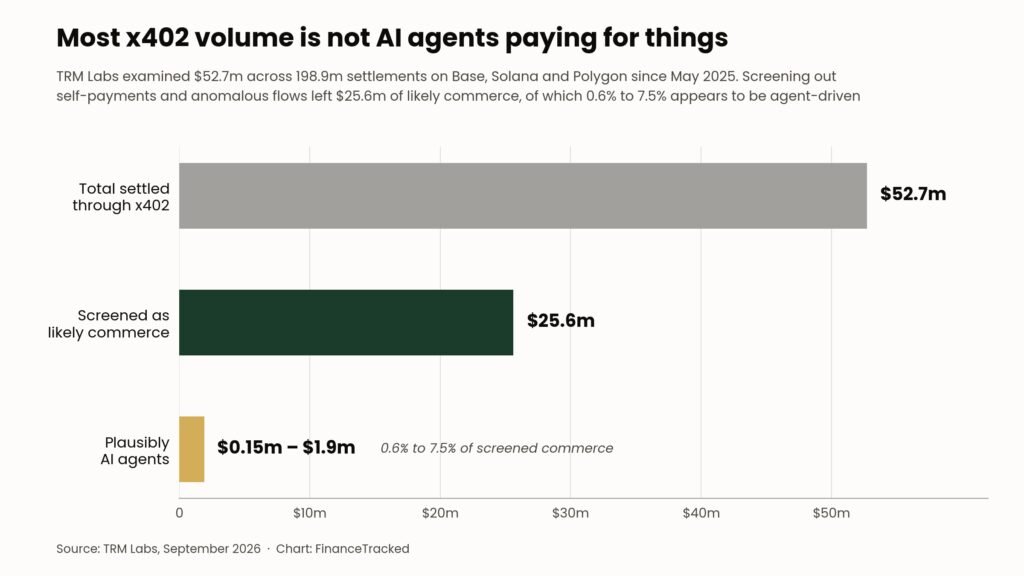
Of that screened pool, TRM estimates 0.6% to 7.5% appears to be agentic. The number of agents transacting rose to a mid-year peak and then fell back, while the volume they move stayed at roughly $5,000 to $11,000 a month.
TRM ran two models. A permissive one counts any transaction plausibly originating from an agent. A strict one requires facilitator-broadcast payments averaging under a dollar with varying amounts, sustained across months, plus agent-registry registration or payments to multiple sellers.
Visa and Artemis found the same inflation
A joint report from Visa and Artemis, published 16 July with data to 21 April, adjusted x402’s volume to about $15 million across 109.6 million transactions, with roughly 422,000 buyers and about 5,300 sellers.
That study filtered and identified wash and test activity rather than modeling which transactions came from agents. TRM went the further step.
The two count different universes, so the totals are not comparable. Their directions are different.
A memecoin drove much of the transaction count
A pay-to-mint memecoin experiment called PING required users to query a URL, receive a 402 response and pay 1 USDC to mint tokens. Transactions rose over 10,000% in a single week, with PING alone processing more than 150,000 transactions in its first month, according to Chainalysis.
Base’s near-zero gas fees let users repeat the loop hundreds of times.
Part of it is also structural. The x402 facilitator gives builders 1,000 free transactions a month, then charges a tenth of a cent, so any team wanting to show traction can ping itself cheaply.
TRM’s own caution cuts the other way. A single-purpose AI agent repeatedly buying one service looks exactly like a script, so the screen may undercount.
Why two credible firms can describe the same protocol differently
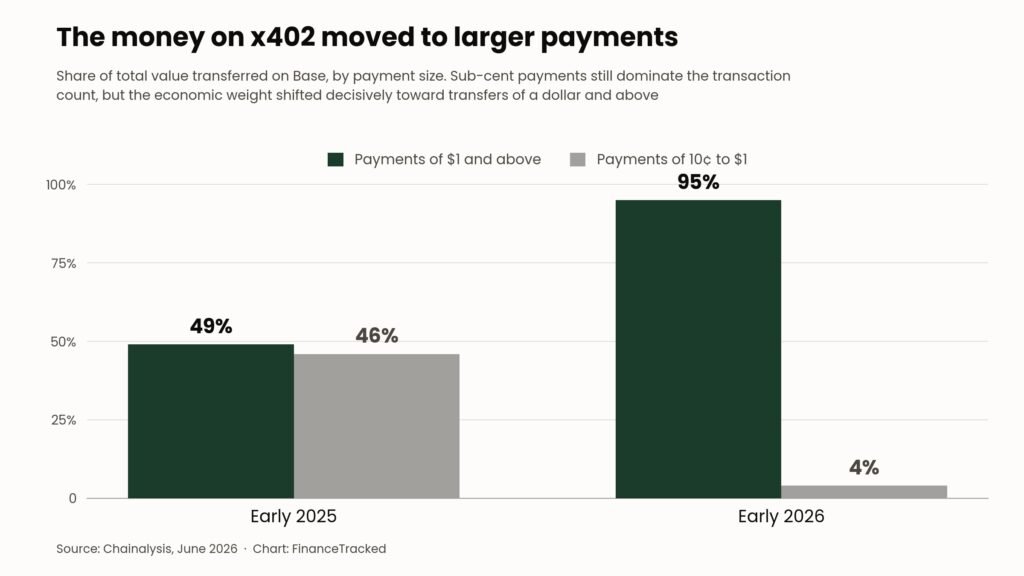
Anyone reading both studies will hit an apparent contradiction. Chainalysis reports that payments of a dollar or more now account for 95% of x402 volume. TRM’s strict test looks for payments averaging under a dollar as evidence of an AI agent.
Both are right, because they are counting different things.
Value is how much money moved. Count is how many payments happened. On a rail carrying millions of sub-cent transactions alongside a few thousand larger ones, those measures point in opposite directions. A few dozen $50 payments outweigh a million payments of a tenth of a cent by value, while being almost invisible by count.
So Chainalysis is describing where the money is: increasingly in larger transfers. TRM is describing what an AI agent looks like: many small payments, varying in size, repeated over months.
The practical reading is that x402 now carries two different kinds of traffic on the same rail, and any headline figure blends them.
The case that AI agent payments are growing
Chainalysis analyzed the same protocol and found a pattern that speculation alone does not explain.
Testers are converting faster. The rate at which wallets move from a single test transaction to real payments improved fourfold in six months.
Retention is drifting up without a catalyst. When PING was running, memecoin farmers pushed weekly retention to 87% for a week in October 2025, then went dormant and cratered it to 5%. The recent rise has no such trigger, which Chainalysis calls the metric skeptics should watch.
The users look distinct. x402 payers have an average wallet age of 197 days against 423 for the rest of Base, hold 26 different tokens against four, and have received roughly 12 times more capital funding.
Chainalysis’s own verdict is measured: x402 has moved beyond proof-of-concept, but mass adoption remains distant, and the user base skews to newer crypto-native entrants rather than institutions.
What the ChatGPT experiment showed
The most visible attempt at consumer agent shopping ran for five months.
OpenAI launched Instant Checkout on 29 September 2025, letting US users buy from Etsy sellers inside ChatGPT, with over a million Shopify merchants described as coming soon, per OpenAI.
At launch, it supported single-item purchases only, with multi-item carts promised next. Instacart launched a grocery-cart experience through Instant Checkout in December 2025, but the broad rollout across Etsy and Shopify never materialized. The Information reported that roughly a dozen Shopify merchants ever went live.
OpenAI withdrew the feature in March 2026.
ChatGPT now emphasizes product discovery and lets merchants use their own checkout experiences, including their own stores through an in-app browser and, in some cases, dedicated ChatGPT apps. The protocol survived; the one-size-fits-all in-chat checkout did not.
Two kinds of agent payment, and only one needs new rails
Visa and Artemis split agentic commerce in two.
In macro-commerce, an AI agent buys for a person at the scale a shopper spends, booking a flight or running a subscription. Those amounts sit comfortably on card rails that already exist.
In micro-commerce, one program pays another repeatedly in sums far below a dollar, for an API call or a sliver of compute. Card economics do not work well at that size, because fixed per-transaction processing costs can exceed the value of the payment.
That split explains why so many AI agent protocols exist. They are not all competing for the same transaction.
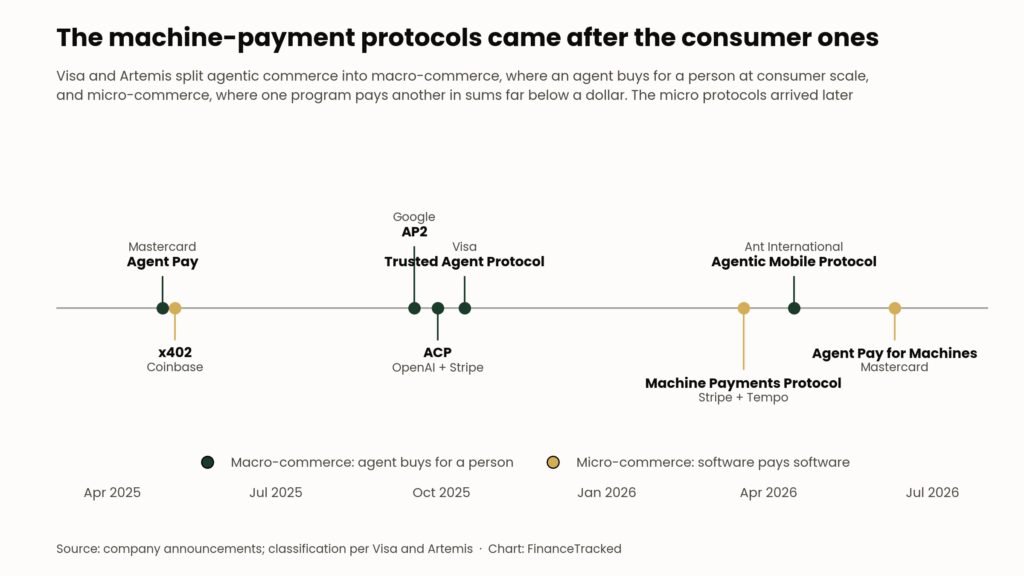
Google’s AP2 uses cryptographically signed mandates covering intent, cart and payment, built with more than 60 partners, including Mastercard, PayPal, Coinbase and American Express, according to Google Cloud.
The networks refused to pick a winner
Coverage frames this as a standards war. The companies are not behaving that way.
Visa built Intelligent Commerce Connect, a single integration that accepts payments initiated through its own protocol and three rivals, according to Visa.
Visa then launched a validator node on Tempo, the blockchain incubated by Stripe, in April 2026. In June, it announced a partnership with OpenAI.
Governance of x402 moved to the Linux Foundation in July, and 40 organizations have joined. Seventeen hold premier status, among them Visa, Mastercard, American Express, Stripe, Adyen, Fiserv, Shopify, Google, AWS, Coinbase and Circle. The card networks, the cloud providers and the stablecoin issuers are sitting at the same table.
Visa’s own report puts it plainly. Card-native protocols are adding stablecoin support while crypto-native ones adopt traditional trust infrastructure, and the line between the two camps is already getting harder to draw.
Then they started building for machines
Mastercard launched Agent Pay for Machines on 10 June 2026, a separate product for AI agents transacting with each other at high velocity, covering payments “some only fractions of a cent,” per Mastercard.
More than 30 launch participants signed on, including Stripe, Tempo, Coinbase, Adyen and Cloudflare.
Stripe built the meter
Stripe completed its acquisition of Metronome in January 2026, buying a metering engine already used by OpenAI, Anthropic and Nvidia, according to Stripe.
It combined that real-time usage metering with stablecoin micropayments on Tempo to create streaming payments. Its Machine Payments Protocol sits alongside that as the standard through which AI agents transact with businesses.
Stripe’s explanation of why cards cannot do this is blunt. The amounts are too small and the usage too fast for existing systems to process minute sums every few milliseconds.
The settlement mechanics underneath are the same ones stablecoin card programs already use, applied to machines rather than cardholders.
MPP’s own early volume was small. Visa and Artemis measured about $25,000 across 115,000 transactions in its first weeks after the March launch, the only other AI agent protocol with published figures.
Stripe also agreed in August 2026 to acquire OpenRouter, which routes requests across more than 400 AI models, per Stripe. The Wall Street Journal earlier reported talks around $10 billion and later reported that Stripe paid more than $7 billion. Stripe itself did not disclose terms.
More on what AI infrastructure costs:
Four AI labs priced frontier models four different ways
A Nigerian founder put a timeline on it
Paystack launched Index, an AI agent checkout, in June 2026, letting users pay through ChatGPT, Claude and OpenClaw. It is live in Nigeria for airtime, mobile data, transfers through Zap and food orders through Chowdeck.
“If you take a step back and compare the number of people that are using their browser for commerce and now introducing agents for discovery, you’ll see that agents are coming up and browsers are going down.” — Shola Akinlade, CEO of Paystack, via Techpoint Africa

He is the only executive in this story who has given a public timeline. Paystack does not expect significant traction for at least another year, and curates its merchants in the meantime.
The infrastructure is running ahead of the demand
This is the same pattern visible across the AI buildout, where committed capital has outrun the revenue meant to justify it. The difference is cost. A protocol takes a standards team, not a data center, which is why so many exist.
The standards bodies have twelve days
Existing dispute rules assume a person at the point of purchase. Visa and Artemis note that chargeback windows and evidence rules were designed for human-speed commerce, with no settled way to reverse disputed payments when chains of AI agents transact thousands of times an hour.
EMVCo has set up an Agentic Payments Task Force and released a draft framework, open for public comment until 30 September, according to EMVCo.
Clinton Allen, who chairs the task force, describes a setting where established consumer-merchant trust models are being redefined, and a consumer may instruct an AI agent within set limits and not be present when the payment executes.
The draft proposes Intent Services, a shared layer letting participants register, reference, retrieve and manage consumer-authorized intent before, during and after a transaction. EMVCo is also weighing Know Your Agent and Agentic Transaction Indicators.
EMVCo names the risk itself: the ecosystem comprises various existing and emerging standards and protocols, and that poses the risk of fragmentation.
More on planning your own finances:
How much you need to retire comfortably
What merchants should take from the volume gap
AI agent payments have far more infrastructure than traffic. The most extensively measured protocol has settled $52.7 million since May 2025, and TRM Labs screening cut that to $25.62 million of likely commerce with a plausibly agent-driven run rate of $5,000 to $11,000 a month.
Chainalysis finds the underlying usage improving, with payments above a dollar now 95% of value and retention rising without a speculative trigger, while still calling mass adoption distant. Read any headline figure carefully: value and transaction count move in opposite directions on this rail.
Two dates matter next: EMVCo’s comment deadline on 30 September, and whether any protocol owner publishes screened rather than raw volume.
Frequently asked questions (FAQs)
How do AI agent payments work?
An agent captures what the user wants, a protocol turns that into a signed record of the authorization, and payment settles through an existing processor or an on-chain rail. Google’s AP2 uses mandates covering intent, cart and payment. OpenAI and Stripe’s ACP keep the merchant as the merchant of record.
How much volume do AI agent payments actually handle?
TRM Labs measured $52.7 million settled through x402 since May 2025, screening it to $25.62 million of likely commerce. It estimates 0.6% to 7.5% of that is plausibly agent-driven, a run rate of roughly $5,000 to $11,000 a month. Visa and Artemis adjusted the same protocol to about $15 million using data through April, and measured Stripe and Tempo’s MPP at about $25,000 in its first weeks.
Why do reports on AI agent payments give different numbers?
Because they measure different things. Some count total value moved, others count transactions, and the studies filter out self-payments and test flows first. On a rail carrying millions of sub-cent payments alongside a few thousand larger ones, value and count point in opposite directions.
Can AI agents actually buy things today?
Yes, in limited form. Paystack Index handles airtime, transfers and food orders in Nigeria through ChatGPT, Claude and OpenClaw. ChatGPT emphasizes product discovery and routes buyers to merchant checkouts rather than completing purchases in chat.
Sources
TRM Labs, Chainalysis, Visa and Artemis, Linux Foundation, EMVCo, OpenAI, Google Cloud, Visa, Mastercard, Stripe, The Information, Techpoint Africa.