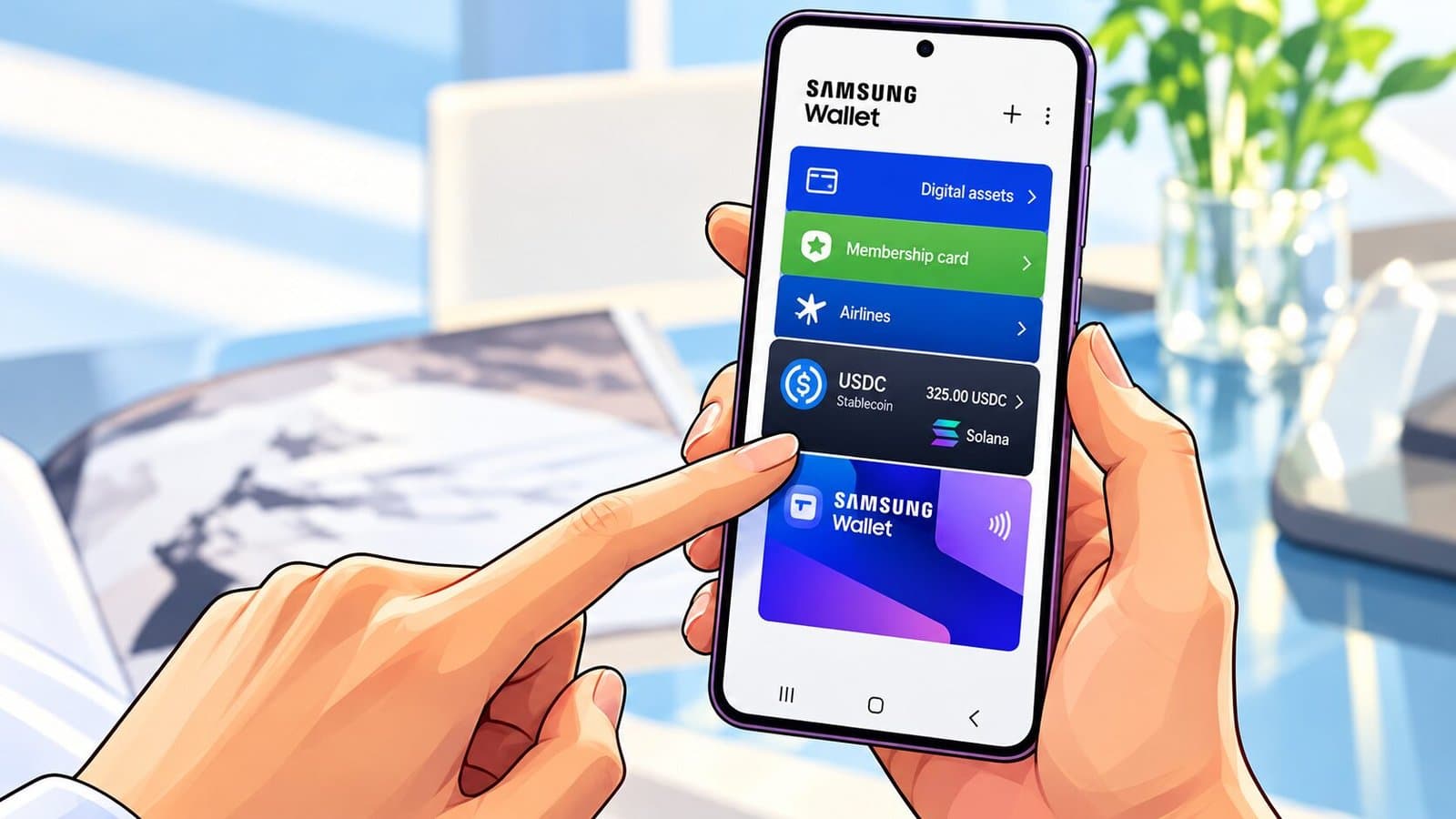

Samsung Electronics America will add stablecoin payments to Samsung Wallet in the last week of October, starting with USDC transfers for eligible Galaxy users in the United States. The rollout reaches a base of about 82 million Galaxy devices compatible with Samsung Wallet.
Recipients can receive local currency directly into eligible bank accounts in more than 60 countries without holding a crypto wallet. Samsung charges nothing to send to another wallet. Bank payouts carry fees the company has not published.
Samsung is not handling the money itself. That division of labor is the actual structure of the deal.
What launches in Samsung Wallet, and what Samsung will not do
Samsung announced the stablecoin payments on October 7, Samsung Electronics America said. Eligible users can send USDC from Samsung Wallet to third-party crypto wallets or exchange accounts abroad, which the company says takes seconds.
Samsung charges no fee on those transfers. Recipient providers may charge their own, and transfers to sanctioned jurisdictions are blocked.
Paying merchants is not part of the launch. Samsung lists online and in-store stablecoin spending as possible later additions.
Bank payouts reach 60 countries and carry fees
The bank route differs. Users can send to eligible bank accounts in more than 60 countries, where recipients are paid in local currency and need no crypto wallet.
Fees apply on that route. They vary by destination and amount, and the app shows them before the sender confirms.
Samsung states that it is not a bank, a money transmitter or a digital asset custodian and that it does not hold customer funds.
Eligibility runs to United States residents aged 18 or older with a Samsung Account, on Galaxy devices running Android 13 or higher. Identity and biometric verification are required.
More on stablecoin payments:
Circle backs UN stablecoin payments as WFP cuts food aid
Bastion holds the licenses, and Coinbase holds the USDC
The regulated work behind the stablecoin payments sits with partners, not Samsung.
Bastion powers the cross-border payment framework as a licensed stablecoin custodian and infrastructure provider, the company said. It runs custody, the user ledger, on-chain transfers, screening, monitoring and authorization.
A New York charter and conditional OCC approval
Bastion holds a limited purpose trust charter through Bastion Platforms Trust Company, LLC, on the NYDFS register. The Office of the Comptroller of the Currency conditionally approved its conversion to a national trust bank in Corporate Decision 1391.
Its operating entity is a FinCEN-registered money services business with state money transmitter licenses. Bastion converts the USDC and routes payouts through local regulated partners.
Coinbase guards the balances while two networks move them
Coinbase is Bastion’s official sub-custodian and safeguards every USDC balance in Samsung Wallet through Coinbase Prime Vault, Coinbase said.
Solana and Sui provide the blockchain infrastructure. Samsung names both networks as partners.
“Financial infrastructure works best when people don’t have to see it.” — Nassim Eddequiouaq, chief executive officer of Bastion, in the company’s announcement

Distribution was the constraint, not the technology
Stablecoin remittance products have existed for years. Reaching people who do not already hold digital assets is the part that has not worked.
Samsung Wallet is preinstalled on Galaxy hardware and already carries cards, boarding passes and identification. Adding stablecoin payments there removes the step where a sender downloads a separate app.
The receiving end matters more. A recipient paid into a bank account in local currency never touches a wallet, a seed phrase or an exchange.
Other operators are attacking the same barrier from the other end, with Nigerian startups routing bill payments through voice and chat rather than an app.
“Sending money abroad should feel as convenient as using the wallet already on your phone.” — Woncheol Chai, executive vice president and head of the Digital Wallet Team at the Mobile eXperience Business at Samsung Electronics, in Samsung’s announcement

The cost claim cannot be checked yet
Remittance pricing is where the stablecoin payments will be judged, and the pricing is not public.
The average cost of sending $200 to sub-Saharan Africa is about 9%, against a global average of about 6%, the IMF noted in June.
Samsung has published neither the bank payout fee schedule nor the list of countries. Whether the service undercuts incumbent corridors is unverifiable on the announcement alone.
Dollar-denominated transfers already move heavily through those corridors, where Nigeria ranked first globally for crypto payments and 18th for holdings in the 2026 Chainalysis index.
Key numbers behind Samsung Wallet stablecoin payments
- About 82 million Samsung Wallet-compatible Galaxy devices in the United States (Samsung, October 7, 2026)
- Bank payouts available in more than 60 countries, in local currency (Samsung, Bastion)
- No Samsung fee on wallet-to-wallet sends, variable fees on bank payouts (Samsung)
- USDC circulation grew 72% in 2025 to more than $75 billion (Coinbase, October 8, 2026)
- Wallets holding USDC grew 59% to nearly 7 million (Coinbase)
- Sending $200 to sub-Saharan Africa costs about 9% on average, against about 6% globally (IMF, June 2026)
Samsung Wallet will support USDC on Solana and Sui
Each network partner framed the deal around itself.
The Solana Foundation issued its own release describing the integration as a Solana partnership, the foundation said.
It said stablecoin supply on the network rose nearly 20% over the year. It put stablecoin volume processed in 2026 at more than $5.25 trillion. Those figures are the foundation’s own.
Samsung’s release names Solana and Sui together as network partners for the stablecoin payments. It has not explained how transfers are routed between them.
“For a decade, stablecoins have proved the technology works. What they lacked was a way to reach the mainstream.” — Lily Liu, president of the Solana Foundation, in the foundation’s announcement
What to watch on Samsung Wallet stablecoin payments
Samsung has put licensed stablecoin payments behind a preinstalled wallet, then stepped back from the money. Bastion carries the charters, Coinbase holds the balances, and two networks move the value.
Three things will show whether it changes remittance pricing. The published fee schedule for bank payouts. The country list, and whether the largest corridors appear on it. And whether the in-store and online payment options Samsung describes as possible ever get a date.