
The CBN stablecoin regulations prohibit algorithmic tokens and impose a licensing and approval regime on non-security virtual asset activity involving Nigeria.
The CBN stablecoin framework took effect on November 5, 2026, under circular PSP/DIR/PUB/CIR/001/004 signed by Musa I. Jimoh, Director of the Payments System Policy Department.
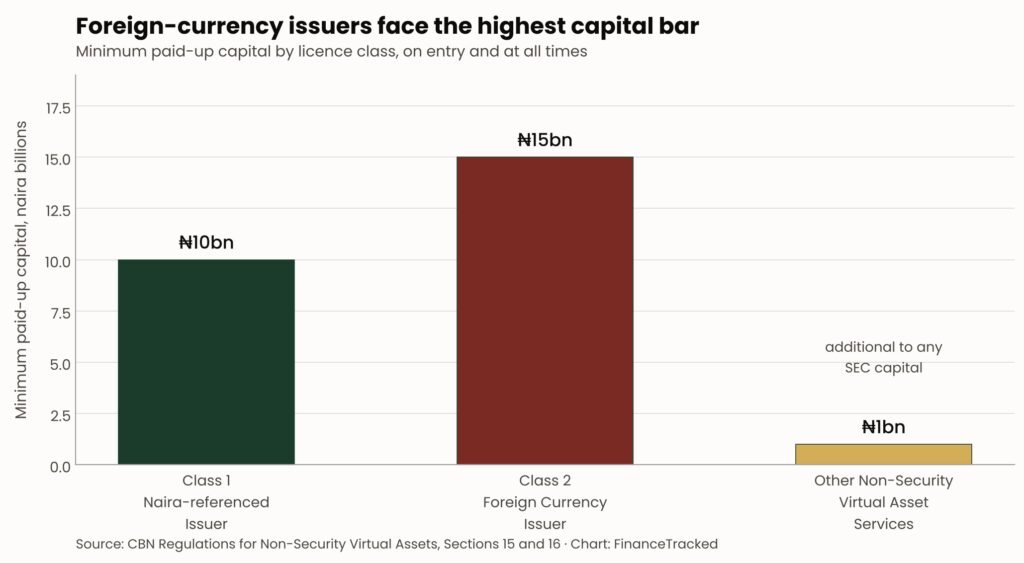
It reaches further than the ban. Foreign-currency tokens offered generally or to retail users in Nigeria must come through a Nigerian-incorporated Class 2 issuer holding ₦15 billion of paid-up capital. Existing operators have 30 days to register and 180 to apply.
The CBN regime creates six licensing and approval routes
The CBN stablecoin rules bar anyone from conducting a regulated activity without approval. Section 2.1.1 sets out six routes.
Two are issuer licences: the Naira-referenced Issuer Licence (Class 1) and the Foreign Currency Issuer Licence (Class 2). The rest are service licences, authorisations and approvals.
Before this instrument, the CBN had no dedicated in-force regime governing stablecoin issuance, reserves and redemption. Its December 2023 guidelines dealt principally with access to banking services for firms registered with the Securities and Exchange Commission.
The Regulations for the Operations of Non-Security Virtual Assets in Nigeria shall take effect from November 5, 2026. — Musa I. Jimoh, Director, Payments System Policy Department, Central Bank of Nigeria
Algorithmic tokens join four prohibited categories
Section 2.2 of the CBN stablecoin rules lists five classes of Prohibited Token that may not be issued, offered, distributed or traded in Nigeria.
Algorithmic stablecoins lead the list, defined as tokens seeking stable value mainly through algorithmic supply adjustment rather than full backing by eligible reserve assets.
The other four cover fiat-referenced tokens backed mainly by virtual assets, tokens linked to sanctioned persons or jurisdictions, and purported stablecoins without an enforceable right to redeem at par.
The last is anything else the Bank determines poses an unacceptable risk.
Dollar tokens need a Nigerian issuer
Section 6.5 of the CBN stablecoin rules has the widest reach. A foreign-currency-referenced stablecoin may be made available to people in Nigeria only as a Class 2 Stablecoin issued through a Nigerian-incorporated entity.
A foreign licence, registration, approval, regulatory status or arrangement with a Nigerian intermediary shall not substitute for that licence or for Token Approval. — Section 6.5, CBN Regulations for the Operations of Non-Security Virtual Assets in Nigeria
Section 15.3 closes the alternative. There is no offshore issuer exemption from incorporation, licensing or capital.
Recognition covers wholesale settlement only
The CBN stablecoin rules leave one narrow route for foreign tokens. Section 11.10.17 lets the Bank recognise a foreign-currency-referenced stablecoin issued outside Nigeria.
A Recognised Foreign Stablecoin may be used only by an Authorised Dealer or an approved licensee, and only to settle wholesale cross-border transactions.
Recognition requires an equivalent home regime, cooperation with the home authority, enforceable redemption at par, and the ability to freeze on lawful order.
The fifth condition is that the stablecoin is not offered to retail customers in Nigeria. Recognition may be varied or withdrawn at any time.
Existing operators face four deadlines
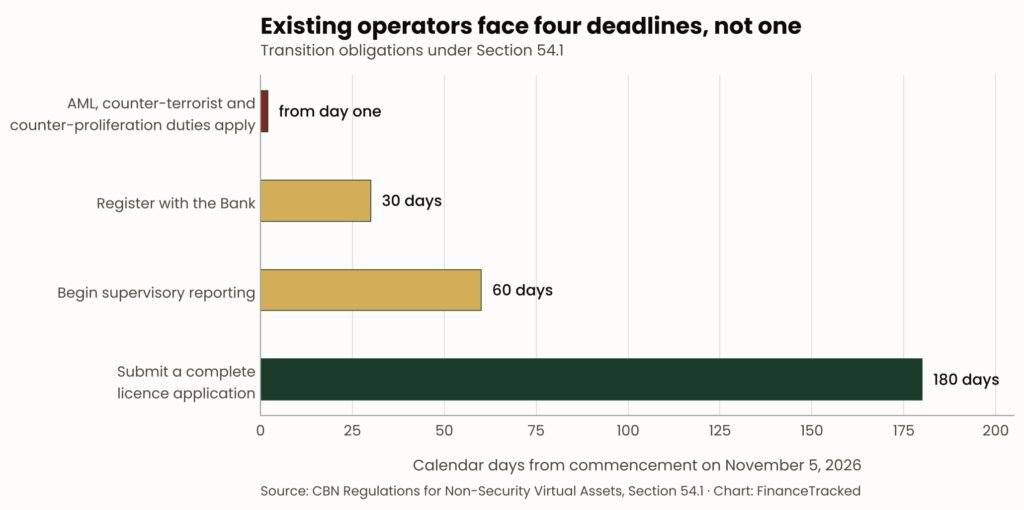
The CBN stablecoin transition under Section 54.1 gives an existing operator 180 calendar days to apply. During that window it may continue only at its existing scale.
It must register with the Bank within 30 days, comply with financial crime rules from commencement, and begin supervisory reporting within 60 days. Failure to apply in time requires cessation until licensed.
Class 2 arrangements need express interim permission
Existing foreign-currency arrangements get no automatic grace under the CBN stablecoin rules. Section 54.1 says they shall be assessed against the Nigerian incorporation, issuer licensing and service-provider approval requirements.
Continued access during that assessment requires the Bank’s express interim permission, and confers no permanent exemption. Registering within 30 days does not by itself buy the right to keep operating.
Peer-to-peer platform operators face a parallel duty, applying for approval under Section 10 within the same period.
Key numbers behind the CBN stablecoin rules
- ₦10,000,000,000 minimum paid-up capital for a Class 1 naira-referenced issuer (CBN, November 5, 2026)
- ₦15,000,000,000 for a Class 2 foreign currency issuer (CBN, November 5, 2026)
- ₦1,000,000,000 for other services, additional to any SEC capital (CBN, November 5, 2026)
- 180 calendar days for an existing operator to submit a complete application (CBN, November 5, 2026)
- ₦250,000,000 to ₦500,000,000 per breach of the reserve leverage or encumbrance prohibition (CBN, November 5, 2026)
The rules reach firms with no Nigerian office
The CBN stablecoin rules are drawn to catch issuers that never set foot in the country.
These Guidelines apply to any person performing a Regulated Activity, whether or not that person maintains a physical presence in Nigeria. — Applicability, CBN Regulations for the Operations of Non-Security Virtual Assets in Nigeria
The list names foreign issuers whose tokens reach people in Nigeria, alongside exchanges, wallet providers and custodians.
Section 11.10.15 anticipates avoidance. No person may structure, split or route a transaction through a peer-to-peer service, an affiliate, an offshore entity or an unhosted wallet to escape the section.
A systemic tier opens at ₦500bn or 5 million users
The CBN stablecoin regime creates a supervisory top tier. A token becomes a Systemic Stablecoin once its naira-equivalent circulating supply exceeds ₦500 billion on each day for thirty consecutive days.
The alternative trigger is use by more than 5 million people in Nigeria, measured from supervisory data. The Bank may also designate based on volume, user concentration or the share of activity attributable to Nigeria.
More on stablecoin controls:
Mastercard is selling the controls for stablecoin risk
The SEC had proposed an algorithmic ban first
The prohibition in the CBN stablecoin rules is not new to Nigerian policy.
The Securities and Exchange Commission exposed proposed rules in August 2026 that sorted stablecoins by backing and barred algorithmic versions except in exceptional cases. Those rules had not taken effect when the CBN regulations commenced.
What changed is the regulator. The CBN has claimed the payment layer, while the circular states the Regulations do not displace the SEC’s statutory mandate.
Operators crossing both perimeters may face both regimes. For SEC-licensed firms providing CBN-regulated services, Section 16 stacks the capital, and the same capital cannot be counted twice.
More on Nigerian fintech under regulatory pressure:
OPay IPO is withdrawn after a foreign regulatory inquiry
What to watch on the CBN stablecoin rules
The 30-day registration deadline falls first and will show how many firms were operating in the gap. The 180-day application window closes in May 2027.
Watch whether any foreign issuer seeks recognition under Section 11.10.17, and whether the Bank publishes the equivalence assessments that decision requires.
The naira-referenced side matters too. A Class 1 issuer must maintain ₦10 billion of paid-up capital, on entry and at all times. That is a high floor for naira tokens in a market where the CBN’s $500 million push failed to stop the naira’s slide.