
Goldman Sachs, Citigroup, Banco Santander and Deutsche Bank are among the firms backing a joint bank stablecoin venture. The group has committed about $270 million, Bloomberg reported, citing people familiar with the matter.
The money is intended to cover five years of operations at a new company that will issue a dollar-denominated token. That company is expected to be incorporated in the United States.
The venture itself is not new. Twenty-one institutions announced it on September 1, 2026, with a market debut targeted for the first half of 2027. What the reporting adds is the price of building it.
$270m averages $54m a year across five years
Spread evenly, the commitment would work out at about $54 million a year. Bloomberg did not say that spending will be even, and early licensing, technology and hiring costs could be front-loaded.
The reporting also does not establish that all 21 institutions are contributing, or how much any of them has put in.
Everything else about the bank stablecoin sits on the public record, in a joint announcement issued more than two months before the funding figure surfaced.
The $270m is an operating commitment, not a token target
The reporting does not disclose the form of the funding, how the issuer will allocate it, or whether any part of it could meet a regulatory requirement.
That figure should not be read as the intended circulating supply of the bank stablecoin. Under the US payment stablecoin framework, reserve assets must back outstanding tokens at least one for one.
Operating capital sits under separate rules. The OCC’s final rule treats reserve assets and the capital and operational backstop as distinct obligations.
bank-grade compliance, strong governance, distribution and institutional risk management — The twenty-one institutions, describing the venture’s design goals in a joint statement issued through Banco Santander
Twenty-one institutions put their names to it in September
The September announcement committed the group to establish a company in the second half of 2026, subject to closing conditions. The company will operate globally.
It has no announced corporate name. The venture is known internally as Project Faro, Bloomberg reported, which gives the issuer behind the bank stablecoin a label but not a public identity.
The effort began in October 2025, when ten banks started exploring a reserve-backed form of digital money. The roster has since more than doubled.
Standard Bank is Africa’s only seat at the table
Ten of the institutions are North American, and eight are European. MUFG Bank represents East Asia and Sirius International Holding the Middle East.
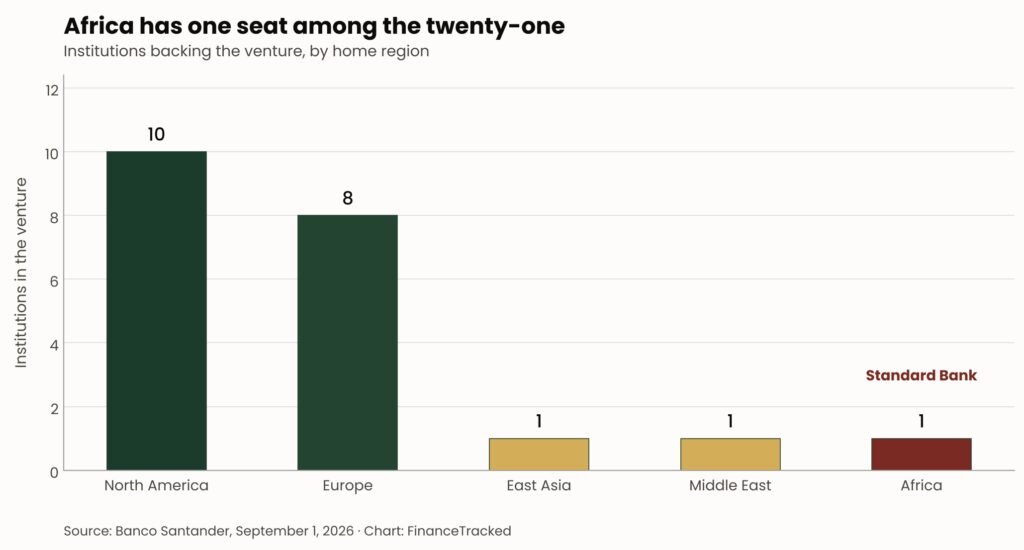
Standard Bank is the only Africa-headquartered participant. Its Stanbic arm appears elsewhere in the region’s capital markets, including the $200 million placement attached to the withdrawn OPay IPO.
The group has not disclosed an African rollout or any volume targets. Membership alone does not confer regulatory access across the continent, and the reach of the bank stablecoin there depends on market-access rules rather than the roster.
A dollar token first, with the euro named as a priority
The initial offering is denominated in US dollars. The group has said it plans tokens in other G7 currencies, with a euro version treated as a priority.
That puts the bank stablecoin alongside Europe’s fast-developing tokenized payment infrastructure, where seven banks in the ECB’s Pontes launch also back stablecoins.
The stated uses run across wholesale, institutional and retail, covering cross-border payments and digital asset settlement.
Key numbers behind the bank stablecoin
- About $270 million committed, intended to cover five years of operations (Bloomberg, November 10, 2026)
- 21 institutions across five regions, one of them African (Banco Santander, September 1, 2026)
- Company to be established in the second half of 2026, subject to closing conditions (Banco Santander, September 1, 2026)
- Market debut targeted for the first half of 2027 (Banco Santander, September 1, 2026)
- GENIUS Act effective date of January 18, 2027 (OCC, October 21, 2026)
The company is expected to form before the GENIUS Act
The group said the initiative intends to be “GENIUS Act and MiCA-compliant, as applicable.” Incorporating in the United States places the bank stablecoin inside the first of those regimes.
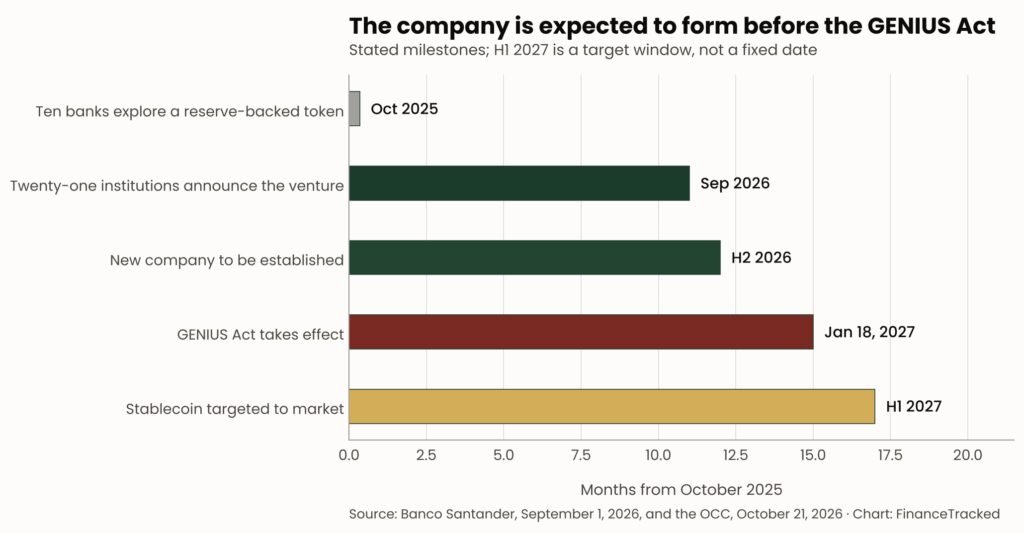
If the second-half timetable holds, the company would exist before the GENIUS Act takes effect on January 18, 2027. The token is targeted for a window that opens the same month.
More on stablecoin controls:
Mastercard is selling the controls for stablecoin risk
Nigeria has already written its own rulebook
The regulatory map the bank stablecoin must cross is filling in fast. Nigeria’s central bank brought its own regime into force on November 5, 2026.
For general or retail availability, a foreign-currency stablecoin must be issued through a Nigerian-incorporated Class 2 issuer. That issuer needs at least ₦15 billion of paid-up capital, as the CBN stablecoin rules set out.
The framework keeps a much narrower route for approved offshore tokens used in wholesale cross-border settlement.
More on stablecoin payments:
Circle takes a UN payments role with its stablecoin
Cross-border settlement is the stated job
The group has framed the bank stablecoin as plumbing rather than a product. Cross-border payments and digital asset settlement are the two uses named in the announcement.
Both are areas where banks already move money, slowly and at a cost. A stablecoin issued by the banks’ jointly backed company would keep that traffic inside the regulated system.
Design goals of bank-grade compliance and institutional risk management point the same way. This is infrastructure aimed at existing flows, not at new retail demand.
What to watch on the bank stablecoin
The company needs an announced name and incorporation documents. Both would convert Bloomberg’s unnamed sourcing into a public record.
Watch whether the $270 million figure is confirmed by any participant. Watch also whether the other seventeen institutions are disclosed as contributors, or whether the funding sits with a smaller group.
The deeper question is distribution. Twenty-one institutions can fund an issuer, but retail distribution depends on the market-access rules of each jurisdiction where the token is offered. On that test, the roster behind the bank stablecoin matters less than its licensing.