
Circle Foundation announced two grants on September 25 to fund stablecoin payments at two United Nations agencies. The United Nations Development Programme (UNDP) will use its grant to set up a Digital Asset Innovation Pool.
The World Food Programme (WFP) received a three-year commitment to build stablecoin payments infrastructure. Neither grant carries a disclosed value. Both agencies are operating under severe funding pressure, while WFP has already cut food assistance in multiple operations.
That squeeze goes unmentioned in the announcement, and that squeeze makes delivery cost one of the few variables agencies can still improve.
What the two Circle Foundation grants pay for
UNDP’s pool is meant to carry stablecoin payments from pilot work into regular program delivery, according to Circle Foundation’s announcement.
WFP will spend three years on governance frameworks, treasury systems, compliance tools and fintech integration. It plans to test two to three country corridors over that period.
“If we can help humanitarian and development institutions move value faster, more transparently, and at lower cost, we can ensure more of every aid dollar actually reaches the people who need it.” — Elisabeth Carpenter, Chief Strategic Engagement Officer at Circle and Founding Chair of Circle Foundation, in Circle Foundation’s September announcement

Circle names four places where the stablecoin payments have already run. Aleppo in Syria covers cash-for-work. Haiti covers disbursements where connectivity fails. Guatemala covers remittance-linked community investment.
The Gambia covers mobile wallets tied to cash-agent networks, the same last-mile problem that shapes African fintech expansion.
Circle Foundation is a donor-advised fund managed by Fidelity Charitable. It published no figure for either grant, and none appears anywhere in the wire syndication of the announcement.
Aleppo stablecoin payments cost 2% to deliver, against 10%
The stablecoin payments pilots produced the number that makes the argument. In Aleppo, distribution costs fell from about 10% of funds under conventional methods to about 2%, according to reporting on UNDP’s blockchain payments work.
That gap is eight cents on every dollar moved. For an agency whose budget is shrinking, it is the rare saving that does not come out of a caseload.
“We have shown that digital payments can reach the people that conventional systems miss, and in some of the hardest places to operate.” — Robert Pasicko, team leader, UNDP Alternative Finance Lab, speaking in July

The figure does not appear in Circle’s announcement. It comes from UNDP’s own pilot work, which predates the grant.
UNDP’s stablecoin payments already had a partner
The program Circle is funding has been running for more than a year, with a different blockchain behind it.
On July 6, UNDP agreed to an 18-month arrangement with the Stellar Development Foundation that runs to the end of 2027. Its stated purpose is a standing capability rather than further pilots.
The four places Circle names are UNDP’s own pilots under the Sustainable Development Goals Blockchain Accelerator. Circle’s release concedes the lineage, saying the work builds on solutions piloted through that accelerator.
Circle’s announcement names neither USDC nor Stellar. It refers to regulated payment stablecoins throughout. The token and network chosen set what settlement actually costs, which is the variable the grant is meant to improve.
Key numbers behind the aid payment squeeze
- Aleppo distribution costs fell from about 10% of funds to about 2% (UNDP, via Global Government Finance, July 10, 2026)
- WFP halved West Bank food assistance from 400,000 to 200,000 people from September (WFP, September 1, 2026)
- WFP said it needs $386 million over six months for Palestine operations (WFP, September 1, 2026)
- WFP said it needs $189 million over six months to restore Syria operations (UN News, May 13, 2026)
- About $38 billion in annual humanitarian funds still move on legacy systems (Circle Foundation, January 21, 2026)
WFP builds stablecoin payment rails while it cuts caseloads
The cost argument lands against a specific backdrop. WFP is not choosing between payment infrastructure and food. It is losing the food budget regardless.
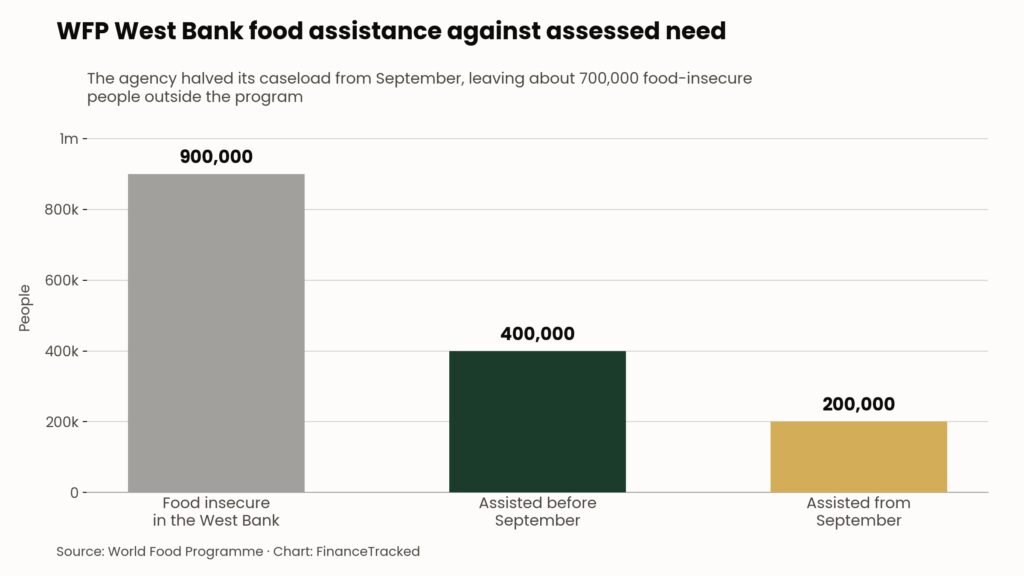
From September, the agency halved food assistance in the West Bank from 400,000 people to 200,000. It said it needed $386 million over the following six months. About 900,000 people there are food insecure.
“Families who were once thriving and earning a living from their land are now unable to afford enough food.” — Shaun Hughes, WFP country director for Palestine, in the agency’s statement
Syria lost half its emergency assistance four months earlier
WFP’s May 13 release directly states that emergency food assistance fell 50%, from 1.3 million people to 650,000; coverage fell from 14 governorates to seven; the bread program had reached up to four million people daily; and WFP required $189 million for June–November 2026.
Aleppo sits inside that operation. The city where UNDP proved the 2% delivery cost is in the country where WFP withdrew half its emergency assistance.
The two are not connected by cause. No program money was moved into stablecoin payments infrastructure, and the grant did not trigger the cuts. The connection is arithmetic. When the total shrinks, the share lost in transit is the part an agency can still control.
What to watch on UN stablecoin payments
The grant is real, and the cost evidence is measured, but the announcement claims less than it appears to. Circle is funding the scale-up of a UNDP program that already had Stellar behind it, with no disclosed amount and no named token.
Three things will show whether it amounts to more. Which corridors WFP names. Whether Circle or either agency publishes a figure. And whether the Stellar arrangement and the grant converge past the end of 2027. Institutional stablecoin payments have a habit of arriving through settlement plumbing rather than announcements.