

When someone taps a stablecoin-linked card, the merchant gets paid within days. The company that issued the card has to fund that payment to the network first, every day, including weekends.
Closing that gap is now the main constraint on new stablecoin card programs, according to Visa.
This explains how stablecoin settlement works in a card program, why the funding gap exists, and who is paying to close it.
Three layers that are easy to confuse
A stablecoin-linked card involves three separate things, and most coverage collapses them into one.
What funds the purchase. The cardholder holds a stablecoin balance, and the card draws on it.
What the issuer settles with the network in. This is a separate choice. In the traditional model the program converts the stablecoin to fiat and settles with the network conventionally. A stablecoin-linked card does not automatically settle on stablecoin rails.
Who finances the timing gap. The issuer owes the network on a daily cycle but collects later, and something has to fund the difference.
Only the third is the subject of this piece, but the second is where the recent change has happened.
Stablecoin settlement is an option, not a default
Visa and Mastercard now let selected issuers and acquirers settle directly with the network in stablecoins rather than fiat.
Visa’s settlement pilot supports nine blockchains after adding Arc, Base, Canton, Polygon and Tempo to existing support for Avalanche, Ethereum, Solana and Stellar, according to Visa.
Mastercard supports settlement in regulated stablecoins including USDC, PYUSD, USDG, USDP, RLUSD and SoFiUSD across chains including Arbitrum, Base, Canton, Ethereum, Polygon, Solana, Tempo and XRPL, per Mastercard.
Authorization still happens in under a second either way. Settlement happens on a cycle, and the obligation falls due whether or not the issuer has collected from the cardholder.
Why the headline stablecoin numbers mislead
Before looking at scale, the numbers usually quoted need unpicking.
Reported stablecoin transaction volume runs to roughly $35 trillion a year. Most of it is not payments.
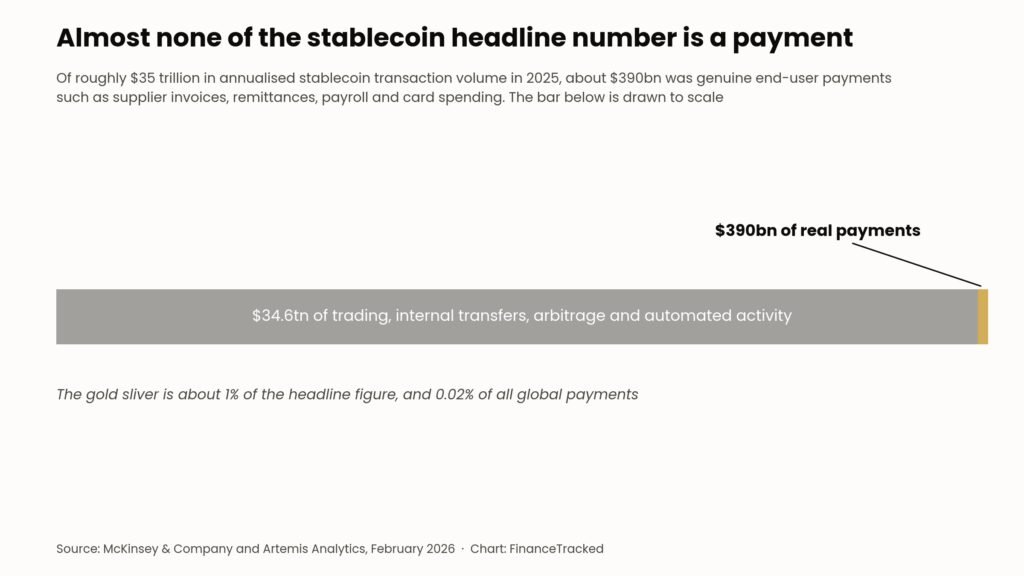
End-user payments were running at an annualized rate of about $390 billion, roughly 0.02% of global payments volumes, according to McKinsey and Artemis Analytics.
The rest is exchanges moving funds between their own wallets, automated smart contract activity, arbitrage and trading flows. McKinsey’s own conclusion is that raw reported volumes should be treated as a starting point for analysis rather than a proxy for payment adoption.
Where card spending actually sits
Card spending is the smallest of the real payment categories.
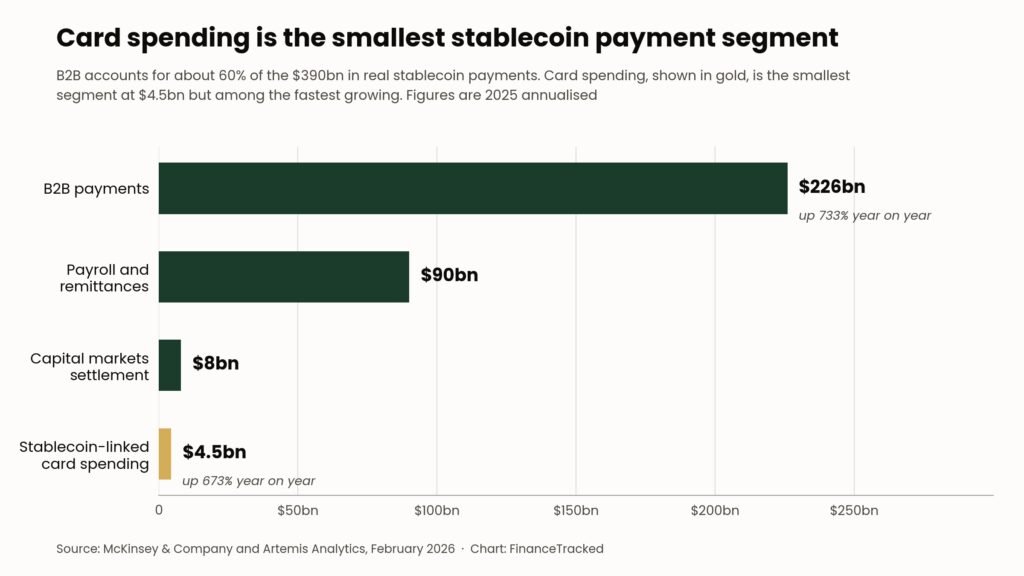
McKinsey and Artemis put stablecoin-linked card spending at $4.5 billion in 2025, up 673% on the prior year. B2B payments dominate at about $226 billion, roughly 60% of the total, having grown 733% year on year.
So the rail is real, growing fast, and small.
Why working capital is the constraint
An issuer funds its settlement obligation daily while collecting from cardholders later. The larger the program, the larger that revolving gap.
Traditional warehouse credit facilities are built for size. Early-stage programs may need only a few million dollars and settle every day, which makes conventional facilities uneconomic.
Visa’s own framing is that some programs are limited less by demand or network infrastructure than by access to working capital structured for how they operate day to day.
That is the same problem PayPal’s move into banking addresses from a different direction: payment companies extending credit against flows they can already see.
How receivables financing closes the gap
The financing answer is to lend against the settlement receivable itself.
Credit Coop, working with Visa, has built a stablecoin-denominated revolving credit facility secured by settlement receivables. It uses daily Visa settlement files to size the funding and a smart contract called Spigot to automate repayment, according to Visa.
Functionally it does what a lockbox under a deposit account control agreement does in conventional receivables lending, but automatically and daily rather than through a bank operations team.
Borrowing costs for participating programs have fallen by as much as 30% as more lenders have underwritten these facilities, Visa said.
The Rain and Karta example
Rain, a Visa Principal Member, has used the facility since August 2023 to fund its daily settlement obligations. It has financed roughly $2 billion across more than 2,000 borrow events and over 7,000 repayment events, with no defaults, per Visa citing Credit Coop.
Karta, a travel card issuer, launched and scaled on a Credit Coop facility before raising $140 million in June 2026: a $15 million Series A led by Galaxy Ventures and a $125 million institutional credit facility from Community Investment Management.
That is the ladder. A small on-chain revolving facility builds a repayment record, and the record supports institutional credit.
Who is building on the rail
Visa reported a $7 billion annualized settlement run rate in April, up 50% quarter on quarter, with more than 130 stablecoin-linked card programs across over 50 countries, per its April release. In September, Visa said settlement had passed a $20 billion annualized run rate with more than 160 programs live, though its own footnote flagged that figure as pending confirmation with its investor relations team.
Stripe reported that stablecoin payments volume doubled to around $400 billion in 2025, with an estimated 60% in B2B flows, and that volume at Bridge, the stablecoin platform it acquired, more than quadrupled, according to Stripe.
In Africa, Flutterwave spent five years embedding stablecoin settlement into a platform now spanning more than 30 countries.
The same competitors are also collaborating on shared infrastructure. Visa, Stripe, Mastercard, American Express, Discover and more than 140 businesses have signed up to Open USD, a stablecoin governed by an independent company whose board is made up of its partners, according to Open Standard. Partners receive the earnings from its reserves, less a management fee, and can mint and redeem at no cost. It goes live later this year.
More on what the AI buildout means for payback:
What an AI slowdown does to $700 billion in AI capex
Banks are building an alternative settlement asset
This addresses a different part of the problem. The banks are not financing the issuer’s timing gap; they are offering an alternative to stablecoins as the thing being settled.
The Clearing House, owned by 25 of the largest US financial institutions, is building on-chain clearing and settlement of tokenized deposits between banks, plus a connectivity layer linking blockchain activity to the RTP and CHIPS networks, according to The Clearing House.
Participants include JPMorgan, Bank of America, Citi, Wells Fargo, HSBC, PNC, Truist and U.S. Bank.
The pitch is programmability and 24/7 settlement using commercial bank money rather than a third-party issuer’s reserves.
What could break it
A young financing market. This is a new asset class with substantially less diversified lender participation than mature card-receivables markets.
A record rather than a guarantee. Credit Coop reports no defaults across thousands of on-chain repayment events, which is a strong signal but a relatively short track record.
The scale gap. At $4.5 billion of annual card spending, this is a small share of an already small real-payments figure. The financing structures work; the volume they support is modest.
The bank alternative. If tokenized deposits reach scale, issuers may settle in commercial bank money rather than a stablecoin, and the financing built around stablecoin settlement adapts or does not.
Takeaway
Stablecoin card settlement works because someone funds the gap between the issuer paying the network daily and collecting from cardholders later. Credit Coop’s facility does that by lending against the settlement receivable and automating repayment from the daily settlement file, and the record it produces has carried at least one issuer into institutional credit.
The constraint on new programs is that funding, not demand. Card spending remains the smallest real stablecoin payment segment at $4.5 billion, and the banks are building a tokenized-deposit alternative to the settlement asset itself.
Frequently asked questions (FAQs)
How does a stablecoin card settle with the network?
It depends on the program. Some issuers convert the cardholder’s stablecoin balance to fiat and settle conventionally. Visa and Mastercard now also let selected issuers and acquirers settle directly with the network in supported stablecoins across a range of blockchains.
Who funds the gap before the issuer collects?
Increasingly, a revolving credit facility secured on settlement receivables. Credit Coop’s facility uses daily Visa settlement files to size funding and a smart contract to automate repayment, an approach Visa says has cut borrowing costs for participating programs by as much as 30%.
How big are stablecoin payments really?
End-user payments were running at an annualized rate of about $390 billion, roughly 0.02% of global payments, once trading and internal transfers are stripped out of the roughly $35 trillion headline figure, per McKinsey and Artemis. B2B is about $226 billion of that; card spending is $4.5 billion.
Which institutions support stablecoin settlement today?
Visa and Mastercard both offer stablecoin settlement to selected participants. Stripe operates Bridge. More than 140 businesses including Visa, Stripe, Mastercard, American Express and Discover have joined Open USD. Separately, The Clearing House and 25 major banks are building a tokenized deposit network.
Sources
McKinsey & Company and Artemis Analytics, Visa, Mastercard, Stripe, Open Standard, The Clearing House.