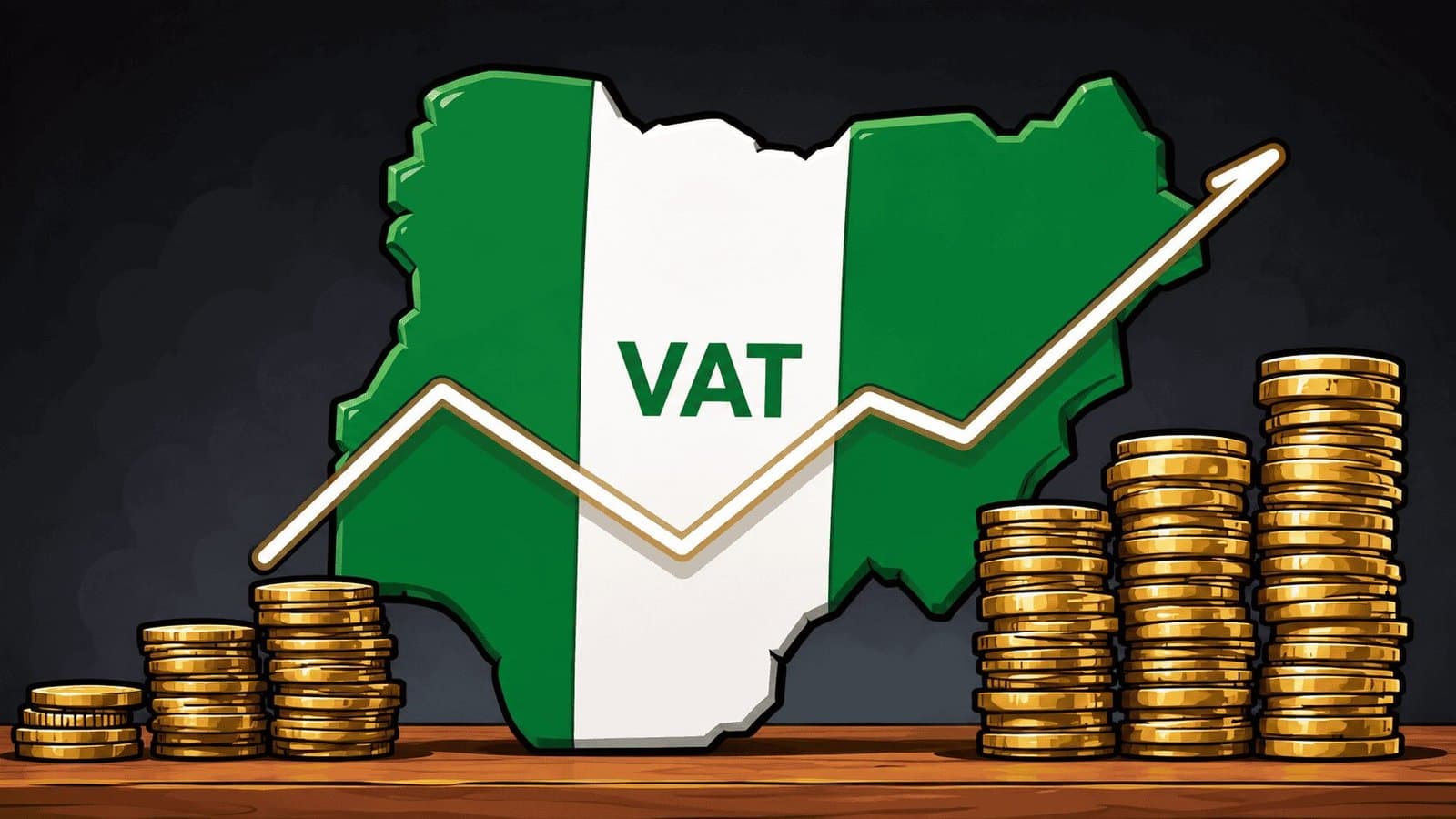

Nigeria pulled in ₦2.42 trillion in value-added tax during the first quarter of 2026, marking a new quarterly high in the country’s most critical non-oil revenue stream.
The figure represents a 17.06% rise compared to the same period last year, when total VAT collections stood at roughly ₦2.07 trillion across all contributing sectors.
Behind that topline number, a sharper story is taking shape inside the data the government released this week. Some sectors are powering ahead while others are contracting at a pace that could complicate Nigeria’s fiscal planning outlook.
Manufacturing drives nearly a third of all VAT collected in Q1 2026
The manufacturing sector accounted for 29.75% of all VAT revenue collected during the quarter, maintaining its dominant position as the single largest contributor, the National Bureau of Statistics confirmed in its latest sectoral distribution report.

Information and communication followed with a 20.61% share, while mining and quarrying contributed 12.32% of the total VAT pool during the three-month window, according to the NBS report. Combined, those three sectors accounted for roughly 63% of Nigeria’s entire VAT haul during the quarter.
Local VAT payments made up ₦1.11 trillion of the total, while foreign VAT payments contributed ₦830.47 billion, and import-related VAT added ₦477.55 billion during the quarter.
Education and public administration VAT collections fell sharply in Q1
Not every sector shared in the expansion, and the laggards posted some of the steepest quarterly declines recorded in recent NBS reporting cycles. Education posted the sharpest quarterly drop at 31.96%, followed by public administration and defense at 31.38%, the NBS report indicated.
Activities of extraterritorial organizations also declined by 29.89% during the same period, underscoring the uneven pace of economic activity across Nigeria’s diverse sectors.
At the other end, activities of households as employers recorded the highest quarterly growth rate at 74.36%, followed by arts, entertainment, and recreation at 20.91%, and manufacturing at 12.82%.
Taiwo Oyedele, who chaired the Presidential Committee on Fiscal Policy and Tax Reforms before his April 2026 appointment as Finance Minister, has argued that Nigeria’s revenue gains would come from expanding participation rather than raising rates.
“When the economy grows, the tax base expands,” Oyedele told BusinessDay in January 2026. “People pay not because rates are higher, but because more people and businesses are participating.”

VAT growth rate is decelerating even as collections hit new records
While the ₦2.42 trillion headline marks a new quarterly record, the 17.06% year-on-year growth rate for Q1 2026 is notably lower than the stronger annual gains recorded in previous quarters of 2025, the NBS data indicated.
The deceleration suggests the initial post-reform surge in tax compliance may be reaching a natural plateau as the comparison base keeps growing larger with each passing quarter.
Nigeria’s GDP grew 3.89% year-on-year in Q1 2026, while the manufacturing sector doubled its real growth rate to 3.29% from 1.69% in the prior year, supporting the broader VAT expansion, NBS GDP data confirmed, as reported by BusinessDay.
Key VAT figures for Q1 2026
- Total VAT collected: ₦2.42 trillion
- Year-on-year growth: 17.06% from Q1 2025
- Quarter-on-quarter growth: 9.98% from Q4 2025
- Local payments: ₦1.11 trillion
- Foreign VAT payments: ₦830.47 billion
- Import VAT: ₦477.55 billion
- Top contributing sector: Manufacturing at 29.75% share
- Source: National Bureau of Statistics, VAT Q1 2026 Report
What Nigeria’s shifting VAT landscape signals for its ₦40.7trn revenue target
The Q1 data confirms that manufacturing and telecommunications remain the backbone of Nigeria’s consumption tax base, together contributing over half of all collections. That concentration creates fiscal vulnerability for a government targeting the Nigeria Revenue Service’s ₦40.7 trillion 2026 collections goal.
President Bola Tinubu signed four landmark tax reform bills into law in June 2025, consolidating more than 60 fragmented tax statutes, the Nigeria Revenue Service confirmed. NRS Executive Chairman Zacch Adedeji noted that reforms to strengthen remittance systems have delivered significant revenue gains, with collections rising from ₦711 billion in May 2023 to ₦3.63 trillion by September 2025, TheCable reported.

Broadening the range of sectors that contribute meaningfully remains a central challenge for fiscal policymakers across all tiers of government. Water supply, waste management, and household employer activities each contributed less than 0.1% of total collections, highlighting the narrow effective tax base.
For everyday Nigerians, expanding VAT collections translates into larger allocations for federal, state, and local governments through the Federation Account. Whether those allocations improve public services is the question that will shape how citizens experience these record-setting numbers.