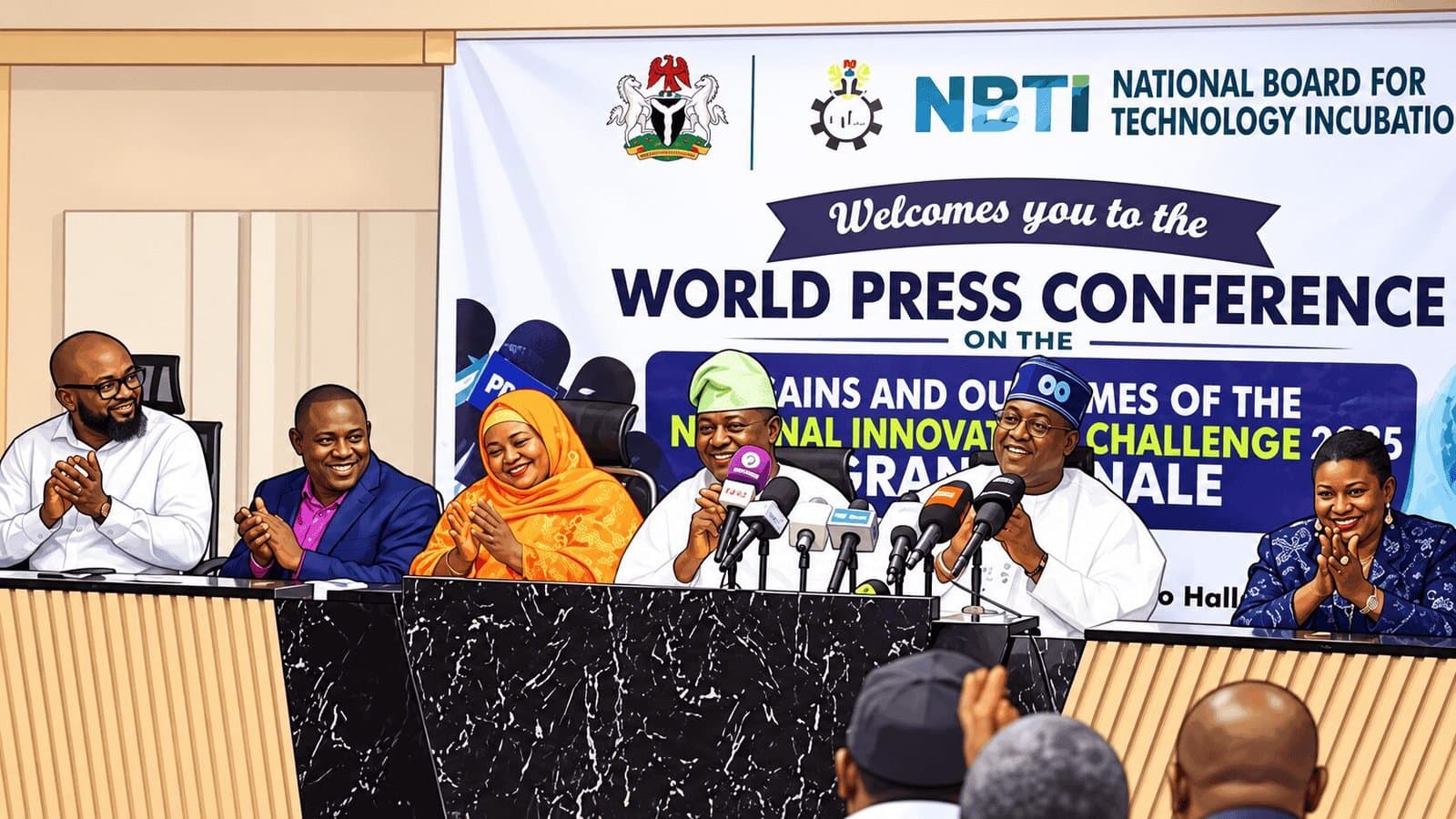

Nigeria’s technology incubation agency returned from a London showcase carrying numbers that sound transformational before you read the fine print.
A $600 million investment pipeline tied to solar energy and small business financing sits at the center of a bold national push.
The figure bundles two separate proposed international arrangements into one attention-grabbing total that conceals important conditions underneath the headline number.
The gap between announcements and deployed capital remains the story you should follow most closely before drawing any conclusions.
NBTI pitches $600m across two proposed international partnerships
The National Board for Technology Incubation (NBTI) presented a proposed investment and development-finance pipeline exceeding $600 million at a press conference on October 21 in Abuja, NAN reported.
The package combines a proposed $500 million solar-energy partnership with Gigawatt Global and a $100 million financing memorandum of understanding with Cambridge Investors.
Gigawatt Global CEO Yosef Abramowitz described the solar component at the NextGen National Showcase, proposing facilities that would generate 10 to 20 megawatts per Nigerian university campus.
The company said it would source equipment and maintenance services from within Nigeria to maximize local job creation and sustain operations domestically.

“The idea is to keep as many of the jobs locally, both for operations and maintenance.” — Yosef Abramowitz, CEO, Gigawatt Global (via NAN)
Abramowitz added that Gigawatt Global would buy panels, solar racking, and cables in Nigeria to maximize local job creation, NAN reported.
NBTI Director-General Kazeem Raji stressed that neither figure represents money that has been received, disbursed, or deployed inside the country at this stage.
He told journalists that realization depends entirely on due diligence, financing arrangements, contractual commitments, and regulatory approvals before any funds arrive.
Nigeria’s startup incubation programs at the state level have shown what patient government backing can produce when execution follows announcements consistently.
NextGen Challenge triples participation from 105 to 298 innovators
The proposed pipeline emerged from the NextGen Innovation Challenge 2026, whose grand finale took place on October 9 in London, United Kingdom.
NBTI organized the event alongside United Kingdom-based partner organization UKALD under a theme centered on translating Nigerian ingenuity into global commercial impact.
More on Nigeria’s investment pipeline:
Participation nearly tripled from 105 innovators in 2025 to 298 representing all 36 states and the Federal Capital Territory (FCT) this year.
The innovations showcased covered artificial intelligence, robotics, agriculture, healthcare, education, renewable energy, telecommunications, and advanced manufacturing across multiple exhibition categories, NAN reported.
Sixteen selected innovators received international accelerator offers valued at approximately $160,000 across international programs, Vanguard reported.
A Dubai-based investor separately pledged $100,000 to support three women-led innovation projects during the London event, Vanguard reported.
Wider continental activity shows Nigerian industrialists expanding cross-border investment commitments that signal growing appetite for enterprise development on the African continent.
Tinubu Light Initiative targets one million small businesses with solar
The $100 million Cambridge Investors memorandum directly supports the Tinubu Light Initiative, a proposed national solar-inclusion program designed to slash energy costs for micro and small enterprises.
The program targets one million businesses across all 36 states and the FCT while projecting 50,000 direct youth employment opportunities during its initial phase.
Minister of Innovation, Science and Technology Kingsley Udeh described the initiative as reflecting the administration’s commitment to building conditions where Nigerian innovation can thrive, NAN noted.

Potential beneficiaries include traders, artisans, farmers, cybercafés, pharmacies, and fashion designers alongside women-owned and youth-led businesses across the country.
Nigeria’s renewable energy investment reached $2.4 billion in 2025, with over 99% flowing into small-scale solar installations, BloombergNEF noted in its Sub-Saharan Africa outlook, The Guardian Nigeria reported.
Enterprise tools like those NativeTalk recently deployed for African SMEs could support the same businesses if reliable solar power unlocks longer productive hours and reduces generator operating costs.
Key pipeline targets and conditions
- The $500 million Gigawatt Global solar component remains a proposed partnership, not a signed financing commitment, NAN reported.
- The $100 million Cambridge Investors MoU supports the Tinubu Light Initiative targeting one million MSMEs nationwide, NAN confirmed.
- NextGen participation grew from 105 innovators in 2025 to 298 from all 36 states and the FCT in 2026, NAN reported.
- International accelerator offers valued at $160,000 went to 16 selected innovators across international programs, Vanguard reported.
- A Dubai-based investor pledged $100,000 to three women-led innovation projects at the London event, Vanguard reported.