
You would expect a shortened trading week to slow things down on the Nigerian Exchange (NGX). Losing one session out of five should translate to roughly a 20% dip in activity across the board. The week that ended on October 2, 2026, told a different story on the exchange floor.
Trading volume dropped 32%, and the total value of shares exchanged fell 36% from the prior week. Those declines are far steeper than a missing day can justify, raising questions about where investor appetite went.
NGX turnover and trading value slid well beyond the holiday gap
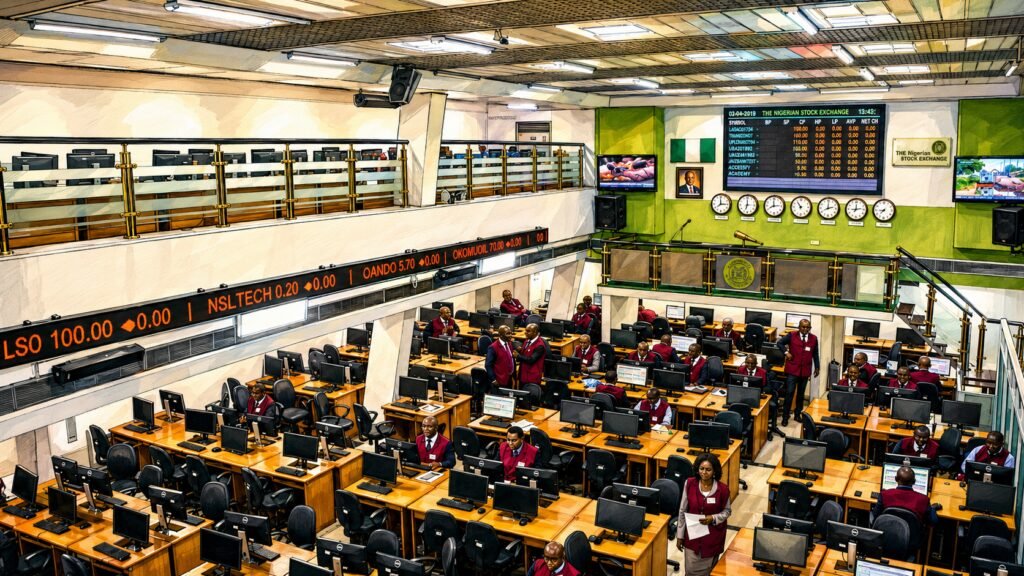
Investors on the NGX traded 3.17 billion shares worth ₦155.02 billion across 206,662 deals during the four-day window, the exchange’s weekly market report showed.
That marked a sharp pullback from the 4.69 billion shares valued at ₦240.82 billion across 261,198 deals the preceding full week.
More on the NGX:
- Ecobank scraps non-exec tenure cap in board reboot
- Airtel Money shows its cards ahead of London listing
- NGX pitches Nigeria as the next China to investors
The number of deals fell by roughly 21%, aligning neatly with a one-day reduction in a five-day schedule. Volume and value, however, fell by margins that suggest something beyond a calendar adjustment.
The All-Share Index (ASI) closed the week at 250,808.27 points, shedding 0.52% from its prior close of 252,113.41 points. Market capitalization slipped 0.50% to ₦162.843 trillion, a loss of roughly ₦820 billion in listed value.
Banking stocks led the decline while insurance quietly advanced
Financial services stocks still dominated activity by volume, contributing 61.41% of total equity turnover at 1.944 billion shares worth ₦77.73 billion.
The top three traded equities were Fidelity Bank, VFD Group, and Access Holdings, which together accounted for 42.42% of total volume.
The NGX Banking Index fell 1.33% for the week, reflecting profit-taking pressure in banking stocks, even as the index is up over 77% year to date.
David Adonri, vice president of Highcap Securities Limited, has urged caution, warning that the cyclical nature of stock markets means an extended rally will eventually face a downturn.

“We have been in a boom for quite a long time, and nobody can accurately predict when a bust will occur,” Adonri told NAN earlier this year, urging investors to hedge their risks in the current environment.
The NGX Insurance Index stood out as one of only four indices that finished the week in positive territory, gaining 0.61%. Oil and Gas edged up 0.05%, the Growth Index climbed 1.85%, and the Main Board added 0.08%, while every other sector index declined.
Fewer stocks advanced as market breadth weakened sharply
Only 44 equities gained in price during the week, down from 61 in the prior session, while 37 stocks declined, up from 32 the week before.
Another 65 equities closed flat, indicating that most listed companies attracted little meaningful trading interest.
ABC Transport Plc topped the gainers chart with a 45.10% weekly surge, climbing from ₦5.10 to ₦7.40 per share across the four sessions.
Critical Minerals Financing Corp followed with a 37.73% gain, and LivingTrust Mortgage Bank rose 32.69%, rounding out a strong small-cap showing.
On the losing side, Sovereign Trust Insurance dropped 12.50%, E-Tranzact International fell 12%, and PZ Cussons Nigeria shed 10.03% for the week.
Nigerian Exchange Group Plc’s own stock slipped 8.86% to ₦168.60 per share during a week when the exchange reported lower activity.
What the turnover gap signals about investor confidence heading into Q4
The gap between expected and actual turnover during a holiday-shortened week typically signals one of two things for market participants.
Institutional investors may be pulling back ahead of quarter-end portfolio rebalancing, or retail participation may be thinning after a strong year-to-date rally.

Aruna Kebira, managing director and chief executive officer of Globalview Capital Limited, told Arise News that the market has shown resilience in the first eight months of 2026 despite volatility and prevailing headwinds.
Kebira described the outlook for the rest of 2026 as cautiously optimistic for long-term investors.
Key numbers from the NGX holiday week
- ASI closed at 250,808.27 points, down 0.52% week over week — NGX weekly report
- Trading volume dropped 32% to 3.17 billion shares from 4.69 billion the prior week — NGX weekly report
- Gainers narrowed to 44 from 61 the prior week; losers expanded to 37 from 32 — NGX weekly report
The year-to-date return on the ASI still stands at a formidable 61.17%, and the broader macro story supporting Nigerian equities has not changed materially, with the exchange actively courting global investors.
But the holiday week exposed a fragility in participation that investors heading into Q4 2026 will want to watch in coming sessions.