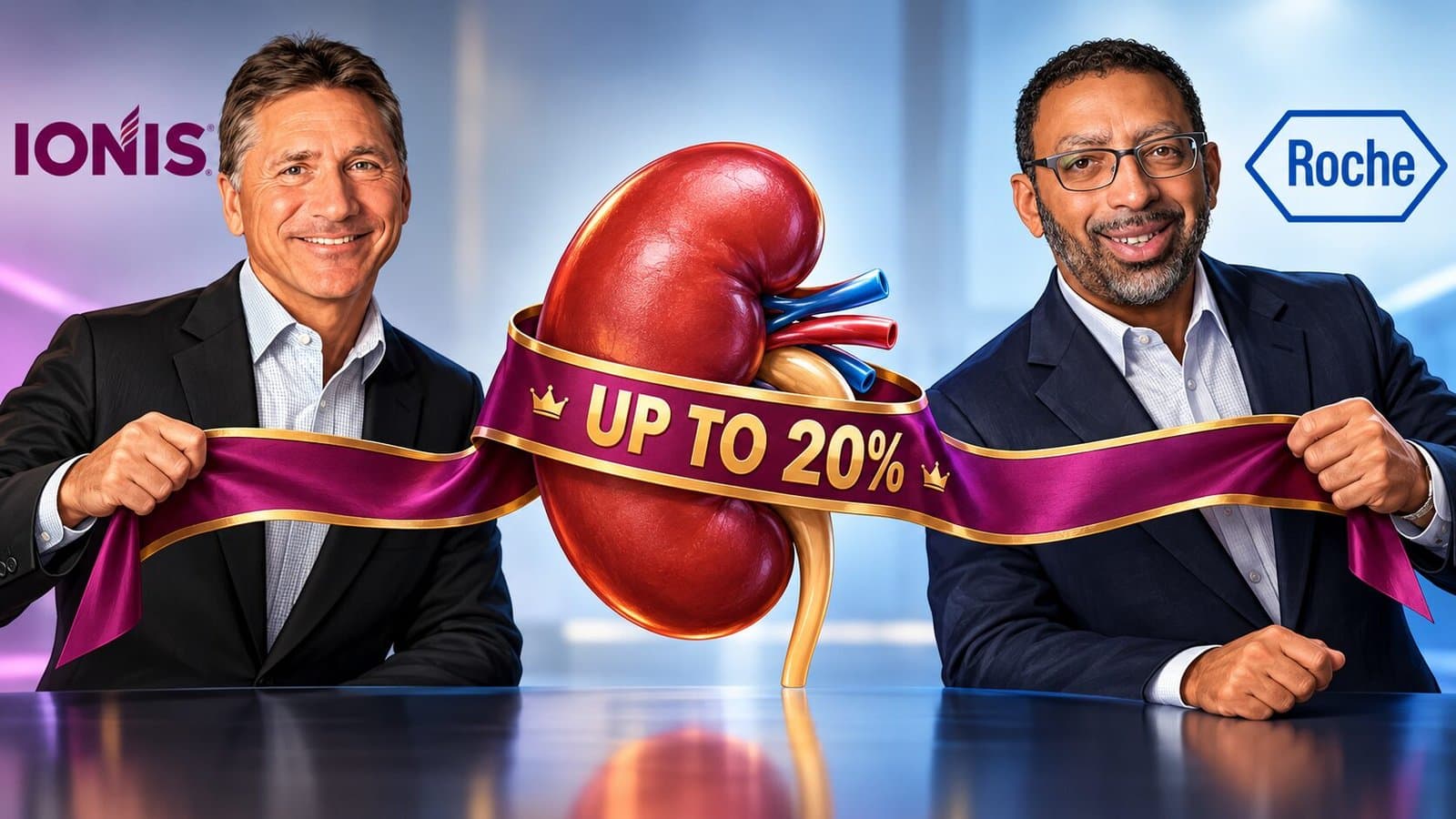

Ionis Pharmaceuticals (NASDAQ: IONS) is now in line for up to $400 million in milestone payments and royalties of up to 20% on a kidney drug Roche is preparing to advance toward regulatory approval.
That payday moved closer on September 23, 2026, when Roche and Ionis said sefaxersen met its main goal in a Phase 3 trial in IgA nephropathy. The result came at a planned interim analysis, the companies announced.
The stock slipped anyway. Partner-run trial results have been important catalysts for Ionis shares this year, with two earlier 2026 readouts going against the company. The market does not yet know the size of the effect. The full numbers will come at an upcoming medical meeting and go to health regulators.
Sefaxersen cut proteinuria at 37 weeks in a 459-patient trial
The IMAgINATION study showed “statistically significant and clinically meaningful” reductions in proteinuria against placebo at 37 weeks, Ionis said in its release. Proteinuria, protein leaking into the urine, marks kidney damage. The trial tracked it through the 24-hour urine protein-to-creatinine ratio.
The study enrolled 459 adults at high risk of disease progression and randomized them one-to-one to monthly injections or placebo, the trial registry shows.
No new safety signals emerged. The trial stays blinded until week 105, when it will test kidney function through estimated glomerular filtration rate (eGFR), the companies said.

“These findings are an important advance for the field and further demonstrate the broad potential of our RNA-targeted technology to make a meaningful difference for people living with serious diseases.” — Brett P. Monia, chief executive officer, Ionis Pharmaceuticals, in the company’s September 23 release
Monia pitched the result as evidence for the Ionis RNA platform as a whole, not just for one kidney drug.
More on pharma stocks:
Novo Nordisk stock falls as 2026 plan targets peer growth
Ionis has received upfront and license payments and remains eligible for up to $400 million more
Roche paid $75 million upfront in October 2018 for an option on the drug, then called IONIS-FB-LRx, Ionis disclosed at the time.
Ionis announced a $55 million payment from Roche in July 2022 for licensing IONIS-FB-LRx for IgA nephropathy and achieving a development milestone in the separate GOLDEN study for geographic atrophy, Ionis confirmed.
Ionis remains due up to $400 million in milestone payments tied to sefaxersen, BioPharma Dive reported. The royalty is the larger prize. The 2018 agreement set tiered royalties from the high teens to 20% on net sales, Ionis said when the deal was signed.
Key figures behind Ionis’s sefaxersen economics
- Payments from Roche: $75 million upfront in October 2018 and $55 million announced in July 2022 for the IgAN license and a GOLDEN development milestone (Ionis)
- Milestones still available: up to $400 million as of September 23, 2026 (BioPharma Dive)
- Royalty rate: tiered, high teens to 20% of net sales under the 2018 terms (Ionis)
- Analyst sales forecast: €400 million ($457 million) by 2030, set before the readout (Fierce Biotech)
- Roche peak sales estimate: €1 billion to €2 billion a year (Fierce Biotech)
Roche’s peak estimate implies up to €400 million a year for Ionis
Most analyst models carried sefaxersen at €400 million ($457 million) in sales by 2030, Roche investor relations head Bruno Eschli said in March, Fierce Biotech reported.
Roche’s own peak estimate runs higher, at €1 billion to €2 billion. Both figures predate the Phase 3 readout. Applying the 2018 range, with 17% as the floor of the high-teens tier, sets the scale.
At €400 million in sales, Ionis would collect about €68 million to €80 million a year. At Roche’s €2 billion ceiling, the same arithmetic reaches €340 million to €400 million.
Those numbers are illustrative. Ionis has not publicly disclosed the sales thresholds that decide which tier applies.
Roche funds the launch and is aiming for a faster approval
Under the 2022 license, Roche handles the Phase 3 program and all later development, regulatory and commercial work, the Ionis announcement stated.
That split leaves Roche responsible for the development, regulatory and commercialization costs while allowing Ionis to participate through milestone payments and royalties if sefaxersen reaches the market.
The wait for that income may also shorten. Jay Garg, Roche’s global head of nephrology, rheumatology and cardiovascular, set out that path at a March investor event. Week 37 proteinuria data would “hopefully lead to accelerated approval,” he said, the Fierce Biotech report added.
Six approved rivals and a Vertex decision crowd the launch window
The bear case starts with the missing effect size, which leaves no basis yet for comparing sefaxersen with drugs already on the market.
Vera Therapeutics’ Trutakna cut proteinuria by 42% against placebo at 36 weeks, Vera reported when the FDA cleared it in July 2026. It became the sixth approved drug for the disease, Fierce Pharma noted.
Vertex’s povetacicept posted a 49.8% placebo-adjusted reduction at week 36 and faces an FDA decision by November 30, 2026, Vertex disclosed.
Novartis’ Fabhalta already blocks complement factor B, the same protein sefaxersen suppresses, though as a twice-daily pill rather than a monthly shot, BioPharma Dive explained.

Roche’s own release calls proteinuria a surrogate
“These interim phase III results show the clinical potential of sefaxersen to modify a key surrogate endpoint of kidney function in people with IgA nephropathy.” — Levi Garraway, MD, PhD, chief medical officer and head of global product development, Roche, in the company’s September 23 release
Garraway’s wording flags the open question. The week 105 eGFR assessment will provide a longer-term measure of whether the treatment preserves kidney function.
William Blair analyst Myles Minter called the disease a “large but competitive market” and rated the monthly autoinjector “relatively competitive,” BioPharma Dive reported. He added that the full data presentation will decide how sefaxersen compares on benefit and safety.
Ionis stock sits near half its February record
Ionis shares rose 2.71% to $46.99 in premarket trading on September 23, Benzinga reported.
The gain did not hold. The stock closed at $43.93 on September 23, down 3.98% from its September 22 close, according to StockAnalysis.
That sits about 49% below the record close of $86.50 set on February 6, 2026, MacroTrends data shows. Partner-trial results were among the developments weighing on Ionis shares this year.
Novartis’ pelacarsen missed its main goal in a heart outcomes study on September 4, 2026, Ionis confirmed.
Ionis shares fell 12% after hours on that result, according to a Reuters report cited by Insider Monkey. A July 2026 Phase 3 heart study of eplontersen also missed its primary efficacy endpoint, BioPharma Dive reported.
What the sefaxersen result means for Ionis shareholders
Ionis now holds a late-stage royalty asset whose launch costs sit with Roche, with up to $400 million in milestones still open. The size of the proteinuria cut, and whether it holds up in kidney function, remain unsettled.
Two checkpoints will test it. The first is the full IMAgINATION presentation, which will set sefaxersen against Trutakna’s 42% and povetacicept’s 49.8%. The second is Vertex’s FDA decision due by November 30, 2026.