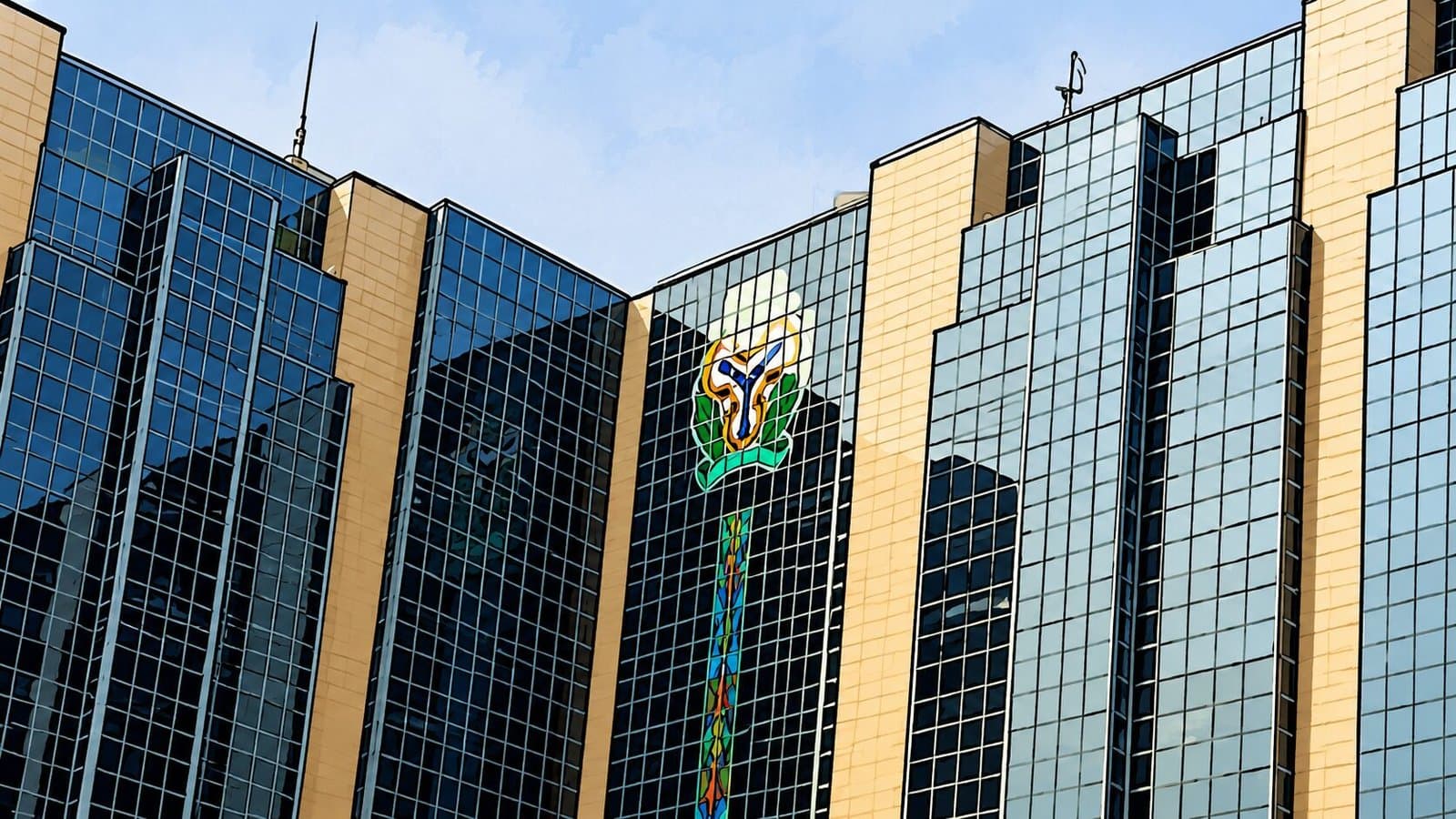

Banks placed N7.33 trillion with the Central Bank of Nigeria (CBN) on Wednesday, the highest level in seven months.
The rise came just a day after the CBN cut its benchmark interest rate by 350 basis points to 23%.
The money sits in the Standing Deposit Facility (SDF), a window where banks leave spare cash with the central bank and earn interest, BusinessDay reported.
Deposits rise 62.75% in one day
CBN data showed that SDF holdings rose 62.75% in a single trading day. They topped N4.51 trillion as of Tuesday.
The last time deposits came close to this level was March 30, 2026, when banks held N7.09 trillion at the time.
Ayokunle Olubunmi, head of Financial Institutions Ratings at Agusto & Co., said that the increase shows the high liquidity in the financial market.
Large SDF balances usually mean banks have more cash than they can lend or invest at good returns, so they leave it with the central bank.
Milestone comes after monetary policy change
CBN Governor Olayemi Cardoso announced the decision on Tuesday in Abuja after the 307th meeting of the Monetary Policy Committee (MPC). The Monetary Policy Rate (MPR) fell from 26.5 percent to 23 percent.
The committee also narrowed the corridor around the MPR to +50/-300 basis points, from +50/-450 basis points before.
Razia Khan of Standard Chartered Bank said the Standing Lending Facility rate is now 23.5%, down from 27%. The SDF rate, which is the floor for short-term rates, is now 20%, down from 22%.
The Cash Reserve Requirement (CRR) did not change. It stayed at 45% for commercial banks, 16% for merchant banks, and 75% for non-TSA public sector deposits.
The cut is the largest since December 2006, according to Tekedia. At that time, Governor Charles Soludo cut the rate by 400 basis points, from 14% to 10%.
The new rate is the lowest since February 2024 and is the second cut this year. The CBN held the rate at 26.5% in July.
Why the CBN made this change
Cardoso said the official rate had lost touch with the market.
“There is a clear disconnect between CBN’s Monetary Policy Rate (MPR) and effective market rates,” he said, according to Tekedia. He explained that the interbank rate was around 22%, the same as the SDF rate.

Banks had begun to use the SDF rate to price their deals, Nairametrics reported. The CBN said this weakened the effect of its decisions on the economy.
In the words of the bank, “the MPR became the de jure rate with the SDF rate as the de facto.”
The CBN said the move is not a switch to looser policy. Cardoso called it “an important operational realignment” and said it does not change the policy stance.
The bank aims to improve how its decisions reach the market and support its move to inflation targeting, TheSun reported.
Nairametrics added that the CBN puts the real policy rate at 11.11% for August, which it sees as a buffer for inflation expectations.
The bank also pointed to better economic data. Headline inflation fell to 15.39% in August from 15.43% in July, the third straight monthly decline. Real GDP grew 4.43% in the second quarter, up from 3.89% in the first.
More CBN policy coverage:
- CBN survey reveals who bears Nigeria’s inflation burden
- CBN reveals $109.9bn FX surge as private flows dominate
- Loan app interest rate caps in Nigeria: what CBN and FCCPC rules say
Treasury bills adjust quickly
The rate cut has also moved the Treasury bills market, BusinessDay reported. At Wednesday’s auction, investors bid N4.09 trillion for the 364-day bill, over ten times the N400 billion on offer.
The bill cleared at 15.89%, down from 16.62% at the previous auction. The CBN allotted N447.07 billion.
Demand was weaker for shorter bills. The 91-day bill cleared at 15.50% and the 182-day bill at 15.80%. Both drew fewer bids than the amount offered.
Adeniyi Adejumobi, an assistant fixed-income fund manager at FCMB, said markets expected lower yields but were surprised by the size of the cut. Victor Ogunfijo of CardinalStone also said the cut signals the start of an easing cycle and that yields should move lower.
Analysts at Coronation Merchant Bank expect the 364-day rate to fall to 15.00 to 15.50 percent. They said the lower SDF rate reduces the loss banks face when they buy one-year bills instead of leaving cash at the CBN.
They also named Open Market Operations (OMO) as the key thing to watch. The CBN sold about N4.40 trillion of OMO paper in one week in September at an effective yield of 19.96 percent.
If OMO yields stay near 20% while bill yields keep falling, Coronation said, the CBN is “not yet easing through its market operations.”
Key numbers to note at a glance
- SDF deposits rose to N7.33 trillion on Wednesday from N4.51 trillion the day before
- The MPR now stands at 23%, down from 26.5%
- The SDF rate is now 20%, and the Standing Lending Facility rate is 23.5%
- The CRR for commercial banks stays at 45%
- Headline inflation was 15.39% in August 2026
- Real GDP grew 4.43% in the second quarter
- Gross external reserves reached $55.25 billion on September 18, the highest in 18 years
- The 364-day Treasury bill cleared at 15.89%
Naira holds steady, reserves stay strong
The naira did not react to the changes. The dollar was quoted at N1,385 in the parallel market on Wednesday, down from N1,390 before BusinessDay reported.
In the official market, the naira gained 0.15% to close at N1,327.78 on Tuesday. Turnover at the official window rose 107% to $694.58 million.
Cardoso said gross reserves stood at $55.25 billion on September 18, enough to pay for about 11.3 months of imports.
BusinessDay reported that reserves were $54.79 billion on September 21, up 30.36% from a year earlier.
Analysts warn of risks
Some analysts see negative effects on the economy due to the size of the cut.
Bismarck Rewane, managing director of Financial Derivatives Company, called it a “jumbo cut” and told Channels Television it is “a big risk,” Tekedia reported.

He said the return for investors fell from 11.1% to 7.61%. He also warned that savers could move into dollars or crypto if returns on naira assets fall further.
Muda Yusuf, chief executive of the Centre for the Promotion of Private Enterprise (CPPE), said the gap between Nigeria’s policy path and tighter policy in major economies could cause investors to pull money out.
Business groups want borrowers to gain. NECA and the CPPE said lower lending rates are not automatic and depend on how banks adjust.
The next MPC meeting is scheduled for November 23 and 24, 2026, as markets look forward to the next guidance.