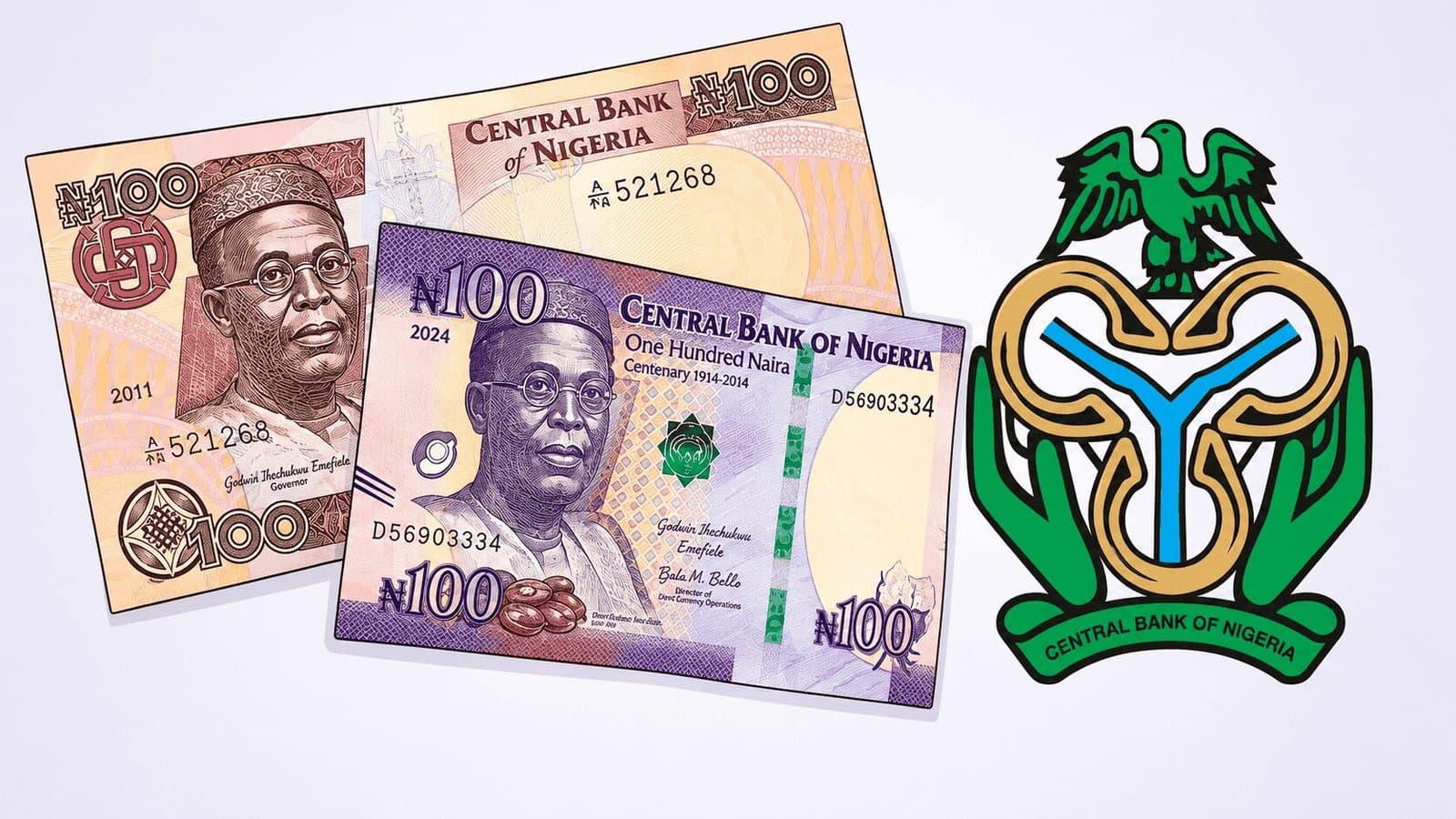

If you hand a trader a standard ₦100 banknote in parts of Nigeria, there is a growing chance they will push it back at you.
That scenario has become widespread enough for the Central Bank of Nigeria to respond with a firm public statement and an enforcement warning.
The apex bank released a circular on July 8, 2026, addressing what it described as growing confusion about the note’s legal tender status.
Some businesses and individual Nigerians have reportedly been turning away the standard ₦100 in everyday transactions over doubts about its continued validity.
The confusion ties back to a more-than-a-decade-old policy decision that introduced a second version of the ₦100 banknote into simultaneous nationwide circulation.
Both notes share the same denomination and face value, separated only by their visual design and the commemorative purpose behind one of them.
CBN invokes the law against ₦100 banknote rejection
The circular, signed by Hakama Sidi-Ali, the CBN’s Acting Director of Corporate Communications, addressed the matter in direct and unambiguous language.

Both the standard ₦100 and the commemorative ₦100 banknotes remain legal tender and must be accepted for all transactions nationwide, the CBN stated.
The statement became necessary after the CBN received reports that some individuals and businesses had been discriminating between the two versions of the note.
The commemorative ₦100 was unveiled on November 12, 2014, to celebrate Nigeria’s centenary, marking 100 years since the country’s amalgamation in 1914.
It entered circulation on December 19, 2014, as a special edition and was never designed to replace the standard version already in use.
“The Bank will not hesitate to apply appropriate enforcement measures against any person or entity found to be in breach,” the CBN warned.
Section 20 of the CBN Act grounds the enforcement threat
The enforcement warning rests on Section 20(5) of the CBN Act, 2007, which makes it an offense for any person to refuse the naira.
Under Section 20(1), all currency notes issued by the central bank serve as legal tender at their face value for payment of any amount.
That provision has served as the legal cornerstone of every CBN currency intervention since the naira redesign controversy began in late 2022.
The CBN directed deposit money banks to continue dispensing ₦100 banknotes to customers through all approved payment channels without any form of discrimination.
Any individual, business, or financial institution found violating the provision could face penalties under the broader enforcement framework of the CBN Act.
For you as a consumer or business owner, any ₦100 note from the CBN carries full legal weight regardless of its design version.
Nigeria’s recurring struggle with currency misinformation
This is not the first time the apex bank has been forced to publicly reassure Nigerians about the validity of its own banknotes.
Currency misinformation has become a recurring challenge for the CBN, with confusion surfacing several times since the disruptive 2022 naira redesign policy.
Key CBN currency interventions since 2023:
- In November 2023, the CBN confirmed all old and redesigned naira notes remained legal tender under Section 20(5) of the CBN Act, the CBN confirmed in a November 8, 2023, press release.
- In December 2024, the bank reiterated that old ₦1,000, ₦500, and ₦200 notes would circulate indefinitely under a November 2023 Supreme Court ruling, the CBN reiterated in a December 2024 statement.
- In April 2025, the CBN dismissed a viral circular on social media that falsely claimed new ₦5,000 and ₦10,000 denominations had been introduced, Nairametrics reported.
The original 2022 redesign policy under former Governor Godwin Emefiele imposed strict deadlines for demonetizing higher-denomination notes across the country.
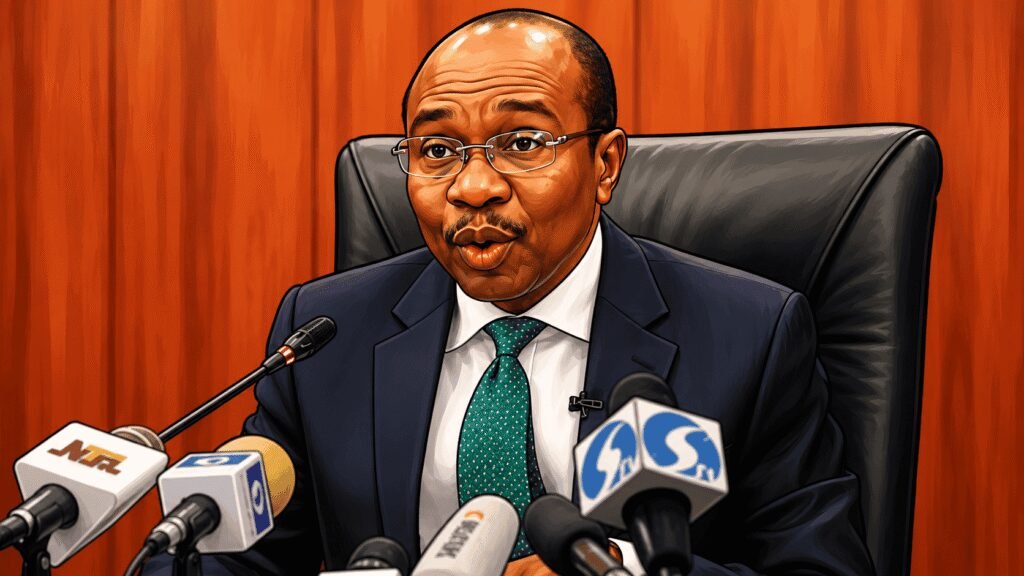
That decision triggered a severe nationwide currency crisis in early 2023 and left lasting confusion about which naira banknotes remained valid.
The Supreme Court ruled on November 29, 2023, that all old and redesigned naira notes could circulate indefinitely without any expiration deadline.
What the ₦100 rejection signals about naira confidence
The deeper concern behind the CBN’s warning is what selective banknote rejection reveals about public trust in the national currency as a whole.
When traders begin discriminating between two versions of the same denomination, it suggests underlying confidence in the monetary system has started to weaken.
That concern stands in contrast to the broader macroeconomic picture, which has shown notable improvement through the first half of this year.
“Nigeria enters the second half of 2026 with its strongest macroeconomic fundamentals in several years,” Dr. Muda Yusuf, CEO of CPPE, stated.

Yusuf noted that exchange-rate stability, stronger reserves, and moderating inflation have reduced macroeconomic vulnerabilities and strengthened investor confidence, THISDAY reported.
Nigeria’s macroeconomic position entering H2 2026:
The naira traded within a narrow band of ₦1,340 to ₦1,430 per dollar in the official market during the first quarter, Business Post reported.
External reserves climbed above $50 billion in the same period, while inflation fell from over 24% in early 2025 to approximately 15% by February 2026, CPPE’s Q1 2026 economic review indicated.
The CBN urged all Nigerians to continue accepting every banknote the central bank has officially issued and to report refusals through its official channels.