
The Central Bank of Nigeria (CBN) cut its Monetary Policy Rate to 23% from 26.5% on 22 September, a day after FTSE Russell readmitted Nigeria to its frontier index. All seven economists polled by Reuters had expected a CBN rate hold.
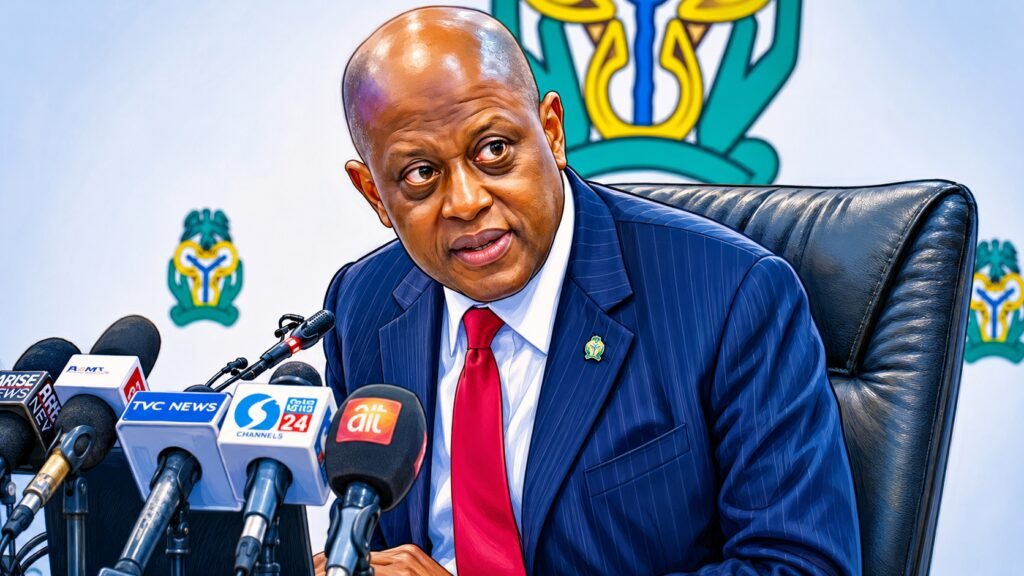
Governor Olayemi Cardoso described the 350 basis point move as a reset rather than a shift in policy. The committee noted that market rates had diverged from its benchmark rate, making policy less effective, he said.
The bill market had already moved. That matters for the foreign money Nigeria hopes its FTSE Russell return will help attract.
The CBN rate decision in full
The Monetary Policy Committee reset the rate to 23% and recalibrated the standing facilities corridor to +50/-300 basis points around it, from +50/-450, the CBN said in a post on X. It kept the cash reserve requirement at 45% for deposit money banks, 16% for merchant banks and 75% for non-TSA public sector deposits.
The Monetary Policy Committee (MPC) at its 307th meeting voted on policy parameters as follows:
- Monetary Policy Rate (MPR): Reset to 23%.
- Standing Facilities Corridor: Recalibrated at +50 / -300 basis points around the MPR.
- Cash Reserve Requirement(CRR): Retained at… pic.twitter.com/015JI2gyhy — Central Bank of Nigeria (@cenbank) September 22, 2026
The corridor change aims to discourage banks from parking idle funds with the CBN, Premium Times reported. The rate banks earn on those deposits falls to 20%, from 22% under the old corridor.
Cardoso framed the decision as technical rather than a new easing cycle.
“An operational reset to enhance the effectiveness of monetary policy and support the transition to an inflation targeting framework.” — Olayemi Cardoso, Governor, Central Bank of Nigeria, at the post-MPC press conference, via Reuters
The CBN did not disclose how members voted. Individual members’ statements are usually published weeks after each meeting, as they were for the July meeting.
The CBN rate had drifted away from the market
The gap Cardoso described shows up in the CBN’s own data. In August, the overnight interbank call rate was 22%, exactly the floor of the old corridor, according to the CBN’s money market indicators. Banks’ prime lending rate was 17.86%, below the policy rate itself.
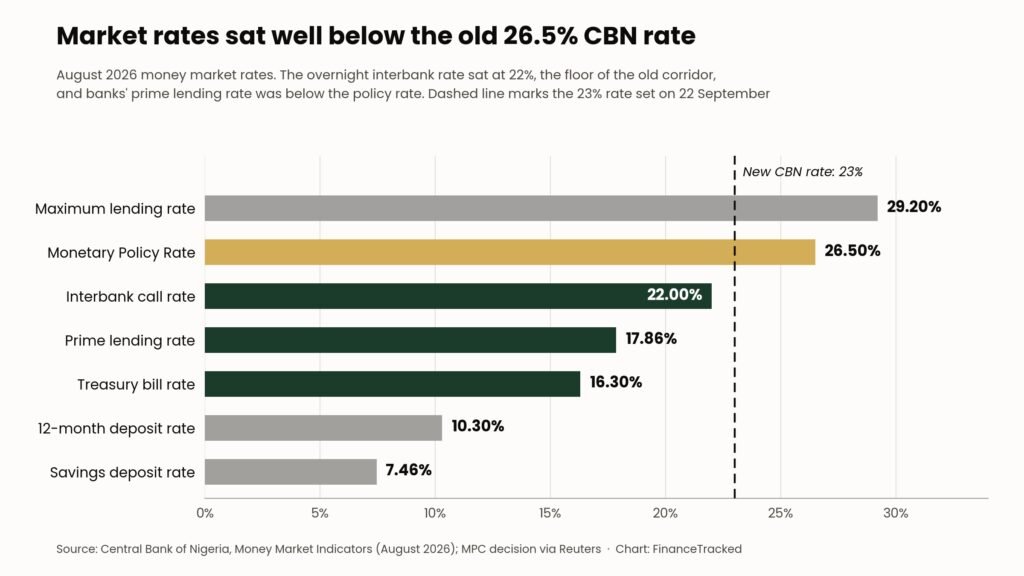
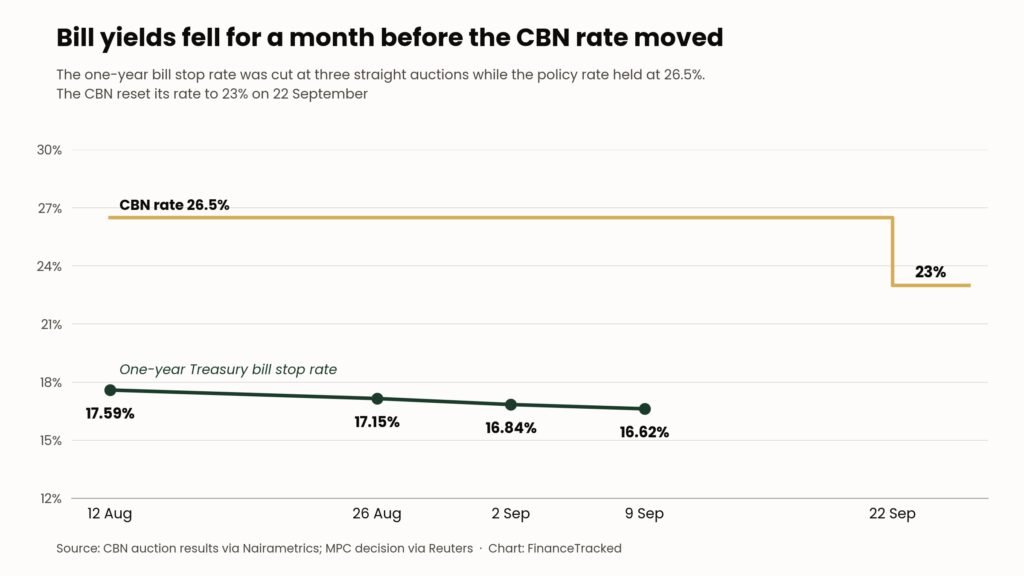
Bill yields kept falling into September. The one-year Treasury bill rate was cut at three straight auctions, from 17.59% on 12 August to 16.62% on 9 September, Nairametrics reported.
The reset moves the CBN rate toward where money was already trading. The new corridor floor of 20% sits below the 22% where overnight money had settled.
Key numbers behind the CBN rate reset
- Monetary Policy Rate: 23%, from 26.5% (CBN)
- Standing facilities corridor: +50/-300 basis points, from +50/-450 (CBN)
- Interbank call rate: 22% in August, the floor of the old corridor (CBN)
- One-year Treasury bill rate: 16.62% on 9 September, from 17.59% on 12 August (Nairametrics)
- August headline inflation: 15.39%, core 13.29% (NBS)
- Economists expecting a hold: 7 of 7 polled (Reuters)
The question the FTSE return left open
When FTSE Russell readmitted Nigeria on 21 September, FinanceTracked’s coverage concluded that foreign participation would depend on how well Nigeria’s FX stability and settlement infrastructure hold up.
The settlement test had already been passed. FTSE Russell found no material settlement, operational or funding issues after Nigeria moved to T+1 settlement in June, NGX Group said.
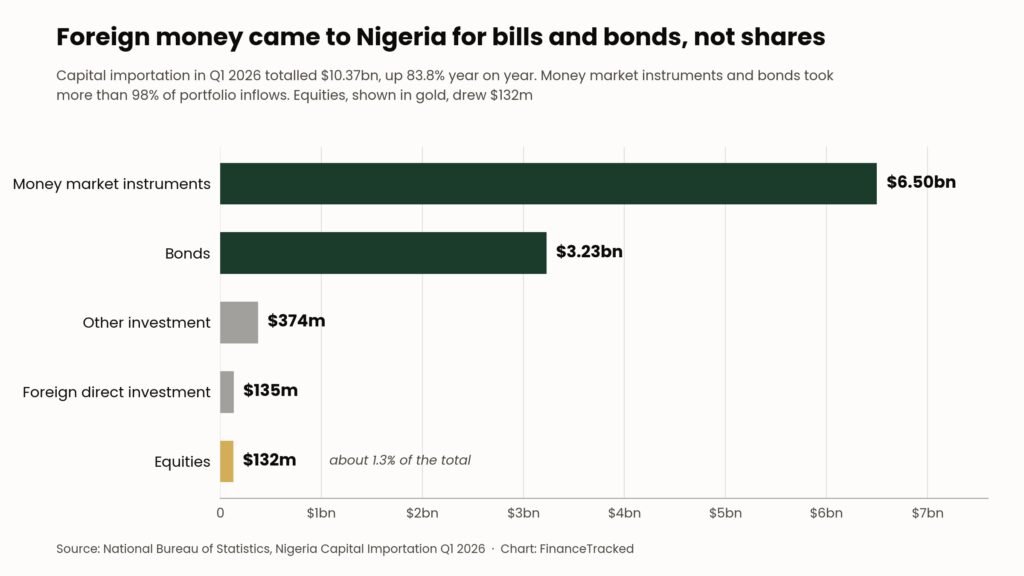
The harder obstacle was return. Foreign capital did arrive: capital importation reached $10.37 billion in the first quarter, according to the National Bureau of Statistics.
Money market instruments took $6.50 billion and bonds $3.23 billion, Premium Times reported. Equities drew $131.81 million.
Foreign investors traded ₦1.29 trillion of NGX shares in the first seven months of 2026, according to NGX’s July report, as reported by Leadership. The figure was barely more than the ₦1.28 trillion traded in the same period of 2025, per NGX Group.
Their share of trading fell to 10.79%, from 22% across 2025, as domestic activity surged, NGX data show.
What the reset changes for foreign money
The answer to that question now runs through yields, not plumbing. A foreign fund comparing Nigerian shares with Nigerian bills cares about what bills actually pay, not the headline CBN rate.
By the CBN’s own account, market rates had already moved away from the 26.5% CBN rate. So the reset brings the benchmark toward yields that had been falling for weeks, rather than suddenly cutting what foreign investors earn.
The equity case strengthens only if bill yields keep falling. The first test is the CBN’s ₦500 billion Treasury bill auction on 23 September, the last of the third quarter, according to Nairametrics.
More on the NGX this month:
Dangote IPO priced at ₦525 as analysts see ₦176 to ₦697
What could stall further CBN rate cuts
Rising fuel costs are the nearest risk. Domestic fuel prices have surged to record highs, which could stall the recent slowdown in inflation, Reuters reported.
Brent crude above $100 a barrel was already pressuring the outlook before the meeting, BusinessDay reported. A CFG Advisory review of MPC meetings, cited by BusinessDay, also flagged pre-2027 election spending as a risk to disinflation.
The next MPC meeting is scheduled for 23 and 24 November, according to the CBN’s calendar.
More on planning your own finances:
How much you really need to retire comfortably
What the CBN rate cut means for NGX investors
The CBN rate fell to 23% from 26.5%, a move Reuters’ polled economists did not expect, and the CBN framed it as a reset to realign policy with market rates. Overnight money was already trading at 22% and the one-year bill at 16.62%, both far below the old benchmark. For foreign investors weighing Nigerian shares, the rate that matters is what bills pay.
Settlement passed FTSE Russell’s test, but equities drew only $131.81 million of $10.37 billion in first-quarter inflows. The 23 September bill auction and November’s MPC meeting are the next signals.