
The Dangote IPO, Africa’s largest share sale, closes on 13 October. Four research houses and a newspaper editorial board have published what they think a Dangote Refinery share is worth, and their estimates run from ₦176 to about ₦697. The offer price is ₦525.
The Dangote IPO spread is not really a disagreement about the refinery. Refining margin is the biggest operating swing factor, but the gap also reflects different discount rates, terminal assumptions and valuation-method weights.
The Dangote IPO in the prospectus’s own numbers
Dangote Petroleum Refinery and Petrochemicals is offering 4.1 billion ordinary shares at ₦525, targeting ₦2.15 trillion gross. After costs of ₦41.49 billion, or 1.93%, net proceeds are about ₦2.111 trillion, all of it allocated to expansion capital expenditure, according to the prospectus.
The Dangote IPO opened on 14 September and closes on 13 October, with listing expected in late November. Market capitalization at listing would be ₦65.22 trillion across about 124.2 billion shares, or roughly $47.8 billion at the prospectus reference rate of ₦1,364.
The new shares represent 3.30% of the enlarged company, falling to about 2.46% once an anchor commitment of up to 1.04 billion shares is allotted, Proshare calculates. Aliko Dangote’s beneficial interest moves from 87.27% to about 84.39%, and NNPC’s from 6.815% to about 6.59%.
The prospectus gives the offer’s purpose as broadening public ownership and supporting long-term growth. Dangote put it more directly on the trading floor.
“The primary purpose of making this offer is to democratise wealth creation. If it is the question of raising money, I think we have raised more than what we need as a group to execute all our projects.” — Aliko Dangote, president, Dangote Group, at the Facts Behind the Offer presentation, via Channels Television

He told the ceremony that the group had planned to raise $2.5 billion in total, $1 billion through a private placement and $1.5 billion through the Dangote IPO. The placement drew about $2.5 billion of applications against the $1 billion sought, and roughly $1.2 billion was returned to investors after allocation, Channels reported.
Seven estimates, and why they are hard to line up
Between 7 and 17 September, GTI Research, CardinalStone Research, Chapel Hill Denham, Renaissance Capital and BusinessDay’s editorial board each published a view on what the refinery is worth.
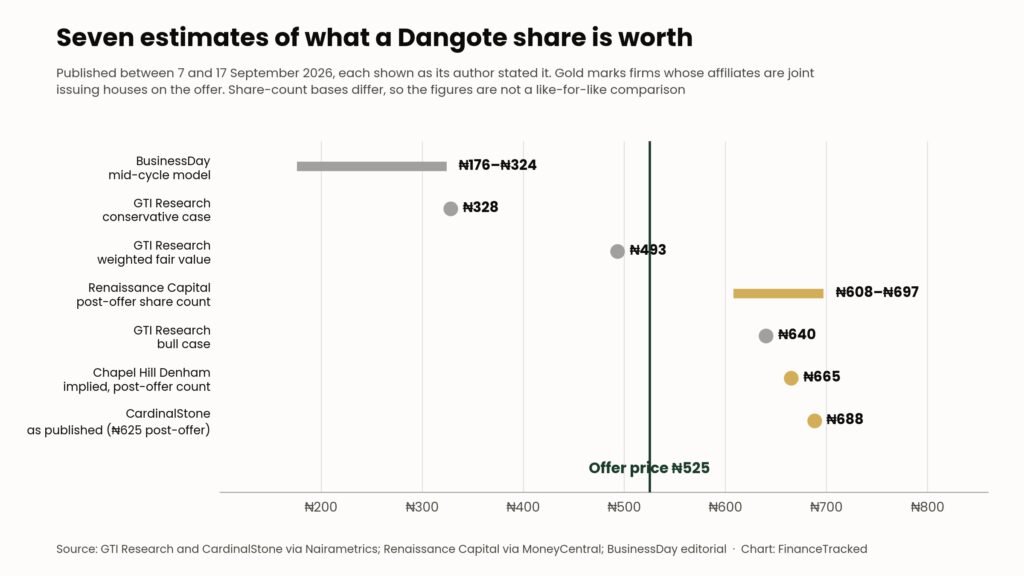
GTI Research puts probability-weighted fair value at ₦493, with a conservative case of ₦328 and a bull case of ₦640. Its 22-page report, led by analyst Abiodun Ogunniyi and published on 16 September, calls the Dangote IPO “FULLY VALUED” and refers to “that unearned premium,” Nairametrics reported.
CardinalStone Research carries a 12-month target of ₦688.09, based on the share count available when its valuation was prepared. Its ₦77.7 trillion equity value equates to about ₦625 across the enlarged post-offer count, per Nairametrics.
Chapel Hill Denham puts fair equity value at $62.53 billion, or ₦82.62 trillion, which implies roughly ₦665 post-offer.
Renaissance Capital Africa values post-IPO equity at $57.11 billion to $65.44 billion, equivalent to about ₦608 to ₦697 on a post-offer basis, MoneyCentral reported. That puts its high end 32% above the offer.
BusinessDay’s editorial board modeled mid-cycle conditions and reached ₦176 to ₦324.
The comparison is not like-for-like
Not every house states the share count behind its figure. CardinalStone’s target uses the count available when it was prepared. Renaissance states a post-offer basis explicitly. Chapel Hill and BusinessDay publish company-level or modeled values.
The three bullish institutional estimates also overlap substantially. Renaissance’s $57.11 billion to $65.44 billion range contains both CardinalStone’s $58.8 billion and Chapel Hill’s $62.53 billion.
Anyone comparing headline numbers should check which denominator each one uses.
Three of the five are connected to the offer
Chapel Hill Denham Advisory, CardinalStone Partners and Renaissance Securities (Nigeria) are all named as joint issuing houses on the Dangote IPO, in a syndicate of more than 20 led by Vetiva Advisory Services.
Their participation does not invalidate the valuations. Research divisions typically operate behind information barriers from advisory teams, and each firm has published its methodology.
Two disclosures are worth reading alongside the numbers, both recorded by Proshare. CardinalStone discloses that the company approved its report and that the responsible analyst holds positions in and is a board member, officer or director of the company. Renaissance states that its communication is not independent investment research.
It does mean three of the five sources come from groups involved in marketing and placing the Dangote IPO. Readers can weigh that for themselves.
What terminal value means, and why it matters here
A discounted cash flow model values the cash a company is expected to generate over an explicit forecast period, then adds a single figure for everything after it. That figure is the terminal value.
The further out it sits, the more assumptions it carries, because nobody can forecast 2035 with the confidence they can forecast next year.
Both bullish houses value it below ₦525 on peer multiples
Chapel Hill Denham’s discounted cash flow returns $79.2 billion, of which discounted terminal value alone accounts for $69.7 billion, roughly 88%. The explicit forecast period and other adjustments make up the remaining 12%, according to Ecofin Agency, which examined the research notes.
Chapel Hill’s own comparable-company analysis produces a different answer: $42.9 billion on EV/EBITDA and $48.9 billion on P/E, averaging $45.9 billion, per the same analysis. The Dangote IPO values the company at about $47.8 billion at the prospectus rate.
CardinalStone shows the same pattern. Its relative methods return approximately ₦320 a share before being weighted at 15% each against a 70% weighting to its discounted cash flow, per Proshare.
So the two most bullish published valuations both sit at or below the offer price on trading comparables. The upside in each comes from intrinsic valuation rather than what peers trade at.
The bear case is a mid-cycle margin
BusinessDay’s editorial board applied refining margins of $15 to $18 a barrel, a 6 to 7 times exit multiple and a 12% to 15% discount rate. That produced ₦176 to ₦324, and its conclusion was that ₦525 can be justified only if earnings stay materially above a normalized industry cycle.
It also offered a replacement-cost check. The 700,000 bpd refinery cost about $19 billion to build, roughly $27,143 per barrel of daily capacity. At the Dangote IPO price, the implied valuation is about $70,308 per barrel per day, or 2.6 times construction cost, BusinessDay wrote.
The company forecasts a lower margin than its analysts
Every valuation in the chart above rests partly on one number: how much the refinery earns on each barrel it processes. That number has moved sharply.
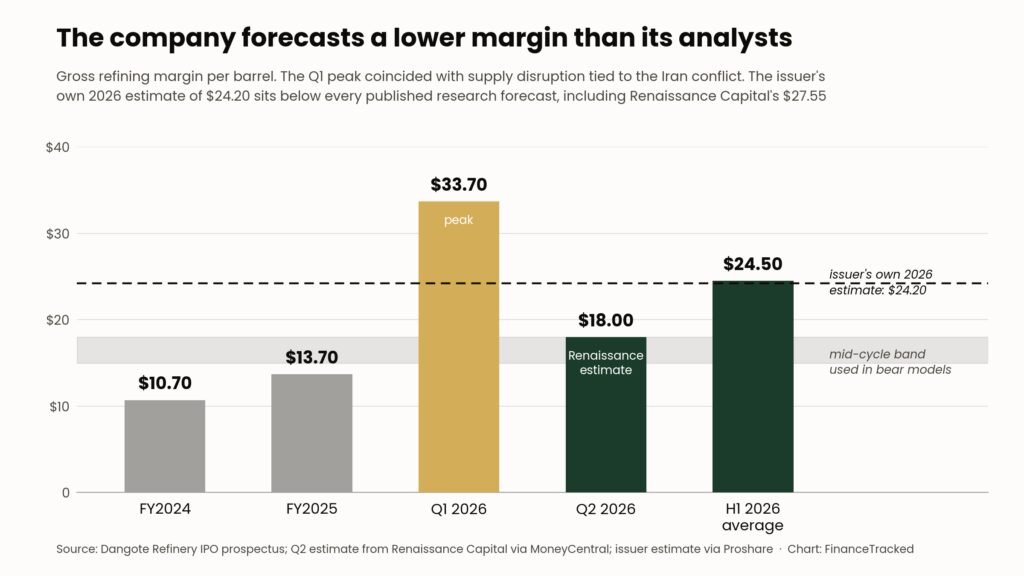
Gross refining margin ran at $10.70 a barrel in 2024 and $13.70 in 2025, then reached $33.70 in the first quarter of 2026 before easing to a $24.50 half-year average.
Renaissance Capital estimates the margin fell to about $18 in the second quarter. Its full-year forecast of $27.55 would require roughly $29 to $30 a barrel in the second half, per MoneyCentral.
Here is the detail that most coverage has missed. The issuer’s own 2026 margin estimate is about $24.20 a barrel, below every published research forecast, Proshare notes. The company is more conservative than the analysts valuing it.
Dangote acknowledged at the signing ceremony that Middle East and Ukraine factors contributed to profits, while arguing the long-term case stands without them, Reuters reported. Proshare estimates 20% to 28% of Russian primary refining capacity was offline at the mid-2026 peak.
The US Energy Information Administration’s September outlook puts Brent at an average of $91 a barrel in 2026 and $74 in 2027, with most Middle East production returning to near pre-conflict levels by the second quarter of 2027.
More on how analysts see the stock after listing:
Dangote Refinery share price prediction: analyst views and post-IPO outlook
Against global refiners, the price is demanding
At ₦525, net debt of $1.40 billion gives an enterprise value near $49.2 billion, about 8.6 to 9.1 times forecast 2026 EBITDA, per Proshare.
Peer benchmarks range from a 5.0 times median to a 7.7 times market-weighted average and a 9.5 times adjusted emerging-market average, so the offer multiple carries a premium on most constructions. GTI’s own five-company peer set averages 4.79 times EV/EBITDA and 8.54 times earnings.
GTI’s answer to that is direct: none of those peers is about to double its capacity. It weighted growth-based methods at 70% of its final number and peer comparison at only 25%, which is why it landed at ₦493 rather than far below.
Three risks every Dangote IPO model has to price
The currency mismatch. GTI identifies roughly 56% of operational cash flows collected in naira against about 70% of crude inputs settled in foreign currency. Roughly 43.8% of first-half revenue was export-related and dollar-linked.
Crude supply. The prospectus says about 60% of 2025 feedstock was sourced in Nigeria, with access to NNPC volumes of up to 350,000 bpd subject to availability, and 36 grades processed by June. Chapel Hill Denham reports deliveries at about 43% of the contractual ceiling, leaving spot and imported barrels to carry the balance.
Execution. The prospectus settles the expansion at $14.3 billion targeted for 2029, correcting the $12.4 billion by 2028 in earlier circulation. Net proceeds fund about 11% of it. The prospectus sets out $4.8 billion of capital spending for the rest of 2026, $3.9 billion in 2027 and $3.1 billion in 2028, while the research models carry roughly $2.3 billion for all of 2026, Proshare notes. The prospectus is also internally inconsistent on timing, with its summary and capex table pointing to 2029 and the detailed use-of-proceeds section saying 2030.
And a fourth that arrives on a date. Free-zone tax exemption is not permanent. The prospectus indicates profits on domestic-market sales may become fully taxable from January 2028. The H1 effective tax rate was 13.6%. BusinessDay calculates that a move toward a 25% blended rate would cut annualized profit by about 13%. The Nigeria Tax Act 2025 sets the framework.
What the prospectus audits, and what it does not
Deloitte & Touche issued unqualified opinions on the financial statements for H1 2026 and every year back to 2021. Revenue of $13.91 billion and profit after tax of $1.82 billion for the half are audited figures.
Operational data is different. The prospectus states that throughput, utilization and product-yield figures are “based on the Issuer’s internal records and have not been independently verified”, that definitions may differ from those other refiners use, and that the data “should be interpreted with caution.”
The distinction matters when the bull case rests on sustained utilization.
Two disclosures worth understanding
From 1 January 2026, the issuer moved to a group centralized treasury model. Under it, first-half losses on third-party commodity derivatives were offset by a gain on an intercompany derivative with Dangote Industries Limited, so the reported margin is presented net of outcomes borne at group level. The external position lost about $410 million, per Chapel Hill’s research reported by Ecofin.
DIL is the controlling shareholder. Ecofin notes that nothing in the disclosure suggests an irregularity, and that profit would not simply have been $410 million lower without the arrangement, since tax treatment and the pricing of both legs also apply. Three questions are open: whether the derivative is symmetrical, at what price DIL takes the other side, and whether it continues once minority shareholders are on the register.
Separately, the prospectus discloses that NNPC is at once a 6.815% shareholder, crude supplier, product offtaker and the adverse party in the issuer’s import-license challenge, with its chief financial officer sitting on the board and the audit and risk committee.
More on planning your own finances:
How much you really need to retire comfortably
What the spread tells a Dangote IPO subscriber
Four research houses and a newspaper editorial board value a Dangote Refinery share between ₦176 and about ₦697, against a Dangote IPO price of ₦525. The difference is not about whether the refinery is a good asset. It turns on whether a half-year built on a $33.70 first-quarter margin repeats, and on how much weight a model gives to peer multiples.
Both bullish houses value the company at or below the offer on trading comparables, with the upside coming from intrinsic valuation. The issuer’s own 2026 margin estimate sits below every research forecast. Three of the five sources come from firms whose affiliates are placing the offer.
Two figures to watch before 13 October: the second-half refining margin, and whether crude delivery improves on the 43% of contractual ceiling reported for the period. The NGX listing itself would reshape the exchange.
Frequently asked questions (FAQs)
What is the Dangote IPO price?
₦525 a share, with a minimum subscription of 10 shares, or ₦5,250. The offer comprises 4.1 billion ordinary shares targeting ₦2.15 trillion gross, opened 14 September and closes 13 October 2026.
Why do analysts disagree so much on the valuation?
They use different methods, margin assumptions, discount rates and share-count bases. Models weighted toward discounted cash flow produce higher figures, since most of that value sits beyond the forecast period. Models weighted toward peer multiples produce lower ones. Chapel Hill Denham’s own DCF and peer analyses differ by more than $30 billion.
Is the Dangote IPO overpriced?
Any answer depends on assumptions no one can settle in advance. GTI Research calls it fully valued at ₦493. CardinalStone targets ₦688.09. BusinessDay’s mid-cycle model gives ₦176 to ₦324. This article reports those views and does not offer a recommendation.
What happens after the Dangote IPO closes?
Applications are collated by 27 October, the Basis of Allotment goes to the SEC on 5 November with no objection expected on 11 November, and CSCS accounts are credited roughly 15 business days after allotment. Trading is expected in late November.
Sources
Dangote Petroleum Refinery IPO prospectus via Stanbic IBTC, Proshare, Nairametrics, MoneyCentral, BusinessDay, Ecofin Agency, Channels Television, US Energy Information Administration, Reuters.