
For years, getting a bank loan in Nigeria meant pledging property, a vehicle logbook, or a guarantor with deep pockets. That barrier locked out millions of salary earners from formal credit, pushing many toward informal lenders charging rates that sometimes exceeded 500% annually.
The landscape has shifted, and today nearly every Tier-1 and Tier-2 commercial bank in Nigeria operates at least one unsecured digital loan product for retail customers. GTBank’s Quick Credit, Access Bank’s PayDay Loan, UBA’s Click Credit, and First Bank’s FirstAdvance are among the most established names in this space.
These products share a core structure: the bank uses your salary history, account activity, Bank Verification Number, and credit bureau records to decide your borrowing limit. You apply through a USSD code or mobile app, the money lands in minutes, and repayment is deducted automatically from your next salary.
That simplicity hides real complexity in pricing, tenor limits, and the way defaults follow you across every account linked to your BVN. This guide maps the full unsecured borrowing landscape from Nigerian commercial banks so you can compare products and understand the true cost.
How unsecured salary loans work at Nigerian commercial banks
The Central Bank of Nigeria retained the Monetary Policy Rate at 26.5% following its 305th meeting in May 2026, keeping commercial bank lending rates elevated, according to the CBN.
More on Nigerian banking:
- NGX Banking Index sheds 10% in brutal weekly selloff
- Nigerian banks split sharply on loan pricing in June
Unsecured salary loans replace property collateral with data-driven risk assessment and salary domiciliation. When your employer pays your salary into a specific bank, the lender gains visibility into your income pattern, spending behavior, and existing obligations.

Banks query Nigeria’s three licensed credit bureaus before approving any digital loan, and a negative record can block applications across the entire banking system. The CBN’s Global Standing Instruction further strengthens lenders by allowing automatic deductions from other accounts linked to the borrower’s BVN nationwide.
Interest ranges from roughly 2.95% monthly at the lowest end to 8% flat on short-tenor products, making it critical to compare effective annual rates rather than headline figures. Management fees, credit life insurance, and VAT on fees are typically deducted upfront from the disbursed amount, reducing the cash you actually receive.
Bank-by-bank breakdown of unsecured loan products in Nigeria
Each major Nigerian bank brands its unsecured loan product differently, and differences in pricing, eligibility, and tenor significantly affect total borrowing cost. The following sections summarize key products available from six of Nigeria’s largest commercial banks as of mid-2026.
More on loans:
Loan apps in Nigeria: complete 2026 guide to borrowing, regulation, and safety
GTBank Quick Credit: lowest monthly rate among Tier-1 banks
GTBank’s Quick Credit offers borrowing limits from ₦5,000 up to ₦5 million for salary earners, with self-employed customers accessing up to ₦500,000 through the same product, according to GTBank.
The monthly interest rate sits at 2.95%, translating to roughly 35.4% per annum, positioning Quick Credit among the established bank-issued digital loans in Nigeria. A one-time credit insurance fee of 1% applies, and the repayment tenor stretches from six to twelve months depending on salary level.
Salary earners need a minimum net monthly salary of ₦30,000 paid into their GTBank account, at least twelve months of salary account history, and a clean credit bureau record. Applications go through the GTWorld app, internet banking, or USSD code *737*51*51#, with disbursement often completing in under two minutes.
Access Bank PayDay Loan and Salary Advance: widest accessibility for non-customers
Access Bank operates three tiers of unsecured digital lending: PayDay Loan, Salary Advance, and Small Ticket Personal Loan, each targeting different income levels. The PayDay Loan offers up to 75% of monthly salary, capped at ₦2 million, at 7% flat for a 30-day tenor, according to Access Bank.
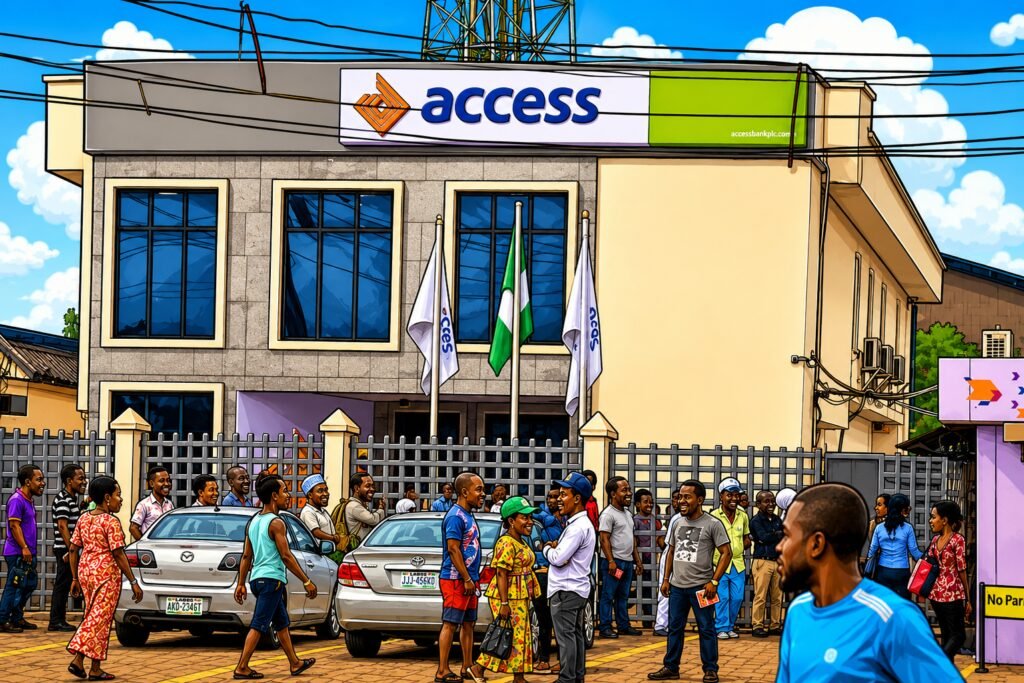
Salary Advance extends borrowing to 200% of monthly salary with a ₦5 million ceiling at 10% on a reducing balance over six months. The Small Ticket Personal Loan raises limits to 400% of salary, up to ₦10 million, at 9% on a reducing balance with a twelve-month window.
Access Bank stands apart because borrowers whose salaries are processed through Remita can apply without holding an existing account at the bank. All three products carry a 1% management fee and credit life insurance ranging from 0.3% to 1.2%, deducted at disbursement.
UBA Click Credit: instant USSD-based lending for salary earners
United Bank for Africa’s Click Credit targets salary earners with a UBA account, offering loans up to ₦1 million repayable over six months. The interest rate was 1.58% per month at the product’s 2020 launch, as reported by BusinessDay, though UBA’s current product page does not disclose a specific rate.
Applicants need an active UBA salary account with at least ₦50,000 monthly salary and six months of inflow history, with 1% management and 1% insurance fees. Applications go through USSD code *919*28# or UBA’s AI chatbot Leo on WhatsApp and other messaging platforms.
Click Credit Plus, a shorter-tenor variant, provides up to ₦200,000 for 30 days, targeting non-salaried individuals with twelve months of consistent deposits. Both products require no documentation or branch visit, with approvals processed in under one minute through automated risk assessment.
First Bank FirstAdvance and FirstCredit: two products for different borrowing needs
First Bank operates two unsecured digital loan products with significantly different pricing structures targeting different segments of its customer base. FirstAdvance’s 30-day variant provides up to 50% of net monthly salary, capped at ₦1.5 million, at 5% flat collected upfront, according to First Bank.
The three-month variant extends borrowing to 75% of net monthly salary, capped at ₦2 million, at 3% flat per month, with 1% management fee and 1% credit life insurance. VAT of 7.5% applies to the management fee on the three-month product, adding a cost layer that borrowers should factor into total calculations.
FirstCredit, a separate product for a broader customer base, offers up to ₦300,000 at 8% flat for 30 days. Borrowers need at least six months of account history, a positive credit bureau record, and a valid BVN to qualify for either product. FirstAdvance is accessible through USSD code *894*11#, while FirstCredit uses *894# via menu navigation, and both are available on the FirstMobile app.
FCMB FastCash, Fidelity FastLoan, and Stanbic IBTC EZCash: mid-tier alternatives
FCMB’s FastCash provides up to ₦400,000 without collateral through USSD code *329*11# or the mobile app, according to FCMB. Fidelity Bank’s FastLoan disburses in under two minutes at 3% monthly interest, while Stanbic IBTC’s EZCash offers ₦20,000 to ₦4 million at 3% monthly with a twelve-month tenor, as reported by nairaCompare.
These mid-tier products fill a gap for borrowers whose primary accounts sit outside the big four banks, though maximum amounts tend to be lower. Zenith Bank’s EazyLoan rounds out the landscape, offering unsecured lending to salary account holders aged 18 to 60 through digital channels.
Key product comparison across major Nigerian bank salary loans
Unsecured loan products at a glance
- GTBank Quick Credit: Up to ₦5 million, 2.95% monthly, 6-12 month tenor, USSD *737*51*51#
- Access Bank PayDay Loan: Up to 75% of salary (max ₦2 million), 7% flat, 30-day tenor, USSD *901*11#
- Access Bank Salary Advance: Up to 200% of salary (max ₦5 million), 10% reducing balance, 6-month tenor
- Access Bank Small Ticket Personal Loan: Up to 400% of salary (max ₦10 million), 9% reducing balance, 12-month tenor
- UBA Click Credit: Up to ₦1 million, 1.58% monthly at launch (current rate undisclosed), 6-month tenor, USSD *919*28#
- First Bank FirstAdvance (30-day): Up to 50% of salary (max ₦1.5 million), 5% flat, USSD *894*11#
- First Bank FirstAdvance (90-day): Up to 75% of salary (max ₦2 million), 3% flat per month
- First Bank FirstCredit: Up to ₦300,000, 8% flat, 30-day tenor, USSD *894#
- FCMB FastCash: Up to ₦400,000, no collateral, USSD *329*11#
- Fidelity FastLoan: Salary-based, 3% monthly, disbursed in under 2 minutes
- Stanbic IBTC EZCash: ₦20,000 to ₦4 million, 3% monthly, up to 12-month tenor
When comparing these products, the effective annual cost matters more than the headline monthly rate because upfront fees reduce the amount you actually receive. A 2.95% monthly rate at GTBank translates to roughly 35.4% annually, while First Bank’s 5% flat on a 30-day product works out to 60% effective annual cost if rolled over monthly.
How Nigeria’s credit bureaus determine your loan eligibility
Every commercial bank queries at least one of Nigeria’s three CBN-licensed credit bureaus before approving an unsecured loan, making credit history the single most important qualification factor. The three bureaus are CRC Credit Bureau, CreditRegistry, and FirstCentral Credit Bureau, all licensed by the CBN in 2008, according to BusinessDay.
“Access to credit for the average Nigerian remains almost zero, noting that real access only exists when loans are affordable, timely, and structured around realistic repayment terms.” — Adedeji Olowe, Founder and CEO of Lendsqr and Board Chairman of Paystack, speaking to Finance in Africa

Credit scores in Nigeria range from 300 to 900, with scores above 700 considered good and below 500 classified as poor. Borrowers can request one free credit report annually from each bureau to verify accuracy before applying for any loan.
A missed payment of 30 days or more can reduce a credit score by 50 to 100 points, with that mark persisting for 12 to 24 months on the file. Defaults exceeding 60 to 90 days cause drops of over 150 points that remain on record for three to five years, blocking unsecured credit access across all banks, nairaCompare reported in its 2026 payday loan analysis.
Eligibility requirements that apply across all Nigerian bank salary loans
While each bank sets its own income thresholds and tenure requirements, core qualification criteria follow a consistent pattern across the sector. Understanding these shared requirements helps you prepare before submitting an application that generates a credit inquiry on your record.
Standard eligibility criteria for unsecured bank loans
- Active salary account: Your employer must pay salary directly into an account at the lending bank, with consistent inflows for two to six months
- Valid BVN: Your Bank Verification Number must be linked to your phone number and account for identity verification and cross-bank recovery
- Positive credit bureau record: A clean repayment history with CRC, CreditRegistry, or FirstCentral is non-negotiable for all digital loan products
- Minimum income threshold: Most banks require net monthly salary between ₦10,000 and ₦50,000, varying by bank and product
- Age limit: Borrowers must typically be between 18 and 59 or 60 years old, with some banks specifying the age at loan maturity
- No outstanding defaults: Existing delinquent loans with any bank, discoverable through the Global Standing Instruction, block new applications automatically
Dr. Muda Yusuf, CEO of the Centre for the Promotion of Private Enterprise, has warned that Nigeria’s elevated rates serve dual policy objectives simultaneously. The high rates help control inflation while attracting foreign portfolio investments needed for exchange rate stability, as reported by National Daily.
For borrowers, this means unsecured credit costs will remain elevated until the CBN signals a more aggressive rate-cutting cycle in the coming quarters. Consumer loan rates between 20% and 46% per annum remain the current reality across Nigerian commercial banking.
Risks of unsecured borrowing and what the Global Standing Instruction means for you
The CBN’s Global Standing Instruction fundamentally changed the risk equation for borrowers who default on unsecured loans from any Nigerian bank. Under this framework, a lender can recover unpaid balances by debiting any bank account linked to the borrower’s BVN across the entire banking system.
A missed payment on an Access Bank PayDay Loan could trigger a debit on your GTBank savings account or UBA current account without separate court action. The mechanism gives banks the enforcement confidence to lend without collateral, but borrowers carry risk across every account they maintain in Nigeria.
Multiple simultaneous loans create compounding risk, as combined repayment obligations can quickly exceed a comfortable share of monthly income. Total monthly loan repayments that exceed 30% of net salary increase default risk significantly, nairaCompare noted in its 2026 payday loan ranking.
The FCCPC and CBN have jointly approved 457 digital lending platforms to operate legally as of 2026, with 35 under conditional approval, according to Brand Spur. Verify that any lender holds proper licensing or FCCPC registration before submitting personal information or accepting loan offers.
How to build a stronger credit profile for better unsecured loan terms in Nigeria
Your credit bureau record is the single most powerful lever for accessing larger loan amounts at lower rates from Nigerian commercial banks. As of 2020, each bureau held an average of about 25 million credit records, a figure that has grown as the reporting infrastructure has matured, according to BusinessDay.
Timely repayment on small, manageable loans builds a positive track record that banks weigh heavily when assessing eligibility for higher-value facilities. Requesting your annual free report from CRC, CreditRegistry, or FirstCentral allows you to identify and dispute errors before they cost you a loan approval.
Each bureau provides online access through its website, and borrowers can visit physical offices in Lagos to resolve discrepancies the digital dispute process cannot address. Strategic borrowing, meaning small amounts repaid on schedule, progressively improves your score and unlocks better pricing from lenders.
Key steps for improving your credit position
- Check your credit report annually through at least one licensed bureau and dispute inaccuracies before they affect future applications
- Avoid applying to multiple banks simultaneously because repeated credit inquiries within a short window can reduce your score significantly
- Repay existing obligations on schedule before seeking new credit, as outstanding delinquencies block applications across the entire banking system
- Start with smaller loan amounts to build a track record, then leverage that positive history to access larger facilities at competitive rates