
If you held Nigerian blue-chip stocks through June, the final trading session of the first half closed with a modest 0.45% bounce that barely dented weeks of unrelenting selling pressure. The NGX All-Share Index settled at 229,419.18 points on June 30, capping a month where more than ₦13 trillion in market value evaporated from the exchange’s historic May peak.
Premium Board stalwarts including MTN Nigeria, Zenith Bank, Access Holdings, and First HoldCo all closed lower on the session, extending a pattern of institutional selling that has defined the past four weeks. Market capitalization dropped to approximately ₦147.22 trillion, down from ₦148.9 trillion just days earlier, according to Vanguard’s month-end analysis, which cited NGX data.
The numbers tell a story of a market caught between two forces: a stunning 45.95% year-to-date rally that ranks Nigeria among the world’s best-performing frontier markets, and a June correction that punished investors who arrived late to the party. What happens next could reshape portfolios heading into the second half of the year.
Seplat, Dangote Cement, and Nestle anchor the June 30 sell-off
The NGX Daily Official List for June 30 shows the session’s damage concentrated in some of the exchange’s most liquid and widely held equities. Seplat Energy, the Premium Board oil and gas heavyweight, dropped from an opening price of ₦11,363.90 to close at ₦10,227.60, shedding more than ₦1,136 in a single session.
Dangote Cement fell from ₦963 to ₦887, a decline of roughly 7.9%, while Nestle Nigeria retreated from ₦3,125 to ₦2,812.50, shedding about 10% of its opening value. BUA Foods mirrored that pattern, sliding from ₦939 to ₦845.10, and BUA Cement also slipped from ₦340.20 to ₦306.20 on the session, the official list confirmed.

These are not obscure tickers, and the sell-off tells you something important about where institutional capital has been moving this month. For everyday investors holding these names, the scale of single-session losses in June’s final stretch reinforces how quickly sentiment can shift in a market that tripled the gains of most global peers.
June erased ₦13 trillion but the bigger picture tells a different story
Market capitalization climbed from ₦99.94 trillion at the start of January to ₦147.22 trillion by the close of June 30, producing a gain of roughly ₦47 trillion in six months, Vanguard reported, citing NGX data. The ASI surged 47.4% over the same period, climbing from 155,613.03 points to 229,419.18 points at the final close, the Vanguard analysis confirmed.
That first-half return places Nigeria among the strongest-performing frontier equity markets globally in 2026, Tribune Online reported. Even after a June correction that slashed the month-to-date return to negative 8.4%, the market’s year-to-date gain remained exceptional. At its highest point, the market crossed the ₦160 trillion capitalization mark for the first time in history and briefly pushed the ASI above 250,000 points, the Tribune report noted.
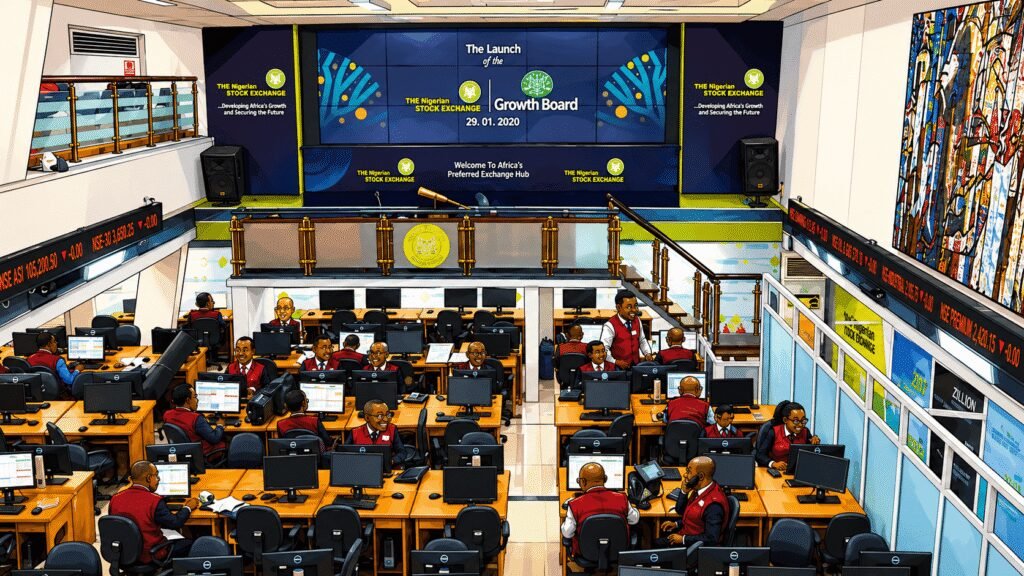
The contrast matters for you as an investor: the first half of 2026 created enormous wealth, but June alone destroyed more than ₦13 trillion of it as portfolio managers rebalanced into fixed-income instruments offering increasingly competitive yields, Umaru Mathew, Head of Capital Market, Commodities and Dealers at Equity Capital Solutions Ltd., told P.M. News.
Profit-taking and fixed-income yields fuel the NGX correction
Mike Eze, Group Managing Director of Crane Securities Limited, described the pullback as a healthy market adjustment rather than a reversal of the broader uptrend. “What investors are witnessing is largely a market correction after an extended period of strong gains,” Eze told The Whistler.
“The money market is still offering competitive returns, and some investors see it as a safer option.” — Umaru Mathew, Head of Capital Market, Commodities and Dealers, Equity Capital Solutions Ltd., via P.M. News
Mathew added that equities still carry strong underlying fundamentals that could support a rebound, P.M. News reported.
Aruna Kebira, Managing Director of Globalview Capital Ltd., pointed to a separate factor shaping trading behaviour across the exchange. Many investors have begun repositioning ahead of the anticipated Dangote Refinery public offering, which Aliko Dangote confirmed is expected to launch in September 2026, P.M. News reported. Early interest in that IPO has approached $2 billion, Legit.ng noted.
Sectoral performance reveals a two-tier NGX market in H1 2026
Not every corner of the market suffered equally during the correction, and the divergence between sectors is striking for portfolio positioning decisions. The NGX Oil and Gas Index emerged as the standout performer of the first half, advancing approximately 90.3% on the back of Aradel Holdings, Seplat Energy, and Oando, the Tribune report confirmed.

NGX sector returns for H1 2026
- Oil and Gas Index: +90.3% year-to-date (source: Tribune Online / NGX data)
- Industrial Goods Index: +79.72% year-to-date (source: Tribune Online / NGX data)
- Banking Index: +40.53% year-to-date (source: Tribune Online / NGX data)
- Consumer Goods Index: +16.3% year-to-date (source: Tribune Online / NGX data)
- Insurance Index: -1.75% year-to-date, the only productive-sector index in the red (source: Nairametrics / NGX data)
Insurance stocks were the only major productive-sector group to post negative price returns for the first half of the year, weighed down by thin underwriting margins, low premium penetration, and ongoing capital adequacy pressures, Nairametrics reported. Banking stocks, despite being among the most actively traded names on the exchange, underperformed the benchmark ASI by roughly 16 percentage points.
What drives NGX direction as the second half of 2026 begins
The market enters July carrying significant year-to-date gains but facing a set of catalysts that could push it in either direction quickly. Mathew of Equity Capital Solutions indicated that the first sessions of July could see continued downward pressure before stocks begin finding support levels, P.M. News reported.
Half-year corporate earnings releases will offer the most immediate catalyst for directional clarity, as investors assess whether companies behind the rally can sustain their profit trajectories into the second quarter. Banking recapitalization progress, Central Bank of Nigeria monetary policy decisions, inflation data, and exchange-rate stability will also shape positioning, the Tribune report indicated.
For retail investors who watched June’s correction erase weeks of gains, the question now is whether the pullback has created a cheaper entry point into fundamentally solid companies or whether more selling lies ahead. Analysts at Cowry Asset Management projected that selective bargain hunting in strong-fundamentals stocks could stabilize the market in the near term, the Whistler reported.