
MTN Nigeria, one of the country’s most valuable listed companies, traded exactly seven shares on the Nigerian Exchange on July 3, 2026. The telecom giant typically moves an average of 6.4 million shares per session, making the single-digit volume a staggering departure from its normal trading rhythm.
That near-silence arrived on a day the All-Share Index surged 2.19%, adding ₦3.16 trillion in market value and reversing the week’s bearish narrative entirely. For a company worth more than ₦15 trillion and freshly crowned with Nigeria’s highest corporate credit rating, the absence raises questions worth examining closely.
MTN Nigeria’s ghost session raises questions about price-driven illiquidity
The daily official list from the Nigerian Exchange confirmed that MTN Nigeria moved just 7 units at ₦750 per share on July 3. That translates to a total transaction value of ₦5,250 on a day the broader market turned over ₦27.61 billion, GTI Securities reported.
Over the three months through June, MTN averaged roughly 6.4 million shares per session valued at around ₦5 billion, AFX market data showed. The July 3 figure represents a volume collapse of more than 99.99% against that rolling average, a gap difficult to attribute to routine sentiment shifts alone.
At ₦750 per share, MTN ranks among the priciest equities on the exchange alongside Seplat Energy, BUA Foods, and Nestle Nigeria. That price level means a single lot purchase demands significant capital outlay, which can thin out retail participation and compress trading frequency over time.
June’s record ₦13.29 trillion sell-off shaped the volatility heading into July
MTN’s paper-thin session landed against the most turbulent stretch in Nigerian market history, a June that set records for every wrong reason. The NGX shed approximately ₦13.29 trillion in market value during June 2026, the largest single-month loss ever on the exchange, Nairametrics reported.
The benchmark All-Share Index fell 8.28% across the month, squeezing year-to-date returns from over 60% at end of May to 47.43%. All 20 NGX indices finished June in negative territory, confirming that the correction reached every sector of the exchange without exception, the report confirmed.
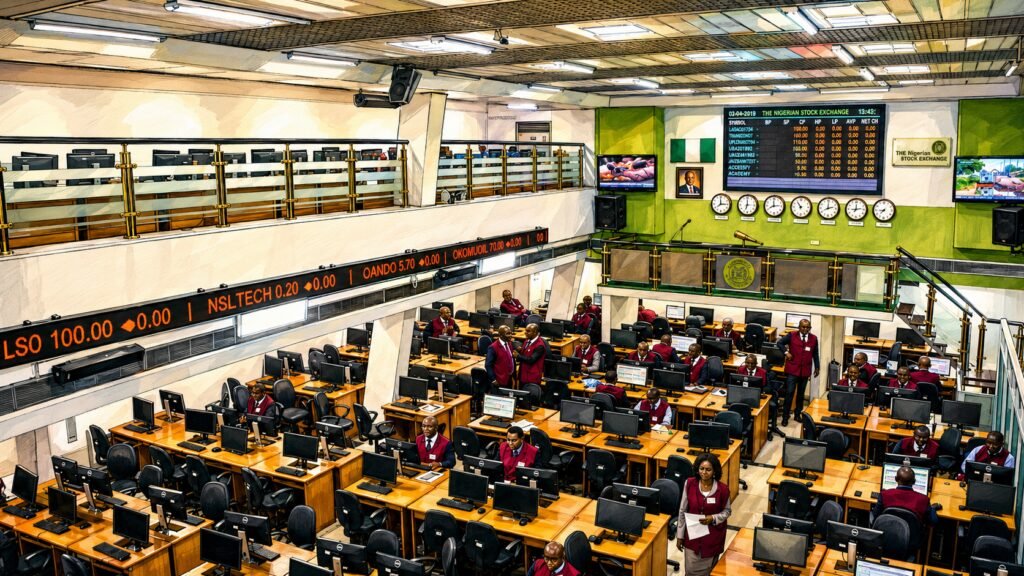
July’s opening session on July 1 extended those losses immediately, with profit-taking in blue chips erasing another ₦2.39 trillion in a single trading day. The session was dominated by bearish sentiment and weakened trading activity as selling pressure pushed the market lower, APT Securities and Funds Limited noted, ThisDay reported.
The market bounced back sharply by July 3, with the ASI gaining 2.19% to close at 229,240.34 points, GTI Securities reported in its daily brief. Market capitalization recovered to ₦147.10 trillion, and breadth turned firmly positive with 39 advancers against just 14 decliners across all listed equities.
Agusto’s Aaa upgrade highlights the gap between MTN’s credit story and its trading volume
MTN’s near-invisible trading day came just two days after a landmark credit upgrade that should have drawn, not repelled, investor attention. On July 1, Agusto and Co. elevated the company’s long-term rating to Aaa, its highest national scale level, up from Aa+, Nairametrics reported.
The move followed an earlier affirmation of MTN Nigeria’s AAA long-term and A1+ short-term national ratings by Global Credit Rating Company. MTN Nigeria is the only non-financial institution in the country holding an active Aaa rating from Agusto and Co. at this time, the company disclosed.
“This outcome reflects the strength of our earnings recovery, the quality of our cash flows and disciplined balance sheet management.” — Karl Toriola, CEO, MTN Nigeria (via Nairametrics)

The underlying numbers support that assessment. Operating cash flow in the first quarter of 2026 rose 73.3% year over year to ₦764.10 billion, the Nairametrics report confirmed. Borrowings fell 24.9% to ₦314.97 billion by March 2026 from December 2025, with no new debt raised during the quarter, the report showed.
What thin volume in premium-priced stocks signals for the wider NGX market
MTN’s experience was not isolated among the exchange’s priciest names on July 3, according to the NGX daily official list published by the exchange. Seplat Energy, trading above ₦10,000 per share, moved just a single unit, while Nestle Nigeria saw only 4 shares change hands that session.
Key data points from the July 3 NGX session
- MTN Nigeria traded 7 shares at ₦750, totaling ₦5,250 in value, according to the NGX daily official list.
- The All-Share Index gained 2.19% to close at 229,240.34 points on July 3, GTI Securities reported.
- Market capitalization rose by ₦3.16 trillion to ₦147.10 trillion on July 3, GTI Securities confirmed.
- Thirty-nine stocks advanced while 14 declined and 93 remained unchanged on the session, GTI Securities reported.
- June 2026 erased ₦13.29 trillion in shareholder value, the largest monthly loss ever recorded on the NGX, Nairametrics reported.
The thin activity in premium-priced tickers raises a broader question about whether some of Nigeria’s strongest companies are gradually pricing themselves beyond ordinary retail participation.
David Adonri, CEO of HighCap Securities, cautioned against reading the recent NGX correction as evidence of structural weakness in the capital market, Leadership reported. He projected a mild recovery in the second half of 2026, driven by improving corporate fundamentals and sustained macroeconomic reforms under the current administration.