
For most of 2026, South Korea’s stock market held an almost untouchable lead over every other exchange on the planet. Investors flooded into the Kospi index on the back of an artificial intelligence trade that seemed destined to run indefinitely. Then the momentum reversed, and a market that looked invincible began hemorrhaging value at a pace few anticipated.
On the other side of the world, a very different story was building on the trading floor of the Nigerian Exchange. Financial stocks, oil-linked confidence, and a strengthening naira were quietly compounding gains that international investors had largely overlooked. The question now is how Africa’s largest oil producer leapfrogged a tech-heavy Asian powerhouse to claim the top spot.
Nigerian equities deliver 68% dollar returns across 92 global exchanges
Nigeria’s benchmark stock index has returned 68% in dollar terms year-to-date, edging past South Korea’s Kospi at 66%, Bloomberg reported. The data, compiled from 92 global stock exchanges, places the NGX at the top of global equity performance rankings for 2026.
More Nigerian market coverage:
- S&P DJI places Nigeria on its critical 2027 watchlist
- SEC puts capital market operators on a 48-hour clock
Financial services companies have driven much of the rally, with Fortis Global Insurance delivering returns of roughly 1,400% in dollar terms this year. On July 8, the NGX All-Share Index surged 2.27% to close at 242,459.98 points, adding N3.45 trillion in market capitalization, NGX Pulse data confirmed.
Airtel Africa was the single biggest catalyst that session, gaining the maximum allowable 10% to close at a record N5,801.40 per share. Damilola Okeleye, an equity sales trader at StoneX Nigeria Financial Ltd., pointed to structural shifts as the primary engine behind the gains.
“A strong driving force to the gains seen year to date” has been Nigeria’s economic reforms and the potential listing of Dangote Petroleum Refinery and Petrochemicals Fze, Okeleye told Bloomberg.
South Korea’s AI-fueled Kospi rally collapses into bear territory
South Korea’s fall from the top spot was swift and punishing for investors who had crowded into its AI-linked equities. The Kospi index entered a technical bear market after shedding 22% from its June 19 peak, as doubts about AI stock valuations intensified.
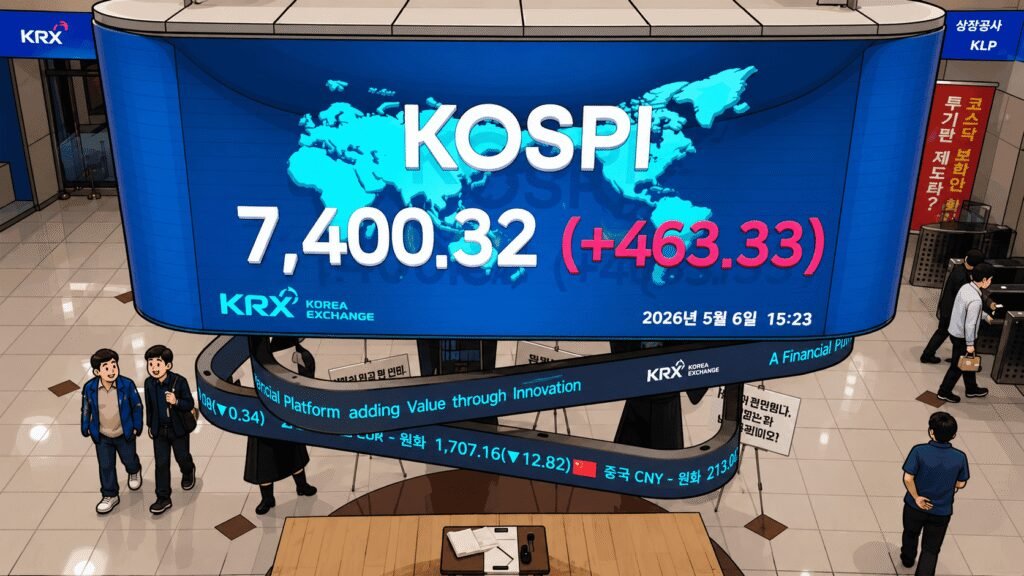
Currency weakness compounded the losses for dollar-denominated investors holding Korean equities throughout the first half of 2026. The South Korean won has depreciated roughly 5% against the U.S. dollar year-to-date, making it the fourth-weakest Asian currency, the report noted.
Nigeria’s trajectory moved in the opposite direction on the currency front, giving foreign investors a double tailwind on their positions. The naira has strengthened roughly 4% against the dollar since January, amplifying equity gains when converted to foreign currency.
S&P Dow Jones watchlist signals potential frontier market upgrade
The rally has gained additional momentum from one of the world’s most influential index providers. S&P Dow Jones Indices placed Nigeria on its 2027 Country Classification Watchlist for potential reclassification from Standalone to Frontier status, NGX Group confirmed.
Kayode Akindele, managing partner at Coronation Capital, estimated that S&P-related passive inflows alone could reach $150 million to $250 million. If FTSE Russell also proceeds with its own reclassification, an additional $200 million to $300 million could follow, Akindele told CNBC Africa.
Key data points from the Nigerian stock market rally
- NGX All-Share Index closed at 242,459.98 points on July 8, up 2.27% in a single session (NGX Pulse)
- Total market capitalization reached N155.59 trillion, approximately $113 billion (NGX Pulse)
- Fortis Global Insurance returned roughly 1,400% in dollar terms in 2026 (Bloomberg)
- Airtel Africa gained 10% on July 8, closing at a record N5,801.40 (MarketForces Africa)
Dangote listing and reforms could shape what comes next for the NGX
The anticipated listing of Dangote Petroleum Refinery and Petrochemicals Fze could reshape the composition of the exchange in the months ahead. As Africa’s largest crude processor, a Dangote listing would deepen the market and potentially attract a new wave of institutional capital, Okeleye noted.
Temi Popoola, group managing director and CEO of NGX Group, called the S&P watchlist placement an encouraging development for the market. He described it as recognition of collective efforts by regulators and market operators to build a more transparent exchange, Vanguard reported.
Whether Nigeria can sustain its position at the top of global return tables will depend on continued reform execution and policy consistency. For now, the NGX has delivered a result that few global investors predicted at the start of the year.