
For all the talk about Nigeria building a self-sustaining tech ecosystem, one statistic from a senior American diplomat complicates that narrative entirely. The number, delivered at a major Lagos industry event, puts a hard figure on how deeply American capital runs through Nigerian startups.
Nigeria’s tech sector has earned global recognition through years of rapid growth, multiple unicorn-level valuations, and a record-setting international ranking in 2025. But how much of that momentum actually rests on local capital, and how much depends entirely on decisions made inside Silicon Valley boardrooms?
The answer, according to one senior diplomat at GITEX Nigeria, is far more lopsided than most observers in Lagos might be comfortable admitting.
U.S. capital accounts for six in every ten foreign tech dollars entering Nigeria
American investors have supplied an estimated 60% of all external capital entering Nigeria’s technology ecosystem over the past decade. U.S. Consul General Brandon Hudspeth shared the figure at the GITEX Nigeria Startup Festival in Lagos on September 2, 2026, naming Visa, Google, Mastercard, Microsoft, Uber, and PayPal among the major contributors, the News Agency of Nigeria reported.
Hudspeth also pointed to Google, Cisco, Meta, and Microsoft as companies currently training hundreds of thousands of Nigerians in technology and artificial intelligence. The funding, he noted, flows from everywhere: major corporations, smaller American venture capital firms, and philanthropic foundations.
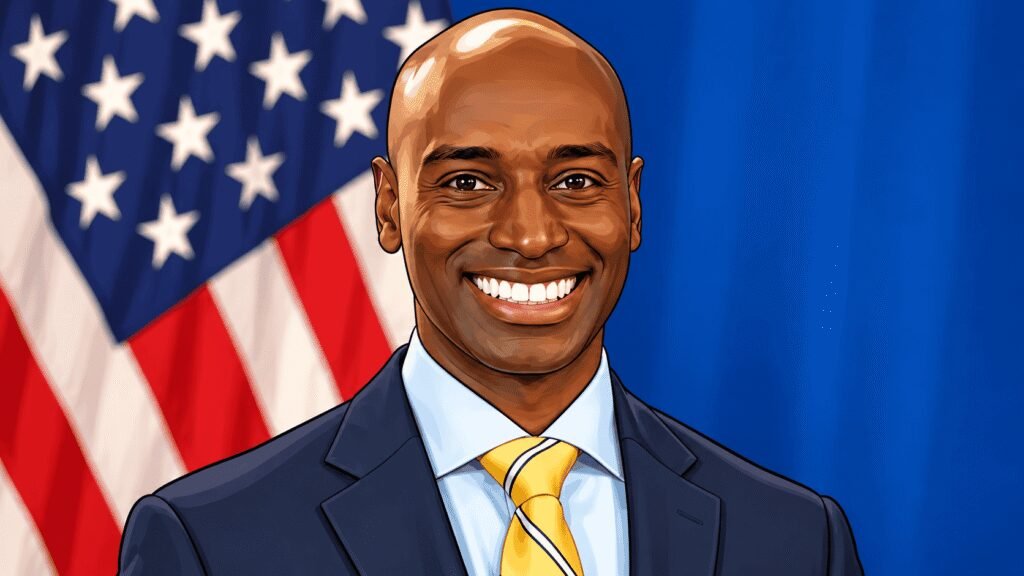
The consul general went further, predicting that six of Africa’s next unicorn companies would emerge from the group of entrepreneurs gathered at the festival. That confidence reflects the depth of existing American involvement, but it also underscores how tightly Nigeria’s startup trajectory depends on sustained U.S. financial backing.
Lagos leads the world’s rising tech hubs, built largely on American investment
Dealroom’s 2025 Global Tech Ecosystem Index ranked Lagos as the number one “Rising Star” globally, ahead of Istanbul and Pune across 69 countries, the Guardian reported. The city’s startup valuation surged nearly 12-fold since 2017, reaching an estimated $15.3 billion, Vanguard reported.
Lagos tech ecosystem by the numbers:
- Lagos has produced six of Africa’s ten unicorns, including Flutterwave, OPay, and Moniepoint, according to Hudspeth.
- Nigeria’s tech sector now accounts for more than 16% of the country’s overall GDP, Nairametrics reported, citing Hudspeth.
- Two-way trade between the U.S. and Nigeria reached nearly $13 billion in 2024, with U.S. FDI hitting $7.9 billion, the U.S. Embassy confirmed.
That growth is impressive by any global standard, but the heavy concentration of external funding from a single country introduces a structural dependence risk. If American investors redirected their attention due to geopolitical shifts or a broader global venture downturn, the pressure on Nigerian startups would be immediate.
A formal U.S.-Nigeria trade framework is designed to deepen the pipeline
The capital relationship now has a formal government structure reinforcing it beyond individual corporate decisions. The U.S.-Nigeria Commercial and Investment Partnership, a five-year agreement signed in July 2024, was built to remove commercial barriers and accelerate bilateral investment, the U.S. Department of Commerce confirmed.
Working groups under the partnership, covering agriculture, the digital economy, and infrastructure, were formally activated during mid-2025 with senior officials from both governments. U.S. foreign direct investment in Nigeria increased 25.2% year-over-year to $7.9 billion in 2024, the embassy reported.
“We’re particularly interested in where AI changes the economics of serving African markets.” — Kola Aina, founding partner of Ventures Platform, speaking to TechCrunch while announcing an oversubscribed $84 million second fund in August 2026.

Local investors are gaining ground in Africa, but have not matched the American scale
The dominance of American capital is starting to face modest competition from within the continent, though the gap remains wide at this stage. In the first quarter of 2025, local investors outnumbered foreign investors in African startup deals for the first time on record, Aina noted in a TechCabal interview. Across the broader African market, tech startups raised a combined $4.1 billion in equity and debt financing in 2025, representing a 25% increase from the prior year, Partech Africa reported.
Nigeria accounted for roughly 30% of all African startup deals during the period, but local institutional investors and pension funds have been slow to deploy at anything close to American levels. Until the domestic capital base deepens, the 60% dependency figure is unlikely to shift in any meaningful direction.
What the 60% figure signals for Nigeria’s startup trajectory
The 60% figure validates American confidence in Nigeria’s tech potential, but it equally highlights how concentrated the funding base has remained over the past decade. American capital has been the largest engine behind Lagos’s rise as a globally ranked startup destination, and the CIP framework deepens that connection further. For policymakers, the challenge is ensuring the ecosystem can sustain itself if American investment shifts. Diversifying capital sources and strengthening local institutional participation will determine whether Nigeria’s tech sector outlasts any single funding partner.