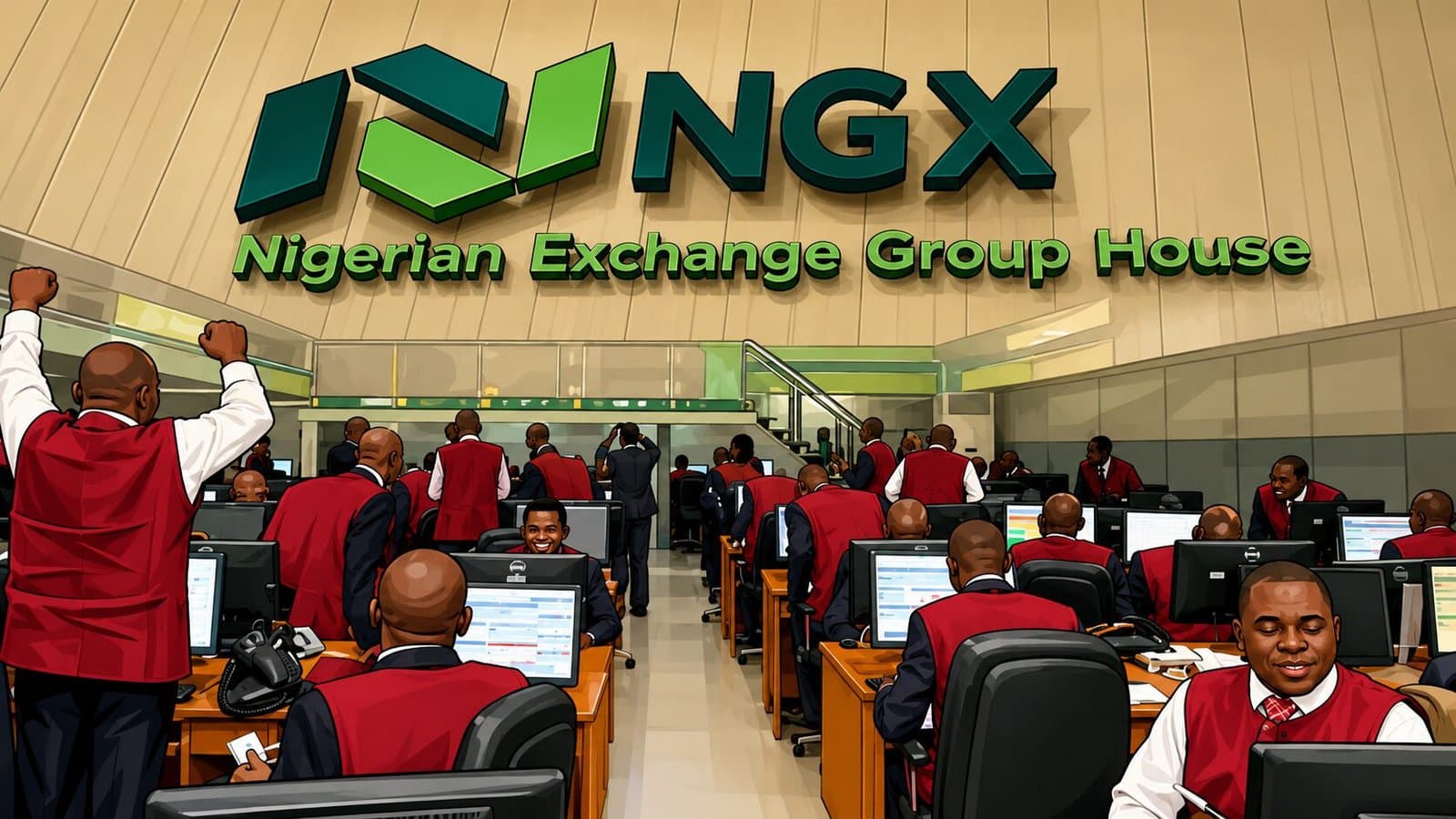

The Nigerian Exchange closed the week ended October 9, 2026, with market capitalization down ₦1.6 trillion to ₦161.260 trillion.
Selling swept through every tracked sector except Industrial Goods, which held on by the thinnest of margins across five trading sessions.
Decliners outnumbered gainers by more than two to one, with 54 stocks closing lower against just 24 that posted gains.
Oil names, bank stocks, and commodity plays absorbed the worst of the damage, while 68 equities remained unchanged throughout the period.
Oil and gas stocks drag NGX with steepest sector loss of the week
The NGX Oil and Gas Index fell 3.85% over five sessions, marking the exchange’s sharpest sectoral decline across all tracked benchmarks.
Aradel Holdings dropped 10% to close at ₦1,377 from ₦1,530, echoing a prior session where the stock hit its floor on thin volume.

More NGX oil and gas coverage:
- NGX oil stocks stumble into the fourth quarter
- Conoil drops 10% as selling pressure sweeps across NGX
- NGX CEO stakes a bold claim to add 10 million new investors
Eterna fell 9.09% to close at ₦40 from ₦44, while Critical Minerals Financing Corporation lost 20.27% as the week’s steepest individual decliner.
Despite the weekly selloff, the Oil and Gas Index still holds a 124.92% year-to-date gain, the NGX weekly report showed.
The NGX Commodity Index also slipped 2.86%, reinforcing the broader pattern of resource-linked equities facing a synchronized pullback, the NGX weekly market report showed.
NGX Banking Index loses 2.64% as Fidelity Bank slides over 10%
The banking sector had a bruising week, with the NGX Banking Index falling 2.64% after delivering some of the exchange’s strongest returns.
Fidelity Bank led the decline, losing 10.64% for the week and dropping from ₦23.50 to ₦21 per share across the five sessions.
The slide came despite the banking index accumulating a 72.5% year-to-date gain heading into a sharp October correction.
Access Holdings, Zenith Bank, and United Bank for Africa were the three most actively traded stocks by volume for the full week.
Those three names alone accounted for 1.020 billion shares valued at ₦50.520 billion, representing 37.56% of total equity turnover, the exchange confirmed.
The NGX Pension Index also fell 2.12%, and the NGX Insurance Index shed 1.74%, underscoring broad institutional selling pressure.
The Consumer Goods Index slipped 0.58% for the week, adding yet another sector to the list that failed to hold ground during the selloff.
David Adonri, CEO of Highcap Securities, has previously noted that Nigeria’s equity market reacts sharply to incoming information before stabilizing, Nairametrics reported in September.
That pattern may offer useful context for investors watching the current correction unfold against a broader year-to-date rally of nearly 60%.
Industrial goods barely survive as NGX’s lone October holdout
The NGX Industrial Goods Index was the only sectoral benchmark to close the week in positive territory, adding a microscopic 0.02% gain overall.
That gain amounted to just 2.26 index points, moving from 10,440.24 to 10,442.50, a move more survival than meaningful strength.
Investors who had followed the exchange’s pitch to global capital at the United Nations may note the contrast between those ambitions and this weekly scorecard.
The All-Share Index fell 0.97% to close at 248,363.55 points, pulling the month-to-date return to negative 1.13% as October opens bearishly.
Sterling Financial Holdings completed a major share reconstruction during the week, delisting 68.5 billion ordinary shares and relisting 6.85 billion at ₦77 per share.
The move slashed the company’s outstanding share count by roughly 90% through a one-for-ten share consolidation ratio approved by shareholders, Nairametrics reported.
The reconstruction effectively reset Sterling’s share price higher while keeping total market capitalization for existing holders the same through the transition.
The exchange has also expanded access through digital channels, including a WhatsApp gateway for public offers, to reach retail investors directly.
Guinea Insurance listed 6.3 billion additional shares from a private placement, and Multi-Trex Integrated Foods returned to trading after its suspension was lifted.
Livestock Feeds was the week’s top gainer, surging 47.75% to close at ₦13.15 from ₦8.90 over the five sessions on the exchange.
Key numbers from the NGX week ended October 9, 2026
- The All-Share Index fell 0.97% to close at 248,363.55, with market capitalization settling at ₦161.260 trillion, the NGX weekly report showed.
- Oil and gas stocks posted the heaviest sector loss at 3.85%, followed by the Commodity Index at 2.86% and Banking at 2.64%, the report noted.
- Investors traded 2.715 billion shares worth ₦158.280 billion in 209,986 deals across the five sessions, the exchange confirmed in its report.
- Livestock Feeds surged 47.75% to lead all gainers for the week, rising from ₦8.90 to ₦13.15, the NGX report indicated.
- The NGX Industrial Goods Index gained just 0.02%, standing as the only sector to close in positive territory for the week.