
If you held Nigerian banking stocks through the first half of 2026, you already know the thrill of a sector that seemed unstoppable. The NGX Banking Index gained more than 35% between January and late June, lifted by a historic recapitalization wave and strong earnings fueled by elevated interest rates.
That streak hit a wall in the first week of July. The index shed 3.72% in five trading sessions, dragged lower by selloffs in some of the sector’s most heavily weighted names. What makes the decline notable is the context surrounding it.
Trading volume across the NGX surged 64% over the previous week, with 3.82 billion shares changing hands. The market fell, but participation spiked, a combination that hints at active repositioning rather than outright panic.
Zenith Bank and GTCO drag NGX banking index to weekly low
The NGX Banking Index closed the week ended July 3 at 2,051.06 points, down from 2,130.27 the previous week, according to the NGX weekly market report. That 3.72% decline marked one of the sharpest weekly declines for banking stocks during the current correction.
Selling pressure concentrated in the sector’s largest names. First HoldCo dropped 8.22% in a single session on July 2, while Zenith Bank shed 3.52% and GTCO lost 1.23% the same day, Nairametrics reported. Wema Bank, Jaiz Bank, and UBA also posted losses as the selloff spread across both tier-one and mid-cap banking counters.
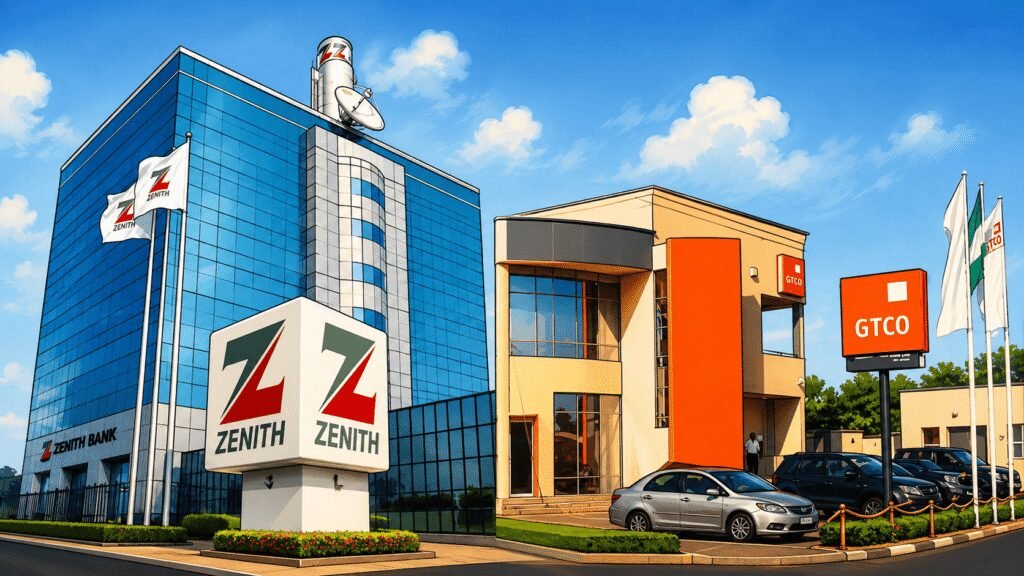
Despite the pullback, the broader NGX saw an unusual spike in activity. Investors traded 3.82 billion shares worth ₦154.39 billion across 258,567 deals, the report showed. That volume figure was 64% higher than the prior week, suggesting active portfolio rebalancing rather than outright retreat.
How a 35% YTD banking rally set up the current correction
The banking sector’s 2026 run was fueled by a once-in-a-generation event. The Central Bank of Nigeria’s mandatory recapitalization exercise pushed banks to raise trillions of naira in fresh equity, drawing waves of retail investors into the market. The combined market value of 12 listed banks climbed ₦9 trillion between December 2025 and May 2026, THISDAY reported.

Zenith Bank emerged as the most valuable banking stock during the rally, with its share price climbing 112% by May to a market capitalization above ₦5.38 trillion, THISDAY data showed. GTCO’s market value also rose from ₦3.3 trillion to ₦5.01 trillion over the same stretch, creating strong incentive to lock in profits once momentum stalled.
The broader NGX All-Share Index has now retreated more than 23,200 points from its all-time peak of 252,508 set in May. Its year-to-date return moderated to 47.31%, well below the 60.49% peak return recorded in late May, according to the weekly report.
Analysts split on whether banking stocks have bottomed
The pullback has divided market watchers into two camps. Olumide Adesina, a financial market analyst at Nairametrics, described the sector’s slide as typical of industries that have delivered outsized gains followed by dividend payouts. Nigerian banks continue to show solid fundamentals supported by strong earnings and elevated net interest margins, Adesina noted.
“We all started the year with a positive mindset, and it worked for us. We saw year-to-date returns increasing, and investors were smiling at the bank. But looking forward to H2, I see the market rebounding — and I do begin to see Q2 results coming out in late July affecting the market positively.” — Charles Fakrogha, CEO, ECL Asset Management Limited, speaking to Nairametrics

Not everyone is ready to call a floor. Abiodun Ogunniyi, Head of Research at GTI Securities, noted that pre-election years in Nigeria follow a predictable rhythm for equities, with strength from January to May and weakness from June onward as political uncertainty builds, he told the outlet.
What the banking index pullback signals for Q3 positioning
Financial services stocks still dominate trading activity, accounting for 60.99% of total weekly volume and 35.37% of total trade value, the NGX report showed. That level of concentration means banking stock movements will continue to drive overall market direction through the third quarter.
Key numbers from the NGX weekly report for the week ended July 3, 2026:
- NGX Banking Index: Closed at 2,051.06, down 3.72% WoW, up 35.31% YTD (source: NGX weekly report)
- NGX All-Share Index: Closed at 229,240.34, down 1.21% WoW, YTD return 47.31% (source: NGX weekly report)
- Market capitalization: ₦147.103 trillion, down approximately ₦1.80 trillion WoW (source: Blueprint Newspapers)
- Weekly trading volume: 3.82 billion shares in 258,567 deals, up 64% WoW (source: NGX weekly report)
- Market breadth: 22 gainers, 57 decliners, 67 unchanged (source: NGX weekly report)
The question for the coming weeks is whether second-quarter earnings releases, expected in late July, will provide enough positive momentum to arrest the correction. Ogunniyi told Nairametrics that the next three to four months could offer significant accumulation opportunities in equities that have pulled back from their peaks.
For now, a 3.72% weekly decline against a 35% year-to-date gain tells you the banking sector’s story in 2026 is far from finished. The easy gains from the first half, however, are clearly behind you.