

Something unusual showed up in First HoldCo’s half-year numbers for 2026. The banking group’s profit nearly doubled, its total assets crossed a landmark threshold, and its stock hit a record high on the Nigerian Exchange.
But the engine behind that growth looks different from what you might expect from Nigeria’s oldest banking franchise. The numbers point to a shift in how FirstBank’s parent company is generating earnings, and whether that shift can last matters more than the headline figure itself.
First HoldCo’s record ₦653.5bn profit hides an earnings shift
First HoldCo reported pretax profit of ₦653.54 billion for the six months ended June 30, 2026, an 83.5% jump from the ₦356.15 billion posted in the corresponding period of 2025. Profit after tax landed at ₦526.13 billion, an 82% increase, while earnings per share climbed to ₦11.74 from ₦6.84, the group’s unaudited financial statements filed with the Nigerian Exchange show.
The surprise sits beneath the headline. Interest income, the backbone of any bank’s earnings, fell 2.7% to ₦1.40 trillion from ₦1.44 trillion a year earlier. Instead, a massive swing in non-core income lines powered the result. Recoveries booked under other operating income jumped from ₦4.17 billion to ₦91.89 billion, while net gains on financial instruments at fair value swung from a ₦53.67 billion loss to a ₦65.79 billion gain, the filing shows.
How a balance sheet cleanup reshaped First HoldCo’s earnings base
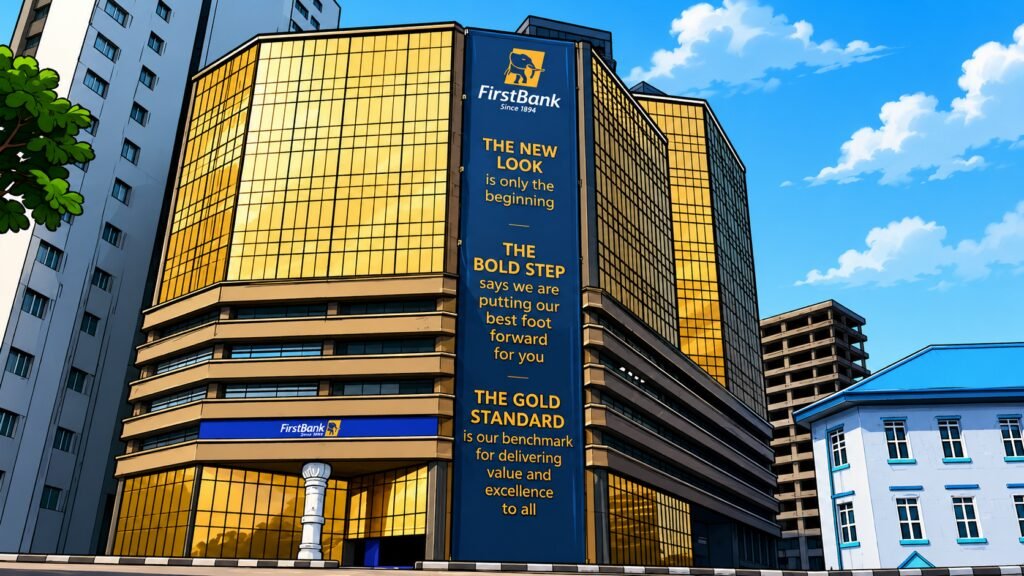
First HoldCo is the parent company of First Bank of Nigeria, the country’s oldest commercial bank, alongside subsidiaries in investment banking, asset management, insurance brokerage, and trusteeship. The group is chaired by billionaire Femi Otedola, who holds a combined direct and indirect stake of about 20.4%, making him the largest individual shareholder, Billionaires.Africa reported.
Key balance sheet metrics at June 30, 2026:
- Customer deposits: ₦21.93 trillion, up 16.2% from ₦18.88 trillion at December 2025
- Loans to customers: ₦9.51 trillion, up 6.1% from ₦8.97 trillion
- Total equity: ₦3.63 trillion, up from ₦3.30 trillion
- Borrowings: ₦964.83 billion, down 50% from ₦1.94 trillion
- Share price: ₦105.50 on July 20, 2026, up 10% on the day and 210% over 12 months
The group’s 2025 full-year results were weighed down by a 71% drop in pretax profit after management absorbed a roughly ₦748 billion impairment charge tied to legacy nonperforming loans, Brandiconimage reported. That cleanup appears to be paying off, with fee and commission income rising 27% to ₦214.66 billion and impairment charges dropping 37% to ₦116.14 billion.
“The first half of 2026 marks an important turning point for FirstHoldCo. These results affirm that the bold decisions the Board took to strengthen the institution were the right ones.” — Femi Otedola, Group Chairman, First HoldCo Plc (via Billionaires.Africa)

CBN’s proposed HoldCo capital rules could test First HoldCo’s gains
Qudus Adebara, a research analyst at DLM Capital Group, noted in an earlier Q1 2026 review that First HoldCo benefited from a recovery in trading income and gains on investment securities that offset declining foreign exchange earnings. He flagged funding pressures and elevated operating costs as the key challenges going forward, the review published on Simply Wall St indicated.
The strong results also arrive alongside a regulatory headwind. The CBN’s draft Financial Holding Company framework, released in June 2026, proposes requiring holding companies to maintain capital at least 20% above the combined minimum capital of their subsidiaries. Cordros Research estimated that First HoldCo faces the largest capital gap among tier-one banks at roughly ₦140.07 billion, though the group’s planned ₦253.10 billion capital raise should cover that shortfall, The Sun reported.
Renaissance Capital warned in a July 16, 2026 report that the proposed buffer across the sector could force Nigerian banks to raise over ₦1.7 trillion in total, potentially diluting shareholder returns at a time when profitability is already moderating, Nairametrics noted. Whether the group’s rally can survive the second half of 2026 may depend less on earnings and more on what the CBN ultimately requires it to hold.