
Seven hundred Nigerian developers applied for just one hundred spots when Cursor launched its first Lagos community event earlier this year. That level of demand signaled something important about the AI coding tool’s growing foothold inside one of Africa’s fastest-expanding tech ecosystems.
Now the platform those developers rallied behind belongs to Elon Musk, and the implications for their daily workflows remain an open question. SpaceX signed a formal merger agreement to acquire Anysphere, the company behind Cursor, for $60 billion in an all-stock transaction.
The deal was announced on June 16, 2026, and would make the AI code editor a wholly-owned subsidiary of Musk’s aerospace and technology conglomerate. Those risks are not speculative, because Cursor’s own leadership once treated the same model dependency concerns as urgent enough to convene an emergency company-wide meeting.
SpaceX acquires Cursor for $60 billion in largest AI tool deal
SpaceX entered a binding merger agreement to acquire Anysphere for $60 billion in class A common stock on June 16, 2026. The transaction represented the largest acquisition of a venture-backed startup so far this year, according to Crunchbase, and a 3.4% dilution at the IPO valuation, CNBC reported.
Cursor ranked No. 37 on the CNBC Disruptor 50 list in 2026, and its annualized revenue crossed $1 billion in November 2025, CNBC reported. The code editor allows developers to generate, edit, and review code through natural language prompts, competing directly with tools from Anthropic and OpenAI. SpaceX expects the merger to close during the third quarter of 2026, subject to regulatory approvals, CNBC reported, citing the company’s SEC filing.
Cursor’s own leadership sounded the alarm on model dependency
The acquisition did not emerge from a position of unchecked confidence inside Cursor’s leadership team. For months before the deal materialized, the company’s management had been grappling with a critical vulnerability tied to its reliance on AI models built by competitors.
Anthropic cut API access to its Claude models for Windsurf, a rival AI coding startup, during that company’s acquisition negotiations with OpenAI, TradingKey reported. That move sent a clear signal across the AI coding industry about how quickly model providers can act when ownership lines shift toward a competitor.
In January 2026, Cursor convened what employees described as an emergency all-hands meeting and announced the company had to build its own proprietary AI models. Using the open-source Kimi model from Chinese AI firm Moonshot AI, Cursor developed its own coding model suite called Composer, TradingKey noted. By May 2026, more than 85% of Composer’s latest version had been completed independently by Cursor’s engineering team, reducing third-party model dependency.
Nigerian developers built a growing ecosystem around Cursor
The tool’s reach into Nigeria is documented and measurable through one specific data point from its community launch this year. Café Cursor, a global community meetup format built around users of the code editor, held its inaugural Lagos event in April 2026, Punch reported.
Organizers initially planned for roughly 100 participants, but the event attracted approximately 700 applications from across the country, Punch reported. Participants included experienced software engineers, students, and first-time builders who collaborated on mobile applications, web platforms, and AI-driven tools during the event.
“This is not just about Cursor; it’s about ensuring Nigeria participates actively in shaping the future of AI.” — Joshua Omobola, developer relations engineer and convener of the Lagos edition, Punch reported.
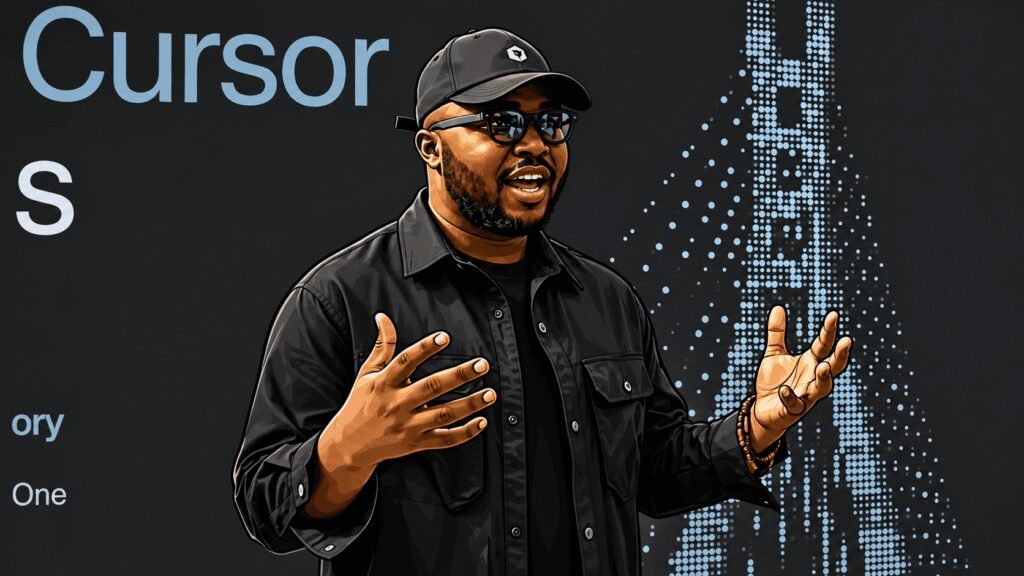
The Lagos chapter planned expansion into other Nigerian cities, including Abuja, Ibadan, and Port Harcourt, with future hackathons aimed at deepening engagement and attracting investment into the local AI ecosystem, Punch reported.
What the ownership change signals for Cursor users across Nigeria
Cursor now operates inside an entity that owns xAI, the Grok model, and the Colossus supercomputer cluster, all of which compete directly with the Claude and GPT models the editor once depended on. The Windsurf precedent demonstrated that model providers can and will restrict access when ownership lines shift toward a rival.
Nigerian developers who built professional workflows on Cursor face a practical concern around the future of model access and pricing under new ownership. Subscription costs are already denominated in foreign currency, which creates an additional barrier for developers in markets like Nigeria where international payment limits remain restrictive. The 700 applications for 100 Lagos event spots suggest a developer base large enough that any shift in Cursor’s platform-level model availability would ripple through active workflows.
Key facts about the SpaceX-Cursor deal and Nigerian developers
- SpaceX agreed to acquire Cursor creator Anysphere for $60 billion in an all-stock deal on June 16, 2026, CNBC reported.
- Cursor’s annualized revenue crossed $1 billion in November 2025, CNBC reported, and surpassed $2 billion by early 2026, TradingKey reported.
- Anthropic cut Claude API access for Windsurf during its acquisition talks with OpenAI, TradingKey reported.
- Cursor convened an emergency all-hands meeting in January 2026 to address model dependency risks, TradingKey noted.
- Café Cursor Lagos received approximately 700 applications for 100 available spots in April 2026, Punch reported.
- Organizers plan Cursor community expansion into Abuja, Ibadan, and Port Harcourt, Punch reported.