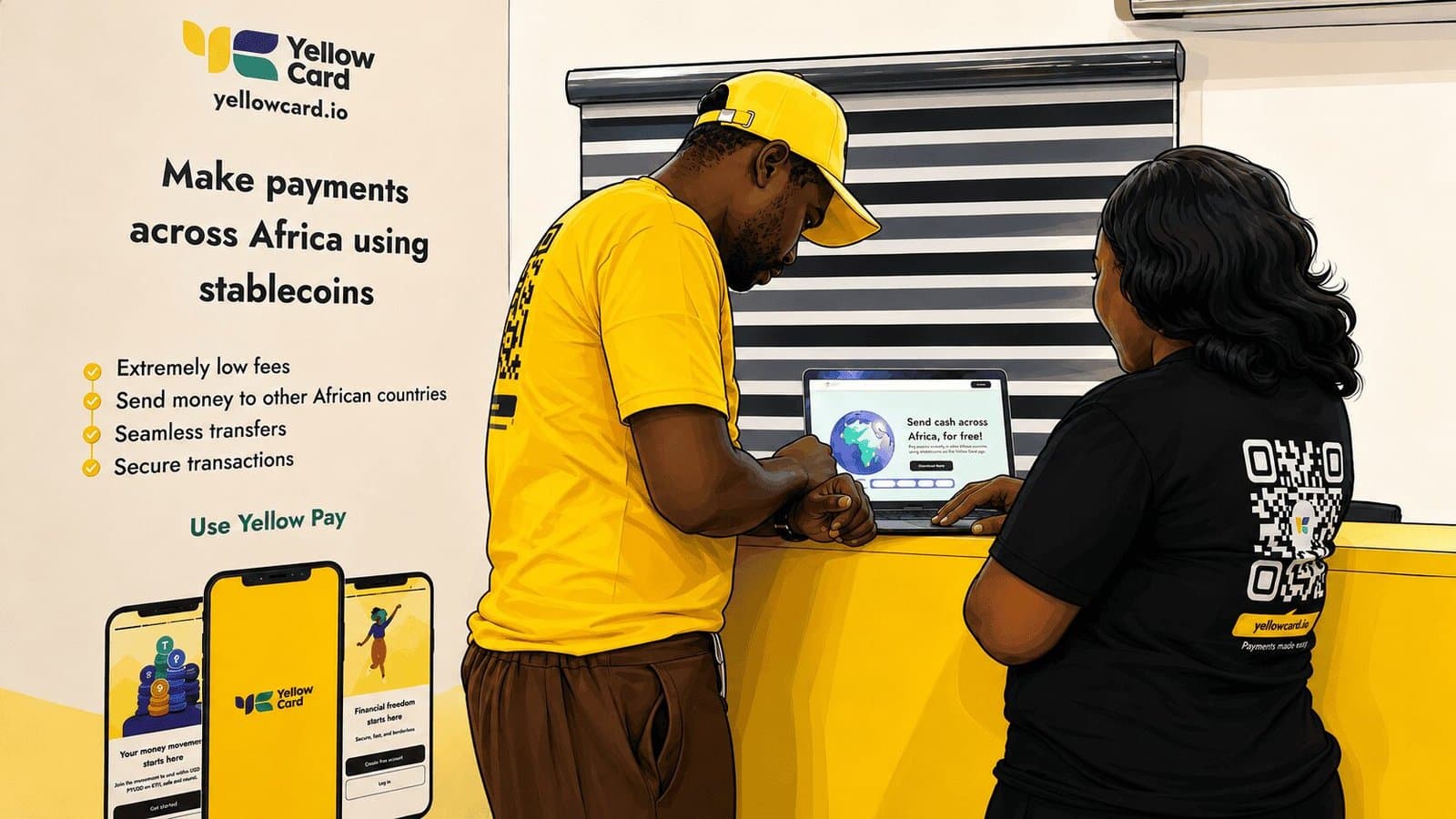

When a company raises $40 million, the number itself rarely tells you much about what comes next. The check size matters far less than the names signing it, and Yellow Card’s latest cap table reads like a roadmap.
Standard Chartered’s venture arm wrote a check. Sony’s innovation fund followed. Polychain Capital and Blockchain Capital rounded out a group that blends traditional banking weight with crypto-native conviction. That combination is not accidental, and it tells you where cross-border payments are heading.
Yellow Card, an Atlanta-founded stablecoin infrastructure company that built its network across Africa, is no longer pitching itself as a crypto startup. If you send or receive money across borders, the infrastructure this company is building could eventually touch your transactions.
What Yellow Card’s $40 million investor lineup signals about stablecoins
The $40 million strategic equity round, announced on August 5, 2026, pushes Yellow Card’s total equity financing past $120 million. SC Ventures, Standard Chartered’s venture arm, participated alongside Sony Innovation Fund, Polychain Capital, and Blockchain Capital, Yellow Card confirmed.
When a bank’s venture arm backs a stablecoin company, it signals internal strategic alignment with blockchain-based settlement. When Sony’s fund joins, it suggests institutional technology capital now views stablecoin infrastructure as a growth category on par with enterprise software.
Alex Manson, CEO of SC Ventures, connected the investment directly to the operational layer that makes stablecoins usable for businesses across emerging markets.
“Stablecoins are here to stay, but their adoption will depend on robust infrastructure and clear real-world utility. Yellow Card is building those rails for businesses across Africa, enabling them to access and move value efficiently across markets.” — Alex Manson, CEO of SC Ventures, via BusinessWire

How Yellow Card evolved from crypto exchange to bank infrastructure
Chris Maurice and Justin Poiroux founded Yellow Card in 2016 to challenge traditional cross-border banking infrastructure. The company initially served retail crypto users across African markets where dollar access was limited and expensive.

Yellow Card by the numbers:
- More than $10 billion in transactions processed since founding, the company reported in its announcement.
- Licenses, authorizations, or registrations in 22 jurisdictions across North America, Europe, and Africa.
- Support for more than 50 currencies through domestic payment rails in each market.
- Strategic partnerships with Visa, Mastercard, PayPal, and Coinbase; Visa and Western Union named as product users.
The company stopped serving retail customers as of January 2026, pivoting entirely to enterprise stablecoin infrastructure, Graphic Online reported. Its core product, Global USD Accounts, gives businesses a single account to hold dollars, swap stablecoins, manage treasury, and move local currencies through domestic rails in over 50 countries.
Maurice framed the ambition in terms that go beyond a typical infrastructure pitch. He told CoinDesk that he envisions “payments flow directly between banks onchain, without B2B payments companies or other payment service companies in the flow at all.”
The $5 trillion forecast driving institutional bets on stablecoin rails
Yellow Card’s round lands against a backdrop of growing institutional conviction in stablecoin-powered payments. Cross-border B2B stablecoin transactions are projected to reach $5 trillion by 2035, up from roughly $13.4 billion in 2026, Juniper Research estimated. The firm expects 85% of all stablecoin transaction value in 2035 to originate from business-to-business activity.
“Stablecoins are not replacing payments infrastructure; they are being adopted where the advantages are most pronounced,” Juniper Research analyst Jawad Jahan noted in the firm’s April 2026 report. “Cross-border B2B is where those advantages are greatest.”
Traditional correspondent banking relies on chains of intermediary banks, each adding fees, compliance checks, and processing delays to international transfers. Stablecoins settle on blockchain networks in seconds and operate around the clock, giving them a structural advantage over legacy rails.
What Yellow Card’s push into Latin America and Asia means for you
The new capital will extend Yellow Card’s approach from Africa into Latin America and Asia-Pacific, where fragmented banking systems and currency controls create similar demand for faster dollar access. Austin Noronha, Managing Director of Sony Ventures-US, called the company’s approach “practical for banks, fintechs, and enterprises” and cited its regulatory-first strategy as a differentiator, the company noted.
For anyone who sends money overseas or runs a business that pays suppliers across borders, stablecoin infrastructure could eventually shorten settlement times and lower costs. The catch is that banks need to integrate these rails into their existing systems before consumers see those benefits at scale.