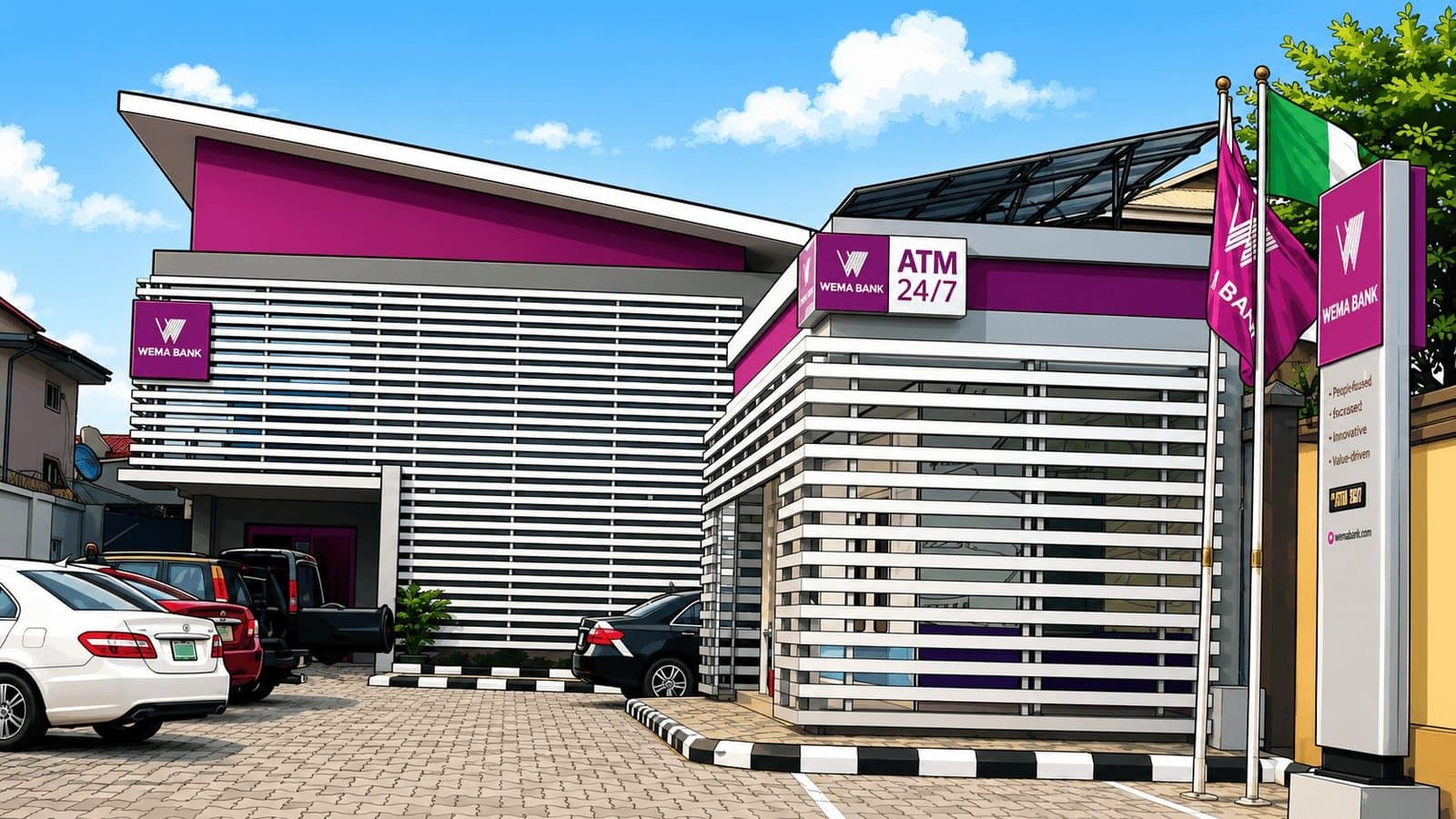

The Nigerian Exchange closed on August 5, 2026, with its benchmark index rising a mere 0.04% to settle at 244,912.24 points. That slim gain hid a difficult session, with 27 stocks declining and only 20 managing to end the day with any gains at all.
Consumer goods names fell sharply, blue-chip banking shares slipped, and profit-taking hit the most liquid names across the entire board. One mid-cap bank, though, stayed nearly flat while the rest of the market moved sharply against large-cap holders across multiple sectors.
Wema Bank opened at ₦28.10, closed at ₦28.05, and gave investors almost nothing to worry about on a day of broad selling. Its stability on a volatile trading day raises a question that matters for anyone following the Nigerian equities market heading into August. The answer sits in a set of half-year earnings figures that landed on the NGX just days before this session unfolded for the broader market.
Wema Bank’s flat close on August 5 obscures a deeper NGX selloff
The All-Share Index added roughly ₦70.62 billion in market capitalization during the August 5 session, pushing total market value to ₦158.09 trillion, Nairametrics reported.
PZ Cussons Nigeria and Honeywell Flour Mills each fell 9.94% on the session, leading a steep decline across consumer goods tickers on the exchange. Among the heavyweight banks, GTCO dropped 1.54%, Zenith Bank eased 1.05%, UBA lost 1.33%, and Access Holdings slid 1.14% during the session.

Wema Bank traded 12,921 shares and closed with a loss of just five kobo, barely moving from its ₦28.10 opening price. The stock sits at ₦28.05 within a 52-week range of ₦16.45 to ₦36.00, having risen from ₦20.40 at the end of 2025, BusinessDay reported. That stability, backed by fresh earnings data filed just days before, may explain why holders chose to sit tight instead of selling.
Wema Bank’s H1 2026 earnings offer a clue behind the stock’s resilience
The bank filed its half-year 2026 results on July 29, revealing pre-tax profit of ₦154.56 billion, a 53.65% increase over H1 2025, Nairametrics confirmed.
Profit after tax reached ₦131.37 billion for the six months ended June 30, representing a 50.12% jump from ₦87.51 billion the year before. Interest income surged 42.70% year-on-year to ₦342.64 billion, while net interest income climbed 51.25% to ₦195.45 billion during the same period.

Total assets crossed ₦5.76 trillion by mid-year, up 13.51% from ₦5.07 trillion at the close of December 2025, the bank’s NGX filing showed. Customer deposits also expanded to ₦3.45 trillion from ₦3.29 trillion, reinforcing the lender’s growing retail footprint across the Nigerian banking landscape. Trading income also rebounded sharply, with net trading gains jumping 657.42% year-on-year to ₦21.53 billion from just ₦2.84 billion in H1 2025.
Wema Bank’s MD hints at acquisitions as analysts flag a strategic shift
The H1 numbers drew attention from at least one prominent analyst who tracks Wema Bank’s trajectory for institutional investors in the mid-cap space. The bank’s strategy appears to be shifting from organic growth toward a more aggressive expansion framework that could include acquisitions and consolidation. Qudus Adebara, a research analyst at DLM Capital Group, outlined that view in a note published on Simply Wall St.
The bank’s own leadership has echoed that positioning, with the managing director hinting at conserving capital for future strategic moves at a shareholder meeting.
“We’re keeping our gunpowder dry… we felt that at this point in time the dividend paid was appropriate, taking into cognisance that there may be opportunities in the future that we will want to take advantage of,” Moruf Oseni, Wema Bank’s managing director, told shareholders at the lender’s annual general meeting in May 2026, Nairametrics reported.

Wema Bank’s returns and valuation signal further room to grow
The bank has delivered an annualized return on average equity of approximately 39.8% based on its first-half performance alone, BusinessDay noted. Its H1 2026 profit after tax of ₦131.37 billion already represents about 67.5% of the bank’s full-year 2025 earnings figure of ₦194.48 billion. At the time of the H1 release, the stock traded at roughly 5.92 times trailing earnings, below the Nigerian banking sector average, BusinessDay reported. If the second half continues at a comparable pace, Wema Bank could meaningfully surpass last year’s record result, the BusinessDay analysis indicated.
Wema Bank H1 2026 at a glance
- Pre-tax profit: ₦154.56 billion, up 53.65% year-on-year from ₦100.59 billion (Source: Nairametrics)
- Profit after tax: ₦131.37 billion, up 50.12% from ₦87.51 billion in H1 2025
- Interest income: ₦342.64 billion, up 42.70% from ₦240.12 billion
- Total assets: ₦5.76 trillion, up 13.51% from ₦5.07 trillion at year-end 2025
- Customer deposits: ₦3.45 trillion, up 4.96% from ₦3.29 trillion
- Stock price on August 5: ₦28.05 (52-week range: ₦16.45 to ₦36.00)
- Dividend: ₦1.25 per share, 25% higher than the prior year (Source: BusinessDay)
Cowry Asset Management expects fresh earnings to stabilize the NGX in August
The prior session on August 4 saw the ASI fall 0.38%, erasing roughly ₦599 billion from total market capitalization in just one trading day. The Banking Index dropped 1.27% on August 4, leading a market-wide rout that also pulled Consumer Goods down by 1.25%, the Nigerian Tribune reported.
By August 5, banking stocks rebounded with a 0.69% gain on the sectoral index, powered mainly by First HoldCo’s sharp 5.38% single-session surge. The firm’s analysts indicated they see room for the market to recover once additional H1 2026 earnings reports reach the exchange, Nairametrics reported.
Wema Bank’s near-flat close on August 5 suggests that investors who own the stock see enough in the earnings story to resist the selling. Whether that conviction holds through a deeper market correction will depend on how the rest of 2026 plays out for the mid-cap lender.