
Nigerian exporters woke up to a more expensive reality on July 24, 2026, after the Trump administration finalized a 12.5% tariff on goods entering the United States from Nigeria.
The duty is part of a sweeping trade action targeting 60 economies under Section 301 of the Trade Act of 1974, a legal tool that allows Washington to penalize foreign practices it considers unfair or harmful to American commerce.
Nigeria did not land in the lower bracket reserved for countries that have adopted or committed to banning imports produced with forced labor, meaning its exporters now shoulder a steeper cost burden than peers in the United Kingdom, India, and Canada.
Bilateral trade between the two countries reached nearly $15 billion in 2025, and more than 100 American companies operate in Nigeria, U.S. Chargé d’Affaires Keith Heffern disclosed at an event in Lagos earlier in July.
Nigeria’s 12.5% rate is higher than what the UK, India, and Canada face
The Office of the United States Trade Representative announced the tariffs on July 23, 2026, splitting the 60 investigated economies into two groups based on their forced labor enforcement posture.
Countries that already enforce a forced labor import ban or have committed to one through a reciprocal trade agreement received a 10% rate, the USTR fact sheet indicated. Argentina, Bangladesh, Canada, India, Indonesia, Malaysia, Mexico, Pakistan, and the United Kingdom all fell into that lower group.
Nigeria, along with Brazil, China, Egypt, South Africa, Saudi Arabia, the United Arab Emirates, Venezuela, and Vietnam, received the higher 12.5% rate for not adopting or enforcing such prohibitions, the agency confirmed.
“The United States has had a forced labor import ban for nearly a century and rigorously enforces it; it’s well past time for our trading partners to do the same,” U.S. Trade Representative Jamieson Greer said in the announcement.

How the tariff replaces duties the Supreme Court struck down
The new duties did not emerge in isolation; they are the latest chapter in a prolonged battle over presidential tariff authority that has reshaped American trade policy since early 2025.
President Trump initially imposed country-specific tariffs under the International Emergency Economic Powers Act in April 2025, with rates as high as 50% on some trading partners. The U.S. Supreme Court invalidated that framework in February 2026, ruling that IEEPA did not grant the executive branch unilateral taxation powers.
The administration responded by imposing a temporary 10% tariff on all imports under Section 122, a provision that expires after 150 days without congressional renewal. That expiration date fell on July 24, 2026, creating a deadline the Section 301 action was designed to meet.
Section 301 carries stronger legal footing because courts have upheld its use in prior trade disputes, including the HMTX Industries case, where the Supreme Court denied certiorari in June 2026, a Congressional Research Service analysis noted.
What the tariff means for Nigeria’s $5 billion export relationship
Nigeria exported $5 billion worth of goods to the United States in 2025, with crude oil and petroleum products accounting for the overwhelming majority of that total, USTR trade data showed.
The new tariff structure does include exemptions for specific product categories, including oil and gas, fertilizers, and certain food items, which could limit the direct impact on Nigeria’s largest revenue earner in the American market.
Non-oil exports to the United States made up a small but growing share of the $5 billion total, covering products like cocoa, lead, oilseeds, and rubber, Trading Economics data showed. Those categories face the full weight of the 12.5% surcharge.
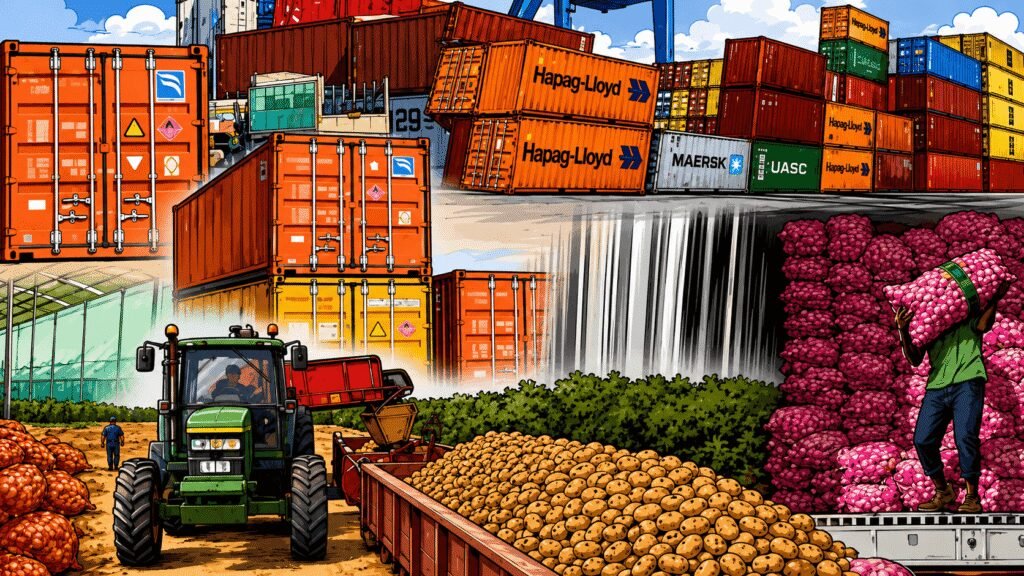
The tariff arrives at a difficult moment for Nigerian exporters. Data from the National Bureau of Statistics showed that Nigeria’s exports to the United States fell 23.69% year over year in the first quarter of 2026, dropping to 1.18 trillion naira from 1.54 trillion naira in the same period a year earlier, The Punch reported.
The forced labor rationale faces skepticism from trading partners
Several trading partners have pushed back on the stated justification for the tariffs, questioning whether forced labor enforcement is the genuine objective or whether the action is primarily a legal mechanism to rebuild the tariff wall the Supreme Court dismantled.
The investigation is less about labor standards and more about pressuring countries to adopt Washington’s ban on Chinese forced labor goods while simultaneously reconstructing the tariff regime the court struck down, analysts told CNBC.
The USTR investigation involved two rounds of public hearings, more than 2,100 public comments, and consultations with over 45 governments before the final determination was issued, the agency stated. Over 100 witnesses testified during hearings held from July 7 to July 9, 2026.
Key facts about the new tariff on Nigeria
- Nigeria faces a 12.5% tariff rate under Section 301, the higher of the two tiers imposed on 60 economies.
- Countries with forced labor import bans, including the UK, India, and Canada, received a lower 10% rate instead.
- Oil, gas, fertilizers, and certain food products are exempt from the new duties.
- The tariffs cover 99.4% of all U.S. imports and replace the expired 10% Section 122 tariff.
- Bilateral trade between Nigeria and the United States reached nearly $15 billion in 2025.
Nigeria’s trade relationship with Washington enters uncharted territory
Just weeks before the tariff took effect, U.S. Chargé d’Affaires Keith Heffern celebrated the growing commercial partnership at the American Independence Day event in Lagos, noting a 14% increase in bilateral trade and calling Nigeria an indispensable partner on the African continent, Vanguard reported.
The new tariff complicates that optimistic framing considerably, especially for non-oil exporters who now face a combined cost burden that could push effective duties well beyond what competitors in 10% tier countries pay for identical goods entering the American market.