
Nigeria’s tax system just gained its first independent office dedicated to taxpayer protection, and its opening move signals just how broken trust has been.
Dr. John Nwabueze, the country’s inaugural Tax Ombud, unveiled a comprehensive institutional roadmap at a stakeholder forum held in Lagos on July 23, 2026.
His office has launched a toll-free call center, a digital case-tracking portal, and formal procedures for handling taxpayer complaints that remain unresolved through regular channels.
The deeper question is whether one new office can reshape a system where overlapping levies and opaque enforcement have kept voluntary compliance near historic lows.
Nigeria’s Tax Ombud reveals a complaint and dispute resolution framework
Nwabueze delivered the roadmap at a stakeholder engagement themed “Promoting Fairness, Transparency, and Trust in Tax Administration in Nigeria,” attended by the country’s leading professional bodies.
More on Nigeria’s tax reforms:
- Nigeria Tax Act 2025 explained: every change that takes effect in 2026
- Joint Revenue Board explained — how federal and state taxes now coordinate
- How to file your personal income tax in Nigeria (FIRS/NRS step-by-step)
The Office of the Tax Ombud was created under the Joint Revenue Board Establishment Act of 2025, which President Bola Tinubu signed into law last year. Since its creation, the office has established governance structures, taxpayer education programs, and a technology-driven system for tracking complaint resolutions in real time, PRNigeria reported.
The office unveiled its website and digital case management portal on May 18, 2026, the Federal Ministry of Information and National Orientation confirmed.
Nwabueze also confirmed his office has begun international benchmarking with established tax ombuds, including South Africa’s, to strengthen institutional capacity and import proven dispute resolution models.
The taxpayer is not an interruption of the work of our institutions. The taxpayer is the reason those institutions exist. — Dr. John Nwabueze, Tax Ombud

Why Nigeria’s tax-to-GDP ratio still trails most of Africa
Nigeria collects roughly 13% of GDP in tax revenue, among the lowest ratios globally, Africa.com reported. The African average stood at 16.1% in 2023, the OECD’s Revenue Statistics in Africa 2025 found.
Key challenges Nigerian taxpayers face
- Businesses in some states pay overlapping levies to federal, state, and local revenue agencies simultaneously
- Roughly 60 tax heads existed at the subnational level before reforms began collapsing them into nine standardized categories
- Limited formal dispute resolution channels have left individuals and small businesses without meaningful recourse against revenue authorities
- Public awareness of taxpayer rights and available protections remains notably low across most of the country
The Joint Revenue Board has worked to consolidate those roughly 60 different tax heads into just nine standardized categories at the subnational level. Sixteen of Nigeria’s 36 states have now adopted that harmonized framework, JRB Executive Secretary Olusegun Adesokan confirmed, Nairametrics reported.
Olufemi Olarinde, Special Adviser on Revenue to Finance Minister Taiwo Oyedele, framed the broader reform effort as a social contract between government and citizens rather than merely a revenue mechanism, the report noted.
Reform cannot succeed in isolation. It requires dialogue, feedback, and the honest exchange of ideas between government, citizens, and businesses. — Olufemi Olarinde, Special Adviser on Revenue to Finance Minister

The federal government is targeting an 18% tax-to-GDP ratio in the medium term, driven by four landmark tax laws that took effect in January 2026, BusinessDay noted.
Nigerian Bar Association calls for binding legal authority behind the Tax Ombud
Not everyone at the Lagos forum focused on what the Tax Ombud has built; some participants questioned whether the office has enough power to deliver meaningful results.
NBA President Mazi Afam Osigwe identified multiple taxation, administrative bottlenecks, illegal collections, and weak public awareness as the system’s biggest structural obstacles, Nairametrics indicated. He called for binding legal authority behind the Tax Ombud’s decisions so the office can effectively override arbitrary enforcement actions by revenue agencies.
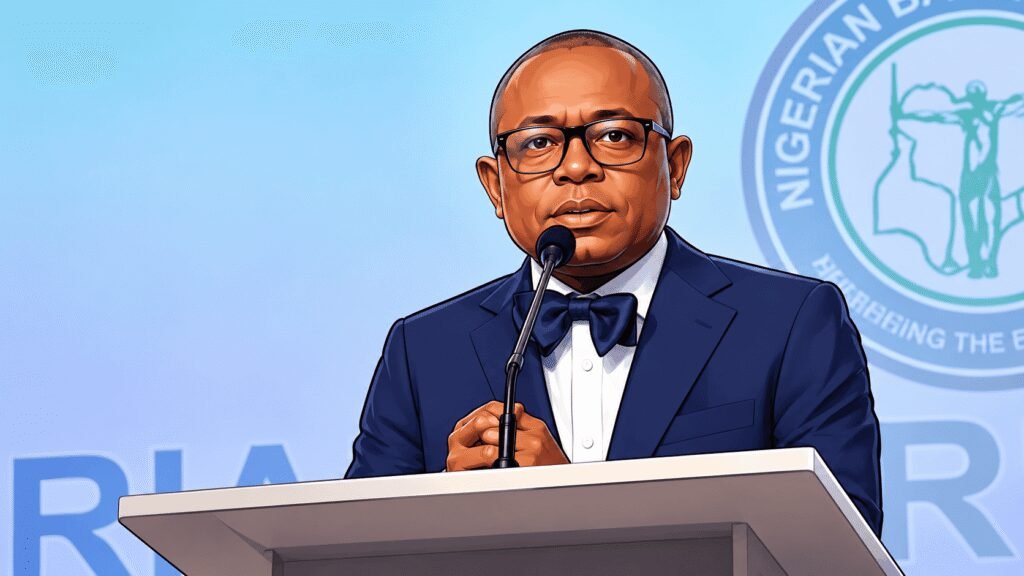
Nwabueze acknowledged the legislative gap, confirming that amendments to strengthen the OTO’s establishing law are being pursued with the National Assembly, Economic Confidential reported.
“The law that created the Office of the Tax Ombud is not as robust as it should be,” Nwabueze told stakeholders at the engagement.
ICAN Vice President Mazi Etofolam Osuji reinforced that position, urging tax authorities and accounting professionals to treat fairness and transparency as non-negotiable foundational principles in administration.
Tax Ombud plans to publish taxpayer rights in three Nigerian languages
Nwabueze disclosed that his office will soon release a comprehensive Taxpayer Bill of Rights translated into three major Nigerian languages to broaden public awareness.
That document would become the first formal, widely accessible declaration of the protections available to ordinary citizens when engaging with revenue authorities across Nigeria.
“Our mandate is to mediate disputes, resolve complaints at minimal cost, and create a tax environment where voluntary compliance thrives because taxpayers have confidence in the system,” Nwabueze said.
Whether the OTO delivers on that vision hinges on two factors: how quickly remaining states adopt the harmonized framework and whether the National Assembly grants binding authority. Nigerian taxpayers now have a new institutional channel for filing grievances, but the system’s capacity to produce meaningful outcomes remains an open question.