
The total volume of physical naira notes and coins moving through Nigeria’s economy recorded a notable month-on-month decline in June 2026, reversing a recent upward trend. The drop comes against the backdrop of aggressive digital payment expansion and a central bank that has repeatedly signaled its intention to shift everyday commerce away from paper currency.
If you have noticed fewer lower-denomination notes at fuel stations and open markets, the numbers now confirm that the trend extends far beyond perception. Something structural appears to be shifting in how Nigerians transact, and the central bank’s own data captures the earliest evidence of that shift playing out in the aggregate figures.
The question for households, businesses, and market participants is whether this decline represents a temporary seasonal adjustment or the beginning of a sustained drawdown that could reshape liquidity dynamics across the informal economy.
CBN data shows ₦167 billion monthly drop in currency in circulation
Total currency in circulation fell to ₦5.523 trillion in June from ₦5.690 trillion the previous month, a decline of approximately ₦166.68 billion, according to the Central Bank of Nigeria’s Money and Credit Statistics. The month-on-month contraction marks a reversal from the steady buildup of physical cash that characterized much of the first half of the year.
Currency outside banks, which captures cash held by households, traders, and businesses rather than deposited in financial institutions, dropped even more sharply. That figure fell to ₦4.92 trillion in June from ₦5.19 trillion in May, representing a ₦270 billion monthly decline that suggests physical naira flowed back into the banking system at an accelerated pace.

Bank reserves rose by ₦233.23 billion during the same period, climbing to ₦33.996 trillion from ₦33.763 trillion, while the CBN’s Special Intervention Reserve held steady at ₦329.39 billion. The simultaneous drop in street-level cash and increase in institutional reserves paints a picture of money migrating from informal channels into regulated ones.
Digital payments surge as Cardoso pushes to dethrone cash
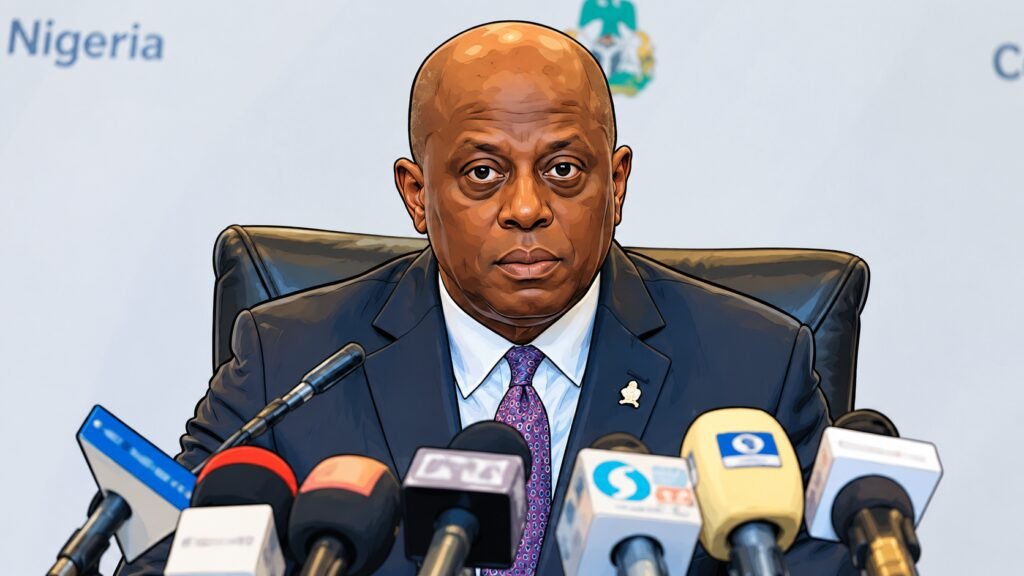
The June figures land weeks after CBN Governor Olayemi Cardoso unveiled the Nigeria Payments System Vision 2028, a sweeping roadmap designed to cut the share of cash held outside banks from roughly 90% to below 40% within three years. Cardoso framed the initiative as a national priority during the Future of Banking Summit organized by CNBC Africa earlier this year.
“Payment systems are no longer simply banking infrastructure. They have become strategic national infrastructure,” Cardoso said at the summit, according to Leadership.
That ambition is backed by hard transactional data from the Nigeria Inter-Bank Settlement System. Electronic payment transactions reached an all-time high of ₦1.07 quadrillion in 2024, representing a 79.6% year-on-year jump from ₦600 trillion the previous year, NIBSS reported. Point-of-sale transactions alone surged to ₦18.78 trillion in the first quarter of 2026, a 79% increase over the same period in 2025, National Daily reported, citing NIBSS data.
Year-on-year cash levels still rising despite monthly dip
The monthly decline does not tell the full story. Compared with June 2025, when currency in circulation stood at ₦5.008 trillion, the latest figure still reflects a year-on-year increase of ₦515.78 billion, or roughly 10.30%. Cash in the Nigerian economy remains elevated by historical standards, and many sectors continue to operate with heavy dependence on physical naira.
Key figures from the CBN’s June 2026 monetary data
- Currency in circulation: ₦5.523 trillion, down ₦166.68 billion from May (CBN Money and Credit Statistics)
- Currency outside banks: ₦4.92 trillion, down from ₦5.19 trillion in May
- Bank reserves: ₦33.996 trillion, up ₦233.23 billion from May
- Year-on-year change: currency in circulation up 10.30% from ₦5.008 trillion in June 2025
- Broad money supply (M3): ₦133.25 trillion, up from ₦129.21 trillion in May (CBN)
Retail markets, transportation networks, and rural communities still rely heavily on physical naira for daily commerce. Cardoso himself acknowledged the gap during a monetary policy briefing in July 2026, attributing the scarcity of ₦100 and ₦200 notes to growing digital adoption and reduced purchasing power rather than any deliberate withdrawal, Neusroom reported.
CBN’s PSV 2028 targets 95% financial inclusion and 10 million digital acceptance points
The central bank’s roadmap goes well beyond reducing cash volumes. The PSV 2028 framework targets 95% financial inclusion among Nigeria’s adult population and envisions more than 10 million QR-code and tap-to-pay acceptance points deployed across markets, transport hubs, and rural communities nationwide.
Cardoso told regulators and fintech operators at the PSV 2028 launch that the regulator’s ambition is to position Nigeria as Africa’s leading digital payments hub. He described the persistent preference for cash among traders as a trust deficit the institution must solve, not a consumer problem to blame, according to Gazettengr.
For ordinary Nigerians watching these numbers, the June data suggests the transition is no longer theoretical. Physical cash is beginning to recede from the system, even if the pace remains uneven and the informal economy’s reliance on paper currency is far from over.