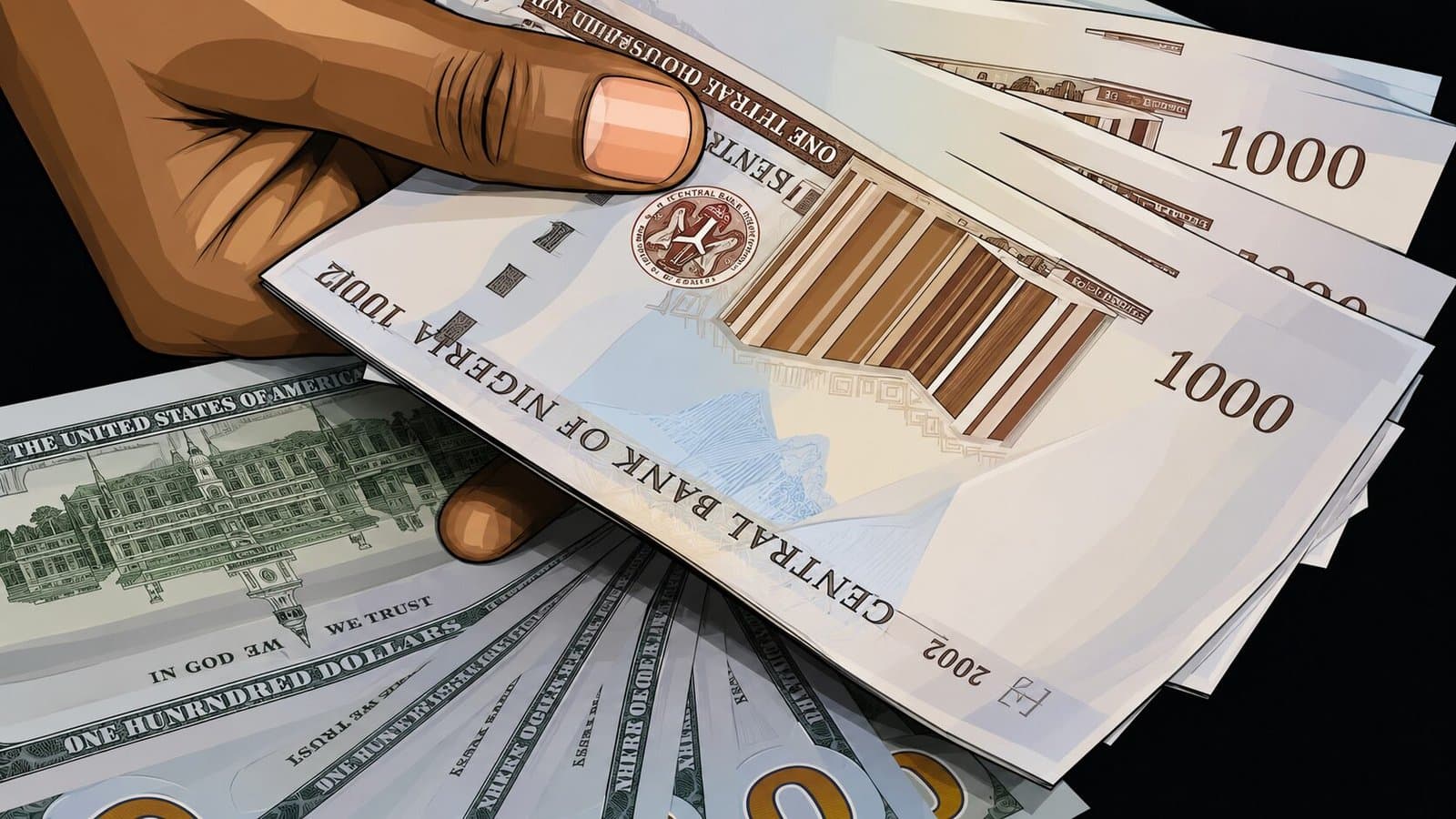

On June 4, 2026, the naira settled at ₦1,359.75 per dollar at the official Nigerian Foreign Exchange Market window. That rate pushed the currency below the ₦1,360 mark for the first time since May 6, 2026, snapping a four-week stretch above that level. The move arrived alongside external reserves that climbed to $49.96 billion, placing them within striking distance of $50 billion.
Reserve growth, a newly revised foreign exchange rulebook, and declining inflation are converging at once behind this shift. Whether the naira can sustain this trajectory will shape everything from import costs to consumer prices across the country.
CBN exchange rate data confirms naira’s four-week best
The naira’s June 4 closing rate represented the currency’s strongest finish since it traded at ₦1,357.34 on May 6, 2026. Trading remained orderly throughout the session, according to data published on the Central Bank of Nigeria’s exchange rate portal.

In April 2025, the naira was trading at ₦1,602 per dollar, meaning the currency has strengthened by roughly 15% over 14 months, Legit.ng reported. Bismarck Rewane, chief executive officer of Financial Derivatives Company, projected in December 2025 that the naira could settle within ₦1,450 to ₦1,500 during 2026, Legit.ng reported. The currency has outperformed that forecast, trading well below its projected floor.
Rising reserves give the CBN a stronger hand in the FX market
Nigeria’s gross external reserves reached $49.96 billion as of June 3, 2026, according to CBN data. The reserves climbed to $49.87 billion as of June 2, a gain of $1.55 billion (3.2%) from $48.32 billion on May 7, BusinessDay reported, before rising further to $49.96 billion the following session. The CBN’s 2026 macroeconomic outlook had set a year-end target of $51.04 billion, now within reach.
Dr. Muda Yusuf, chief executive officer of the Centre for the Promotion of Private Enterprise, has pointed to reserves as the naira’s most critical anchor. “The prospects for the stability of the naira are quite bright. This is largely because our foreign reserves are very strong, and reserves play a critical role in determining the strength and stability of any currency,” Yusuf said, speaking to Nairametrics.

Yusuf has also noted that the reserve buildup has been powered by channels beyond crude oil, including diaspora remittances, portfolio flows, and non-oil exports, Daily Trust reported. Net foreign exchange inflows tripled to $9.22 billion in January 2026, up from $3.11 billion in December 2025, CBN data showed.
CBN’s revised foreign exchange manual adds new market discipline
The naira’s recent strength coincides with the CBN’s fourth edition of the Foreign Exchange Manual, which took effect on June 1, 2026. The revised rulebook replaced the previous edition issued in 2018, closing an eight-year gap in the regulatory framework.
“Foreign exchange is more than a financial instrument; it is a critical enabler in any open economy,” CBN Governor Olayemi Cardoso stated at the launch in Abuja, Economic Confidential reported.

Key provisions in the revised FX manual
- Allowable advance payment for imports increased from 15% to 30%, easing access for businesses
- Foreign companies in the extractive industry granted 100% access to their export proceeds
- 75% of Personal Travel Allowance and Business Travel Allowance transactions must now be processed electronically
- Clearer penalties introduced for infractions and market abuses to strengthen enforcement
Risks that could stall the naira’s momentum
Despite the positive signals, global oil price volatility remains the most immediate threat to the naira’s recent gains. Crude exports remain central to Nigeria’s foreign exchange earnings, and Rewane has warned that a sustained drop below $65 per barrel would tighten dollar supply, Legit.ng reported. The parallel market rate stood at ₦1,395 per dollar in early June, creating a spread of roughly ₦35 against the official closing rate.
Mustafa Abdullahi, a bureau de change operator in Abuja, told Nairametrics that the incentive to hoard foreign currency has declined as liquidity improves.
“The dynamics of the market are changing. As confidence improves and liquidity increases, more people are willing to sell dollars rather than hold on to them,” Abdullahi noted.
Key data points behind the naira’s June 2026 performance
- Official closing rate on June 4, 2026: ₦1,359.75 per dollar, the strongest since May 6
- Gross external reserves as of June 3, 2026: $49.96 billion, up from $48.32 billion on May 7
- Year-over-year comparison: ₦1,359.75 versus ₦1,602 in April 2025, a gain of roughly 15%
- Net FX inflows in January 2026: $9.22 billion, triple the $3.11 billion recorded in December 2025