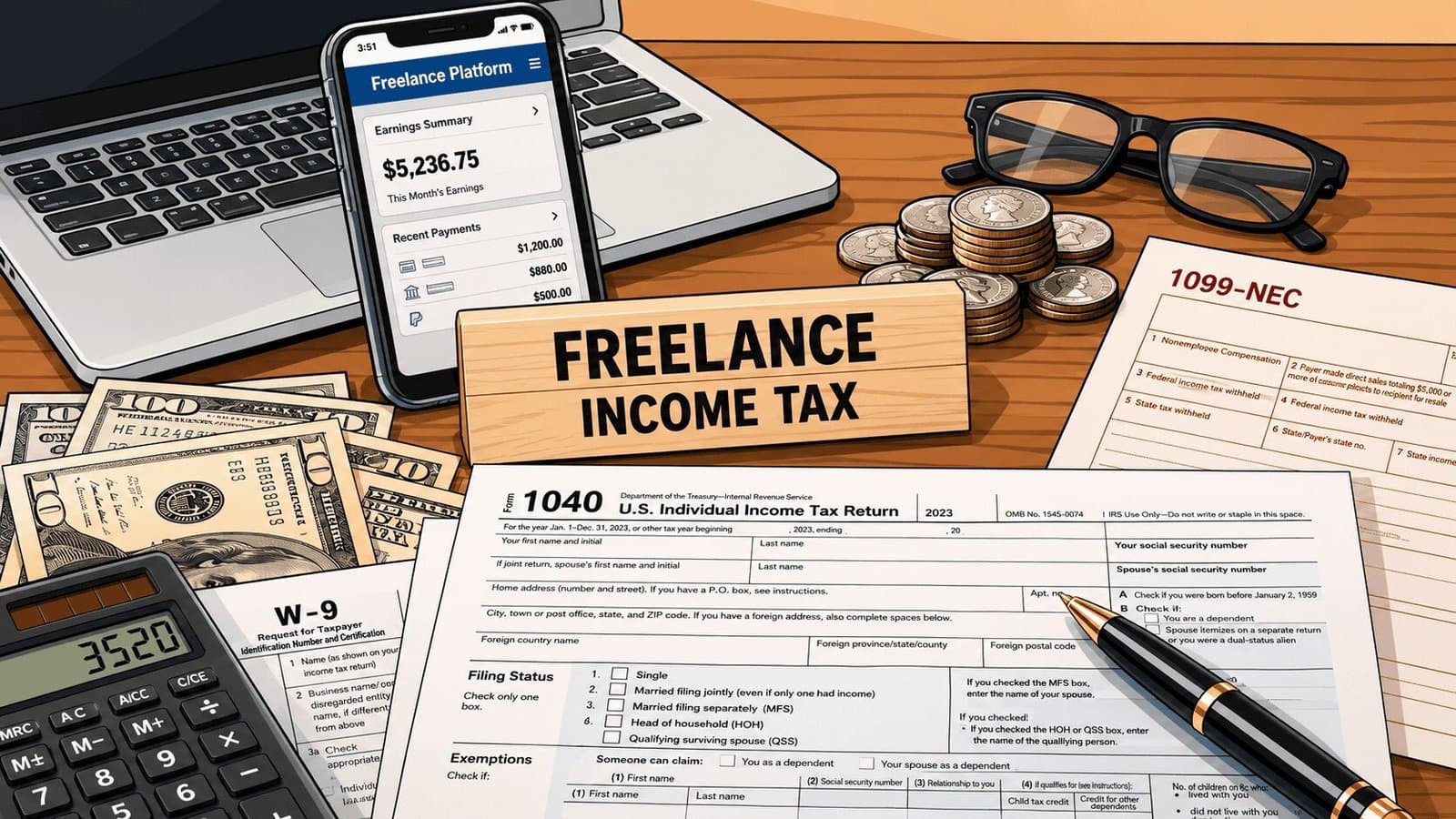

You finished a ₦2 million design sprint for a fintech startup, collected the payout through Wise, and moved on to the next gig. Nobody deducted anything from the transfer, and no tax slip appeared in your inbox. That silence can feel like permission, but it is not.
Under the Nigeria Tax Act 2025, which took full effect on 1 January 2026, every naira you earn from freelance work counts as taxable business income. The law applies equally to local gigs paid in naira and foreign contracts settled in dollars, euros, or cryptocurrency.
If you live in Nigeria for 183 days or more in a calendar year, your worldwide income falls within the tax net. The Nigeria Revenue Service now uses AI-driven tools and cross-references bank data to detect underreporting, Remote Solutions Africa reported. Here is what every self-employed professional needs to understand about freelance income tax Nigeria obligations.
How the Nigeria Tax Act classifies freelance receipts as business income
The Act classifies all freelance earnings under personal income tax, with progressive rates from 0% to 25% based on annual taxable profit. Your first ₦800,000 in taxable income is exempt, up from ₦300,000 under the repealed Personal Income Tax Act, KPMG noted. Income above the exemption is taxed across six progressive bands: 15% on the next ₦2.2 million, 18% on the next ₦9 million, 21% on the next ₦13 million, 23% on the next ₦25 million, and 25% only on taxable income above ₦50 million, according to the Fourth Schedule of the Act.
More on Nigerian taxes:
Penalties under the Nigeria Tax Administration Act 2025
Taiwo Oyedele, now Nigeria’s Minister of Finance, set the compliance expectation while chairing the Presidential Fiscal Policy and Tax Reforms Committee during a 2025 briefing covered by TechCabal.
“You are supposed to report yourself, calculate your tax, and pay if your income is above the threshold,” Oyedele said.

Do freelancers pay tax in Nigeria if they only earn in foreign currency? Yes, without exception. Adewunmi Adewole, an accountant interviewed by TechCabal, explained that foreign clients cannot deduct withholding taxes on your behalf, so the full self-assessment burden falls on the freelancer.
Registration, TIN, and the penalties for non-compliance
Every taxable person must register for a Tax Identification Number through the Joint Tax Board portal at jtb.gov.ng using a BVN and valid national ID. Freelancers who skip registration face a ₦50,000 fine in the first month and ₦25,000 for each subsequent month, the Nigeria Tax Administration Act states.
Filing a late return triggers steeper consequences: ₦100,000 in the first month and ₦50,000 for every month after, TechCabal reported. False income declarations can bring fines up to ₦1 million or a prison term of three years, or both.
Once registered, freelancers must self-assess their annual income and file returns by 31 March of the year following the tax year. For income earned in 2026, the filing deadline is 31 March 2027 through the NRS digital portal.
How the NRS treats foreign client payments through Wise, Payoneer, and crypto
Freelance tax Nigeria 2026 rules leave no ambiguity about foreign-source earnings. If you receive $1,000 and the CBN official rate that day is ₦1,550 per dollar, your taxable income from that payment is ₦1,550,000. The official rate on the date of receipt governs every conversion, not the parallel market rate.
Payments through Wise, Payoneer, or Upwork link to your BVN or bank account, making them fully traceable. Oyedele warned the NRS can approach platforms for income reports directly. “The number of platforms paying you isn’t many,” he said, signaling the agency’s intent to cross-reference payment data with tax filings.
Cryptocurrency earnings received for freelance services are also taxable. Crypto profits fold into your regular income calculation rather than being taxed as separate capital gains, Juicyway reported in its guide to the reform. Crypto losses do not generate a tax deduction under the current framework, Juicyway noted.
Allowable deductions that reduce your freelance tax bill
You pay tax on profits, not gross receipts, and this distinction saves most freelancers meaningful money. The NRS allows legitimate business expenses to reduce your taxable base before applying the progressive bands.
Common deductible expenses for Nigerian freelancers
- Home office costs: A proportional share of rent, electricity, and internet for a dedicated workspace at home.
- Equipment: Laptops, monitors, cameras, microphones, and other tools purchased specifically for professional use.
- Software subscriptions: Design tools, project management platforms, cloud storage, and accounting software for client work.
- Internet and phone bills: Costs directly tied to delivering freelance services, with personal usage excluded from the claim.
- Marketing: Website hosting, domain registration, social media advertising, and portfolio platform subscriptions.
A freelancer earning ₦4.8 million annually with ₦600,000 in documented expenses reduces taxable profit to ₦4.2 million before reliefs are applied. After applying the eligible deductions under the NTA, including pension contributions, rent relief capped at ₦500,000, and National Housing Fund payments, the effective rate can drop significantly for mid-level earners, a worked example in the SmartSMSSolutions freelancer guide illustrated.
Withholding tax on professional fees dropped from 10% to 5%
When a Nigerian company pays you for consulting, design, writing, or any professional service, it must deduct withholding tax at source before sending your payment. The 2026 reform halved the WHT rate on professional services from 10% to 5% for payments to Nigerian residents, Reanda International confirmed. Collect every WHT credit note and offset the total against your income tax liability when filing your annual return.
Foreign clients have no Nigerian tax registration and cannot deduct WHT on your behalf, which makes self-assessment the only compliance path for freelancers whose revenue comes predominantly from outside the country.
When freelancers must register for VAT under the ₦25 million threshold
VAT registration becomes mandatory when your taxable supplies exceed ₦25 million in any rolling 12-month window, under Section 37 of the Nigeria Tax Act, Taxly confirmed. You must then charge 7.5% VAT on invoices and file monthly returns. Most freelancers earning below ₦2.1 million monthly will not trigger this. Services exported to foreign clients qualify for 0% zero-rated classification.
Records to keep and the annual filing schedule for freelancers
Essential records for freelance tax compliance in Nigeria
- Bank statements showing all inflows from clients, including domiciliary account transactions in foreign currency.
- Invoices issued to every client, with dates, amounts, and the CBN exchange rate applied to foreign currency conversions.
- Receipts for all business expenses organized by category: equipment, software, internet, marketing, and professional development.
- WHT credit notes from Nigerian clients who deducted tax at source before paying your invoices.
- Platform payout records from Wise, Payoneer, Upwork, Fiverr, or any other freelance payment service you use.
The annual return deadline is 31 March, filed through the NRS digital portal. Oyedele, speaking at a forum covered by Blueprint, stressed that understanding which deductions apply and what records to maintain will determine whether freelancers save money or face avoidable penalties under the new regime.