



If you hold money in a Nigerian bank or follow African markets, a significant shift just landed on global investors’ radar.
S&P Global Ratings has moved Nigeria’s biggest lenders up a notch, following a sovereign upgrade that capped positive actions by Fitch and Moody’s.
The decision touches household names that millions of Nigerians use for salaries, business loans, and mortgages across the federation today.
For depositors, borrowers, and shareholders, the upgrade signals meaningful change inside the banking system after two punishing years of currency shocks.
Here is what the new ratings reveal about where Nigerian banks now stand and what the move could mean for your money.
S&P upgrades seven Nigerian banks to ‘B’ on stronger sovereign profile
The agency raised long-term global scale ratings on seven institutions from ‘B-‘ to ‘B’ and attached a stable outlook to each lender, S&P Global confirmed in its statement.
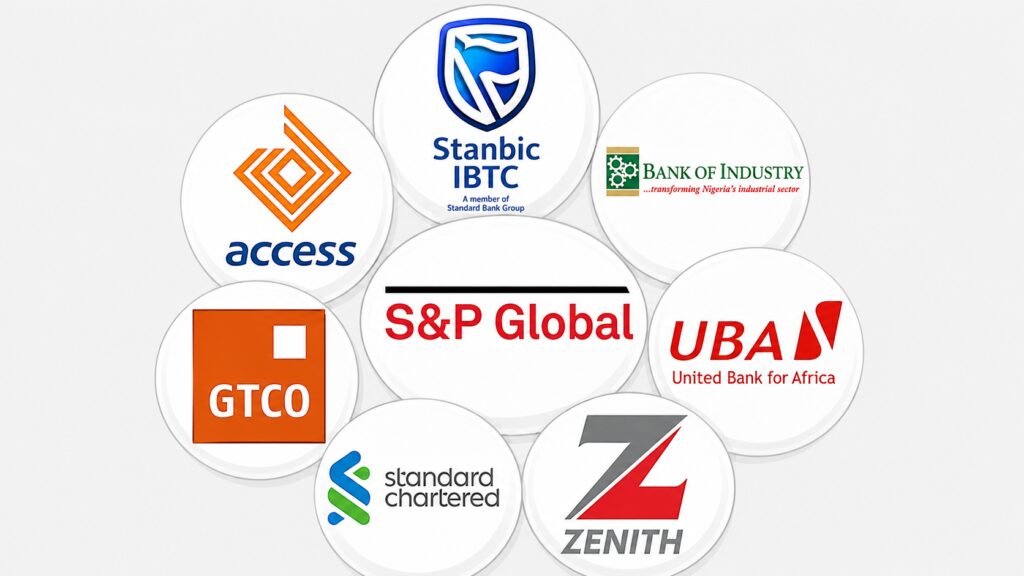
Seven banks sitting a notch higher include Access Bank, Bank of Industry, Guaranty Trust Bank, Stanbic IBTC, Standard Chartered Nigeria, UBA, and Zenith.
Fidelity Bank and First City Monument Bank received outlook revisions to positive from stable, while their existing ratings were affirmed by the agency.
The bank action followed a May 15, 2026, sovereign upgrade that lifted Nigeria from ‘B-‘ to ‘B’ with a stable forward outlook.
S&P described the sovereign upgrade as a reflection of sustained structural reforms that have strengthened Nigeria’s overall macroeconomic profile since 2023.
The rating action also covered national-scale upgrades for nine financial institutions, including Guaranty Trust Holding Company, the report confirmed.
Why Nigerian bank ratings improved after years of currency stress
The Central Bank of Nigeria liberalized the foreign exchange market over two years, restoring steadier dollar access for importers and corporate borrowers.
Tax reforms and tighter centralization of petroleum revenues have strengthened federal earnings, with interest-to-revenue ratios projected to ease over the medium term.
Real gross domestic product in Nigeria expanded by 4% during 2025 on the back of an 8.5% jump in crude oil production, the agency reported.
The non-oil economy also expanded by 3.9% during the same period, reflecting broader diversification gains beyond the petroleum sector, the report noted.
Banks completed major capital raises as the Central Bank’s new minimum thresholds approach for international license holders, set at N500 billion in paid-up capital.
National license holders face a lower threshold of N200 billion, and most lenders have already met the new requirements after two years of fundraising.
What the bank upgrades mean for Nigerian borrowers and investors
Average return on equity across Nigerian lenders should settle between 20% and 23% during 2026, easing from an estimated 25% in 2025.
Return on assets is also expected to moderate slightly to between 3.0% and 3.1%, down from an estimated 3.3% recorded in 2025.
S&P noted that most Nigerian banks would absorb additional provisioning requirements because of their strong profitability levels, ThisDayLive reported.
Nominal lending growth should remain strong at about 25% during 2026, driven primarily by demand from the oil and gas, agriculture, and manufacturing sectors.
Key numbers from the S&P review
- Bank ratings raised: Long-term scale lifted from ‘B-‘ to ‘B’ for seven lenders, S&P Global confirmed.
- Sovereign action: Nigeria upgraded to ‘B’ from ‘B-‘ on May 15, 2026, the agency reported.
- Non-performing loans: Expected to stabilize between 6% and 7% during 2026, the agency forecast.
- Lending growth: Nominal credit expansion projected near 25% in 2026 across the sector.
- Oil output: Nigerian crude production averaged 1.66 million barrels daily in 2026, the report indicated.
Risks still hanging over the Nigerian banking sector outlook
Inflation averaged 18.6% annually across the past decade, and elevated price pressure continues to squeeze household purchasing power, the agency warned in its assessment.
The rate is projected to decline to 17.7% during 2026 and fall below 10% by 2028, but near-term relief for consumers remains limited.
Poverty rates climbed from roughly 30% before 2020 to about 50% of the population, while food insecurity now affects 31 million Nigerians, S&P reported.
The agency projected a slight slowdown in growth during 2026 because of inflationary pressures arising from the ongoing conflict in the Middle East.
Nigeria remains relatively shielded from the broader fallout because of its position as a net oil exporter and emerging refined petroleum producer.
Credit losses in the banking system should remain elevated between 2% and 2.5% in 2026 after the Central Bank lifted pandemic-era forbearance measures.
On the supply side, the 650,000-barrel-per-day Dangote Refinery has reached full operational capacity, strengthening domestic fuel supply and cushioning external shocks.
Pressure on asset quality will persist because of high inflation and elevated interest rates, but the agency expressed confidence that profitability would cushion the impact.