
A stock that gains nearly 80% over twelve months on the Nigerian Exchange tends to attract attention, and Okomu Oil Palm Plc has earned plenty of it. The company’s share price climbed from ₦790 on June 30, 2025, to ₦1,418 on June 30, 2026, according to its Q2 2026 financial statement filed with the NGX. That move lifted the value of Okomu’s publicly traded shares from ₦229.66 billion to ₦412.15 billion in the same window.
For investors scanning the NGX for agricultural plays, those numbers look like a dream run that could keep going. But behind the headline gain, a leading research firm has flagged a very different picture for the months ahead.
If you hold Okomu Oil or have been eyeing the stock, the tension between that rally and the warning beneath it is worth understanding before your next move.
Okomu Oil’s stock rally runs into a Wall Street-style sell call
CardinalStone Research downgraded Okomu Oil Palm to a sell rating in June 2026 and set a 12-month target price of ₦1,066.34, according to the firm’s company update published on Proshare. That target implies roughly 39% downside from the ₦1,750 reference price the firm used when issuing the recommendation.
The core problem, CardinalStone argued, is valuation. Okomu trades at a last-twelve-month price-to-earnings ratio of 27.91x, nearly double the Middle East and Africa peer average of 14.40x, the firm noted, citing S&P Capital IQ data. The target price also implies an exit P/E of 13.33x, above Okomu’s own ten-year historical average of 11.15x.
Qudus Adebara, a research analyst at DLM Capital Group, noted that the company’s FY 2025 revenue rose 52% year-on-year to ₦198.15 billion, driven by strong palm oil production and favorable pricing, according to Simply Wall St. That performance built the foundation for the share price rally that followed.
Falling palm oil prices threaten Okomu Oil’s 2026 revenue growth
CardinalStone projected that Okomu’s revenue growth would slow to 4.1% in FY 2026, the weakest pace in seven years, according to the firm’s report on Proshare. The forecast reflects a combination of lower crude palm oil prices and stiffer competition from imports entering the Nigerian market.
The Federal Government reduced import tariffs on crude palm oil from 35% to 28.75% to ease food price pressures, CardinalStone explained. That tariff reduction opens the door for higher CPO imports, especially from non-ECOWAS regions where standard tariffs apply. The firm added that smuggling activity through more than 300 illegal land entry points has intensified since 2025.
Management told CardinalStone that product prices had dropped by nearly 30% since December 2025, which led the firm to cut its CPO revenue growth estimate from 24.4% to 4.7% for the full year. Total FY 2026 revenue is now projected at ₦206.2 billion versus ₦198.2 billion in FY 2025, the report indicated.
Okomu Oil’s Q1 2026 profit rose, but domestic dependence deepened
The company reported first-quarter 2026 pretax profit of ₦34.09 billion, a 5.88% increase from ₦32.2 billion in Q1 2025, according to Nairametrics. Revenue for the period came in at ₦58.9 billion, with domestic sales accounting for 92.9% of total turnover.
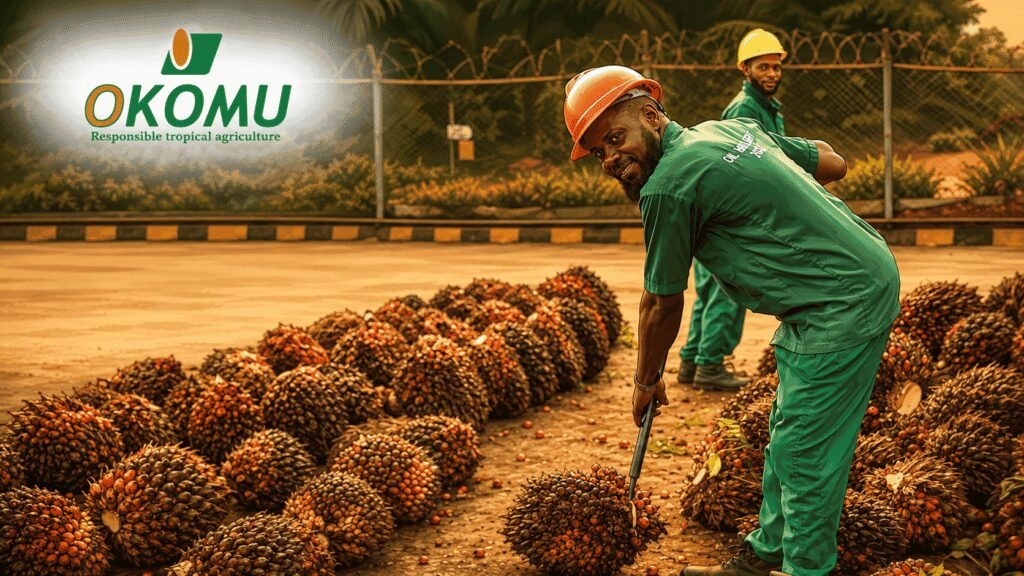
Export revenue fell 37.7% to ₦4.16 billion from ₦7.36 billion a year earlier, BusinessDay reported, making it the weakest part of the company’s revenue mix. That shift means Okomu now relies almost entirely on Nigerian buyers for its growth, a pattern that could amplify the impact of falling local CPO prices.
“The operating environment for Okomu Oil Palm PLC is set to be slightly more challenging in FY’26, as headwinds from softer rubber prices and increased competition from importation activities are likely to temper revenue growth.” — CardinalStone Research
Okomu Oil’s cash pile faces pressure even as dividends stay generous
Okomu paid a total dividend of ₦55 per share for FY 2025, translating to a 90.5% payout ratio, according to CardinalStone’s report. The firm forecasts a slightly lower payout of ₦54.53 per share for FY 2026, which would represent an 85% payout ratio.
The company’s own Q2 2026 earnings forecast, submitted to the NGX in March 2026, projected a profit after tax of ₦11.97 billion for the second quarter, Leadership newspaper reported. That projection, if it holds, would represent a steep drop from the ₦23.6 billion the company recorded in Q1, signaling that management itself anticipated a slowdown before the quarter began.
CardinalStone projected FY 2026 profit after tax at ₦61.2 billion with earnings per share of ₦64.16, a modest 5.6% year-on-year increase, the report noted. The firm expects Okomu’s gross margin to compress to 79.8% from its earlier estimate of 81.5% as fertilizer and energy costs climb.
Key numbers from Okomu Oil’s Q2 2026 filing
- Share price (June 30, 2026): ₦1,418, up from ₦790 a year earlier (Source: NGX Q2 2026 filing)
- Free float value: ₦412.15 billion versus ₦229.66 billion in June 2025 (Source: NGX Q2 2026 filing)
- Q1 2026 pretax profit: ₦34.09 billion, up 5.88% year-on-year (Source: Nairametrics)
- CardinalStone 12-month target price: ₦1,066.34, implying 39% downside (Source: Proshare)
- FY 2025 total dividend: ₦55 per share at a 90.5% payout ratio (Source: CardinalStone via Proshare)
- Q2 2026 projected profit after tax: ₦11.97 billion (Source: Leadership)
Okomu Oil’s premium valuation faces its biggest test since 2019
The last time Nigeria saw this level of import competition in palm oil was before the 2019 border closure, CardinalStone noted. With borders open and tariffs lower, the structural advantage that helped Okomu command premium pricing has weakened.
For investors who have ridden the nearly 80% rally, the question is whether Okomu’s fundamentals can justify a valuation that sits nearly twice the regional peer average. The stock has already pulled back from its ₦1,750 peak to ₦1,418 as of June 30, 2026, narrowing the implied downside from CardinalStone’s target to roughly 25%. The company generates electricity from agricultural waste, which CardinalStone flagged as a buffer against rising energy costs. But that edge may not be enough to offset the revenue and margin pressures building across the rest of the business.