


If you have watched Nigerian fixed-income markets at all this year, the level of government yields is no longer a surprise to you.
What may surprise you is how aggressively the federal government keeps tapping the same long-dated paper to refinance its growing obligations.
The latest issuance lands on May 18, 2026, with settlement two days later, and the numbers inside the offer document tell a clear story.
Two reopened bonds, each sized at N300 billion, are headed under the hammer through 14 primary dealer banks designated by the DMO to handle subscriptions.
The coupon on the shorter of the two papers is the number drawing attention from pension funds, insurers, asset managers, and high-net-worth households alike.
What the DMO put on the table for the May 2026 auction
The Debt Management Office is reopening two existing bonds rather than launching new ones, according to the May 2026 FGN Bond Offer Circular published by the agency.
The first tranche is a N300 billion reopening of the 22.60% FGN January 2035 bond, a 10-year reopening by DMO classification with semi-annual interest payments.
The second tranche is a N300 billion reopening of the 16.2499% FGN April 2037 bond, a 20-year instrument by DMO classification, which completes the offer.
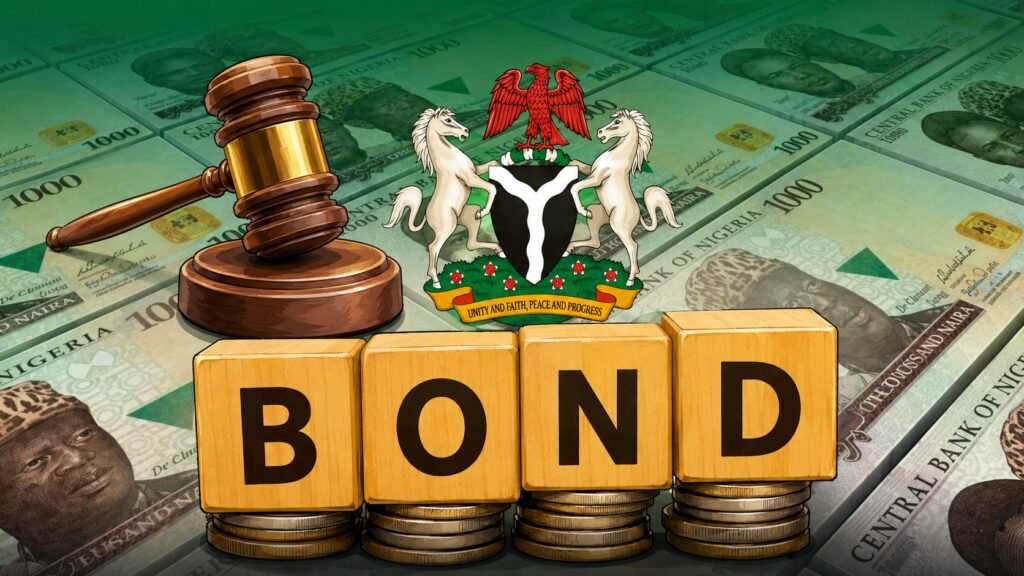
Because both bonds are reopenings, coupon rates are already fixed, so successful bidders will pay a price reflecting the yield-to-maturity that clears the auction.
Each unit is priced at N1,000, with a minimum subscription of N50.001 million and additional investments accepted in multiples of N1,000 thereafter.
The bonds carry the full faith and credit of the Federal Government, qualifying as trustee, tax-exempt, and liquid-asset instruments under Nigerian law.
Why the 22.60% headline coupon matters more than the offer size
The 22.60% figure is the coupon set when the January 2035 bond was first issued, and it now sits among the highest in reopened tenors.
That number does not mean May 2026 buyers will earn 22.60% outright, since the yield-to-maturity bid in the auction determines actual investor return.
Recent auctions still suggest demand is heavy at the long end of the curve, with April 2026 drawing N948 billion against N700 billion offered, Nairametrics reported.
In that April outing, the same 22.60% January 2035 bond cleared at a marginal rate of 16.59%, alongside lower stop rates on shorter tenors.
In a December 2025 note carried by dmarketforces.com, Cordros Capital Limited projected DMO bond supply would rise through 2026 amid a N20.10 trillion budget gap.
The firm flagged that the DMO is expected to raise bond supply above 2025 levels, with off-calendar Treasury bill auctions also shaping near-term yield signals.
How investors are likely to read the two-tranche structure
Long-dated reopenings give the federal government a way to lengthen the average tenor of its debt while locking in funding at fixed coupon rates.
Coupons of 22.60% on the 2035 paper and 16.2499% on the 2037 paper create an unusual spread that fixed-income desks flag as inverted curve behavior.
In June 2024 BusinessDay coverage, fixed-income analyst Segun Adams of Afrinvest West Africa argued smaller DMO allotments would persist as the agency managed fiscal pressure.
That 2024 view sits awkwardly with the April 2026 record, when the DMO drew N948 billion in bids and allotted across all three reopened tenors.
By December 2025, average FGN benchmark bond yields closed near 15.64% in secondary trading, according to Cordros Capital data carried by dmarketforces.com.
That secondary-market level sits well below the 22.60% coupon attached to the January 2035 reopening, illustrating why long-dated paper remains a magnet for buyers.
Key facts from the May 2026 offer circular
- Auction date is May 18, 2026, with settlement scheduled for May 20, 2026, the DMO confirmed.
- Two reopened bonds of N300 billion each, totaling N600 billion across the two tenors offered.
- The 22.60% FGN January 2035 bond is the ten-year reopening leg of the auction.
- The 16.2499% FGN April 2037 bond is the twenty-year reopening leg of the auction.
- Units cost N1,000 each, with a minimum subscription pegged at N50.001 million.
Interest is paid semi-annually, with full principal repaid at maturity in a bullet structure.
What the May auction signals about Nigeria’s borrowing posture in 2026
The May 2026 offer comes in N100 billion smaller than April’s auction, where the government raised N700 billion across three reopened instruments at varying yields.
The step-down signals a more measured borrowing pace, even as Nigeria’s public debt stood at N159.28 trillion as of December 31, 2025, the DMO reported.
The DMO has consistently used reopenings of benchmark lines, including the January 2035 bond, as its primary tool rather than launching new long-dated paper.
Patience Oniha, director-general of the Debt Management Office, leads the agency’s day-to-day execution of that calendar, with offer circulars setting volumes auction by auction.

Sponsored client commentary in Nairametrics in April 2026 noted that elevated coupons give long-duration buyers a window to lock in fixed income.
Investors weighing participation can verify allotment outcomes through the DMO’s bonds auction results page, which lists clearing rates after each auction date.
What you should track next is whether the marginal yield clears nearer the 22.60% coupon or stays below it, mirroring the 16.59% April print.
That single number will reveal whether the yield moderation Cordros Capital projected toward 18% by end-2025 has carried through into Nigeria’s 2026 reopening window.