




The Central Bank of Nigeria put ₦600 billion worth of Open Market Operations bills up for sale at its May 15, 2026, auction. Investors responded with about ₦2.1 trillion in bids, roughly three and a half times the amount on offer, in a display of demand that has become routine rather than exceptional in 2026.
The oversubscription reflects an aggressive pattern of liquidity withdrawal that has defined the CBN’s monetary stance this year, reshaping how banks, foreign portfolio investors, and pension funds position themselves in the fixed-income market.
For everyday Nigerians, the implications stretch beyond bond trading desks. When the central bank absorbs this much cash at yields above 21%, the ripple effects touch lending rates, credit availability, and the cost of doing business across the economy.
N600 billion offered, over N2 trillion demanded at the CBN’s OMO window
At the May 15, 2026, auction, the CBN floated ₦600 billion across 32-day, 116-day, and 137-day instruments. Total subscriptions reached approximately ₦2.1 trillion, and the apex bank allotted close to ₦2 trillion at stop rates of 21.58%, 20.20%, and 19.98%, respectively, DMarketForces reported.

A separate auction earlier in May drew ₦1.45 trillion in bids against the same ₦600 billion offer, with demand heavily skewed toward the 126-day instrument, BusinessDay noted. Stop rates settled at 21.54% for the 35-day paper, 20.70% for the 70-day tenor, and 20.10% for the 126-day bill.
Why OMO oversubscription has defined the CBN’s 2026 strategy
Open Market Operations are the CBN’s most direct tool for controlling how much cash circulates in the banking system. When the apex bank sells OMO bills, it pulls naira out of circulation, tightening liquidity and pushing short-term interest rates higher across the broader money market.
The scale of activity this year has been staggering. Between May 4 and May 12 alone, three auction rounds recorded ₦5.63 trillion in OMO sales across eight instruments, Nairametrics reported. The CBN offered ₦1.8 trillion across those sessions but allotted more than triple that amount.

Analysts see sustained demand as CBN prioritizes stability over comfort
“The CBN is prioritizing macro stability over liquidity comfort. The scale of OMO activity suggests the bank is not ready to relax, especially with election-related FX risks already on the horizon.” — Ayodele Akinwunmi, Head of Research, FSDH Merchant Bank (via Nairametrics)
Speaking after the separate May 12 auction that drew ₦1.45 trillion in bids, fixed-income market expert Taiwo Kareem told BusinessDay that OMO demand is expected to remain robust because the instruments pair low risk with attractive yields. He noted that near-term liquidity is likely to stay in surplus, supported by inflows from maturing securities, bond coupon payments, and FAAC distributions.
Victor Ogundijo, a fixed-income trader at CardinalStone, offered a more granular view of that same auction. He observed that investors are gravitating toward longer-dated tenors because stop rates on mid- and longer-dated papers have converged, making those instruments more attractive on a risk-adjusted basis, BusinessDay reported.
How the CBN’s OMO blitz connects to borrowing costs across Nigeria
When the CBN offers yields above 21% on risk-free government paper, commercial banks have a strong incentive to park funds in those instruments rather than extend loans to businesses and consumers at comparable returns. That dynamic feeds directly into the elevated lending rates that Nigerian businesses have grappled with throughout this tightening cycle.
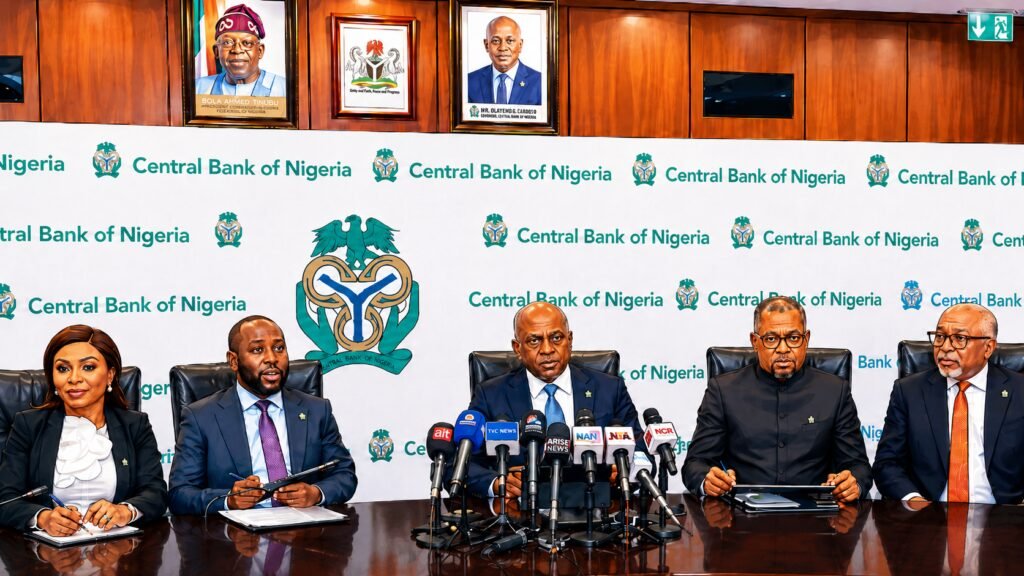
The Monetary Policy Committee retained the benchmark rate at 26.5% at its 305th meeting on May 20, 2026, after trimming it by 50 basis points in February, Channels Television reported. With headline inflation ticking up to 15.69% in April from 15.38% in March — its second consecutive monthly rise after an 11-month stretch of decline — the committee signaled little appetite for further cuts.
Key OMO auction figures that tell the full story
May 15, 2026, auction snapshot:
- Offer size: ₦600 billion across 32-day, 116-day, and 137-day tenors
- Total subscriptions: Approximately ₦2.1 trillion, or roughly 3.5x the offer
- Amount allotted: Close to ₦2 trillion as the CBN opted for aggressive sterilization
- Stop rates: 21.58% (32-day), 20.20% (116-day), 19.98% (137-day)
- Monetary policy rate: Held at 26.5% following the MPC’s May 20, 2026, meeting
- Headline inflation: 15.69% in April 2026, up from 15.38% in March
The auction data on the CBN’s portal paints a clear picture of persistent excess liquidity meeting a central bank determined to drain it. Whether you hold fixed-income instruments, run a business dependent on bank credit, or simply track borrowing costs in Nigeria, these results deserve close attention.
